

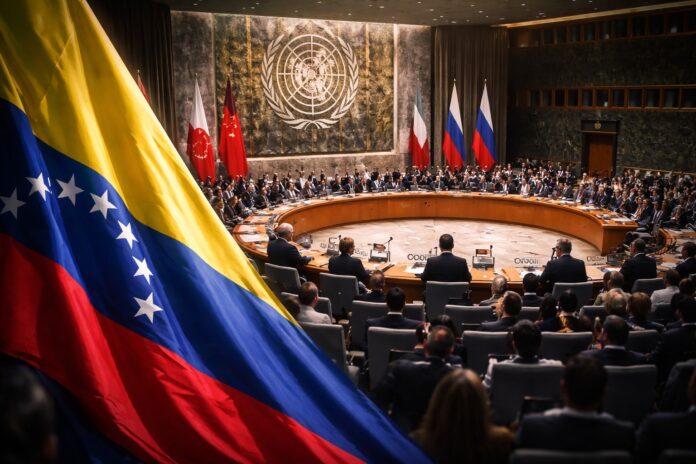
Colombia at the Security Council: The Maduro Case as a Stress Test for the UN Charter—and the Global Ban on Force
News cycles love shock and spectacle. Institutions, by contrast, live on precedent: the quiet accumulation of what the world comes to accept as “normal.” That is why Colombia’s move to put the Maduro case on the UN Security Council’s agenda—reportedly backed by China and Russia—matters beyond any single headline.
The Council debate was not only about Venezuela and Nicolás Maduro. It was about the line between accountability and unilateral coercion, between law and power, between a rules-based order and an order that merely borrows the language of rules. Reuters+2AP News+2
The deepest question is not whether a leader accused of serious crimes should face justice. The deeper question is how the international system pursues justice without weakening the core restraint that keeps conflicts from cascading: the UN Charter’s prohibition on the use of force, with narrow, carefully bounded exceptions.
1) Why Colombia brought it to the Council—and why that choice carries weight
Colombia is not a random messenger. It entered its non-permanent Security Council term on January 1, 2026, and it chose to engage a major crisis immediately. That kind of early move signals an intention to shape the Council’s frame—what the dispute is “about,” which principles apply, and what should count as legitimate state behavior. UN Press+1
According to reported accounts, Colombia condemned the operation as a breach of sovereignty and the UN Charter, even using language that treats the act as an aggression-like violation. Reuters+1
In Security Council politics, words are never merely words. They are attempts to lock in a legal and moral interpretation that can outlast the moment.
2) “Dangerous precedent” is not rhetoric—it is a warning light
At the meeting, the UN Secretary-General, speaking through senior UN political leadership, raised concerns about legality and destabilization and described the implications as a “dangerous precedent.” Reuters+1
That phrase is institutional shorthand for a problem with long memory: exceptions, once normalized, become templates. If a cross-border seizure framed as “law enforcement” becomes broadly tolerated when performed by the powerful, it will be invoked—sooner than we think—by others with far less restraint and far fewer safeguards.
3) Article 2(4) vs. Article 51: the legal heart of the dispute
The UN Charter’s baseline is straightforward: states must refrain from the threat or use of force in international relations. Two pathways traditionally limit that rule: (1) Security Council authorization, or (2) self-defense under Article 51 when an armed attack occurs.
In reported statements, the U.S. side invoked Article 51, while critics and legal experts questioned whether the operation could plausibly fit within self-defense—and pointed to the lack of UN authorization or Venezuelan consent. Reuters+2Reuters+2
Here is the hinge: self-defense cannot operate as a universal permission slip. If “self-defense” expands to cover any extraterritorial operation branded as counter-terrorism or counter-narcotics, then the Charter’s restraint collapses into a purely discretionary standard: each state becomes judge, jury, and enforcer of its own threats.
4) The seduction—and danger—of “moral justice” without legal limits
Public opinion often compresses complex legal questions into a single moral intuition: If a leader is accused of grave wrongdoing, shouldn’t someone act? The answer can still be “yes,” but the method matters. Accountability achieved through unilateral force carries systemic costs. It teaches the world that power can substitute for process.
The international system does not survive on good intentions. It survives on predictable constraints. A world that tolerates ad hoc, cross-border captures for “justice” will eventually become a world where rivals apply the same logic for revenge, regime change, or resource coercion—each wrapped in legal vocabulary.
5) The geopolitical shadow: China, Russia, and the contest over rule-making
China and Russia’s reported support for moving the issue into the Council should not be read only as reflexive opposition to Washington. It is also a struggle over who writes the operating manual for the use of force in the 21st century. Reuters+1
At the same time, coverage suggests some U.S. partners emphasized international law and restraint while avoiding an outright confrontation with Washington. Reuters+1
That posture carries a risk of its own: when allies defend “law” in general terms but hesitate on concrete cases, the norm weakens precisely when it needs reinforcement.
6) The Security Council’s reality: veto power as both brake and alibi
Even if many Council members saw the operation as unlawful, the United States can block binding Council action through its veto. That does not make the debate irrelevant. It simply shifts the arena from enforceable outcomes to the battle over legitimacy: the Council becomes a record of the fracture and a platform for competing interpretations of the Charter. Reuters+1
In that sense, the Council acts as a global seismograph. It may not stop the earthquake, but it tells us—clearly—where the fault line runs.
7) One principle, three implications
The case can be distilled into one principle:
The ban on force is not a moral luxury; it is a security guarantee for everyone.
From that follow three implications:
-
Accountability without militarized shortcuts. If the world wants credible justice, it must strengthen mechanisms that do not depend on unilateral raids.
-
Self-defense must remain narrow to remain meaningful. Article 51 works only when states apply it with discipline, not convenience.
-
Smaller and mid-sized states can still shape the conversation. Colombia’s early move, at the start of its Council term, shows how agenda-setting can matter even when veto politics blocks formal outcomes. UN Press+1
Closing: the rule that protects tomorrow
International politics rewards what is “effective” in the short run—and punishes what is destabilizing in the long run. The Maduro case at the Security Council forces a choice about what the international community treats as civilization in global affairs: binding rules that restrain the strong, or exceptions that free them.
This is not an ideological question. It is a practical one. If the world accepts that power can move leaders, borders, and legal standards at will, then fear becomes policy, escalation becomes habit, and everyone plans for the worst. If the world holds the prohibition on force as a real constraint with tightly limited exceptions, then—even in crises—de-escalation remains possible.
Colombia did not resolve the crisis by convening debate. But it named the core problem with clarity: legality is not an ornament of diplomacy; it is the foundation of peace. Reuters+1