

Table of Contents
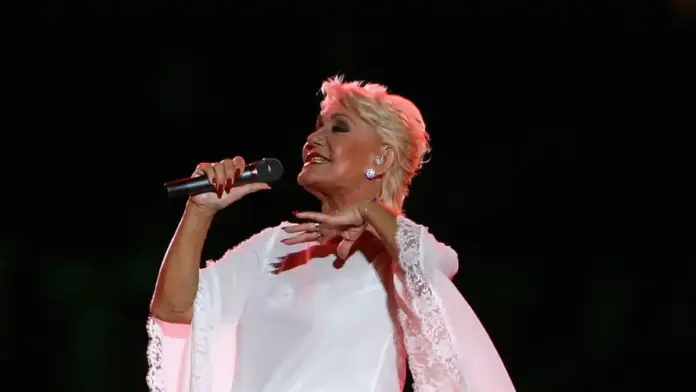
Marinella Dies at 87: The Voice That Became Part of Greece’s Cultural Memory
Marinella’s death is not just major cultural news. It is the end of an era.
Marinella, one of the most iconic voices in Greek music, died on March 28, 2026, at the age of 87, according to multiple Greek and international reports published the same day. Her family said she died at home after a long and difficult decline that followed the severe stroke she suffered on stage in September 2024. This is why her death lands not only as a celebrity obituary, but as the closing of a historical chapter in Greek song.
What Greece loses here is larger than a successful recording artist. Marinella belonged to a category of performer that is now increasingly rare: an artist whose voice moved beyond albums and concerts and entered the emotional structure of public life. For decades, she was not simply known. She was recognized across generations as part of how Greece sounded to itself. That is the scale on which her death should be understood.
That distinction matters because public mourning often flattens artists into generic praise. Marinella deserves a more precise reading. She was not important only because she lasted a long time, or because she had famous songs, or because she carried a large name. She mattered because she linked eras of Greek cultural life that are now receding from living memory: the postwar laïko tradition, the age of major live performance, the authority of the stage singer, and the period when vocal interpretation itself could shape a national emotional register.
From Kyriaki Papadopoulou to Marinella
Marinella was born Kyriaki Papadopoulou in Thessaloniki on May 19, 1938. Her professional life stretched across nearly seven decades, a span that by itself says something extraordinary about her durability. But longevity alone does not explain why she became so deeply embedded in Greek cultural memory. The more important fact is that her career remained relevant across radically different musical and social periods without losing its identity.
She did not emerge as a manufactured media figure. She came out of an older performance culture in which stage presence, vocal force, and audience trust had to be earned repeatedly in front of real crowds. That background stayed audible in the way she sang. Even when styles evolved, she rarely sounded like someone chasing the moment. She sounded like someone carrying her own center of gravity into it.
For English-language readers on Newsio who want a wider cultural lens on how a public figure can move from profession into collective memory. Marinella belonged to that rarer, more serious category inside Greek music.
She was shaped by Greek song—but she was never limited by one label
It would be too small to describe Marinella simply as a folk-pop singer, even if laïko remained central to her public image. Reports published after her death consistently emphasize the breadth of her career and the scale of her presence in Greek music. She was not remembered as a niche specialist. She was remembered as one of the defining female voices of modern Greek song.
That is part of why her death resonates so widely. Plenty of singers have hits. Far fewer become interpretive reference points. Marinella had that status. She could carry popular repertoire, emotionally heavier material, and large-stage performance without sounding borrowed from one style to the next. Her voice did not merely deliver songs. It gave them dramatic weight.
This is also where her importance crosses into the wider cultural territory Newsio often examines in English: the places where performance, memory, and public ritual overlap. In a very different context, Newsio’s piece on Valentine’s Day in Greece and Mytilene’s local ceremonies shows how symbols endure when they attach themselves to shared memory. Marinella’s voice did something similar in music. It attached itself to private emotion and public memory at the same time.
The Kazantzidis chapter mattered—but it did not define her
No serious portrait of Marinella can avoid Stelios Kazantzidis. Their artistic and personal relationship became part of Greek cultural mythology, and with reason. They were one of the great pairings in the history of Greek popular music. But the lasting significance of Marinella’s career is not that she stood next to a giant. It is that she became a giant in her own right.
That distinction is essential. In male-dominated musical systems, women are often remembered through association first and achievement second. Marinella outgrew that trap. She built an autonomous artistic authority that made her impossible to frame as a secondary figure in someone else’s legend. Her later public stature proves that point more clearly than any retrospective slogan could.
Why Eurovision 1974 still matters in her story
Marinella represented Greece at the Eurovision Song Contest in 1974 with “Krasi, Thalassa kai t’ Agori Mou,” becoming the country’s first Eurovision representative. That detail is more than a trivia point. It shows how she was already viewed at the time: not simply as a successful singer, but as a performer who could carry national representation on an international stage.
The historical significance here is not only institutional. It is symbolic. Greece did not send an interchangeable singer into its first Eurovision appearance. It sent a recognizable national voice. Readers who want the official historical framework for the contest can trace that wider tradition through Eurovision’s official platform, but in Marinella’s case the bigger point is straightforward: she already had the stature to embody the country publicly.
The Herodes Atticus collapse changed the final chapter of her life
The final phase of Marinella’s life was marked by one of the most painful public scenes in recent Greek cultural memory. On September 25, 2024, she collapsed on stage at the Odeon of Herodes Atticus during a live performance. The Associated Press reported at the time that she had suffered a severe hemorrhagic stroke and was hospitalized in critical condition. She later returned home after months of hospitalization, but reports after her death make clear that she never truly recovered from that event.
That moment has stayed with the public because of what it symbolized. Marinella was so deeply identified with the stage that seeing her fall there felt like seeing a whole era physically break in front of its own audience. Her death now completes a story that had remained painfully open ever since that night.
Why this loss feels larger than one obituary
When a performer reaches Marinella’s level, songs alone no longer explain the impact. What endures is something broader: the way a voice becomes attached to homes, family memory, radio eras, television eras, celebrations, heartbreak, and the emotional weather of ordinary life. That is why so many deaths in popular culture generate headlines, but only a few feel like the closing of a national chapter. Marinella belongs to that smaller group.
This is one reason the strongest obituary language around her has emphasized not just fame, but historical scale. To Vima described her as the queen of Greek folk-pop music, while eKathimerini called her one of Greece’s most iconic voices. Those are not decorative phrases. They reflect a broad cultural consensus about what she represented.
For English-language readers on Newsio who approach culture through public meaning rather than gossip, this is the key to understanding her place. Marinella was not just “beloved.” She was institutionally recognizable without being institutionalized. She carried emotional authority without needing reinvention into a modern brand. In that sense, she represented an older and heavier model of artistic legitimacy.
What remains now
What remains is a nearly seven-decade career, a voice that survived format changes and generational turnover, and a public image that never fully detached from seriousness. What also remains is a cultural standard: a reminder of what it meant for a singer to command attention through interpretation, presence, and trust rather than spectacle alone.
For readers interested in how Newsio approaches the wider idea of public memory, symbolic identity, and why some figures remain culturally durable long after the moment of peak fame, this obituary also sits naturally alongside Saint Valentine’s Day in Greece: Mytilene’s special ceremonies and the relics of Saint Valentine and Chuck Norris Was More Than an Action Star. He Was a Global Popular Myth. Different subjects, different scales, but the same underlying question: how do people, symbols, and voices move from event into memory.
Marinella will remain in that space. Not only in recordings, and not only in archives, and not only in tributes published today. She will remain in the way Greek music remembers itself. That is a far larger afterlife than fame.