

Mexico After “El Mencho”: Troop Surge in Jalisco, Retaliation Risks, and the CJNG Succession Question
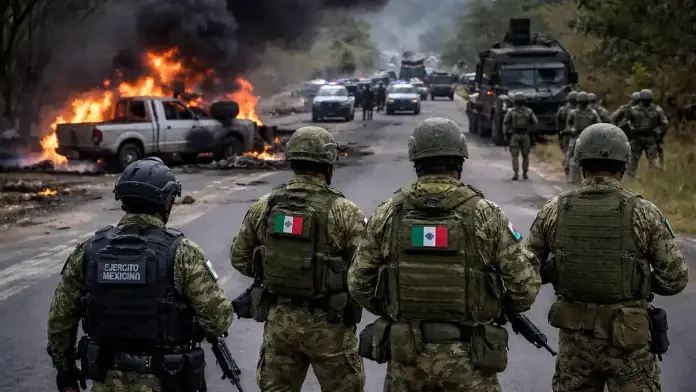
Mexico has moved to contain a fast-moving security shock after authorities said Nemesio Rubén Oseguera Cervantes—known as “El Mencho” and widely described as the leader of the Jalisco New Generation Cartel (CJNG)—died following a military operation in the state of Jalisco. Reporting describes a wave of retaliatory violence shortly after the raid, including roadblocks and vehicle fires across multiple areas.
The government response has been a visible surge in security posture, including large deployments in and around Jalisco as officials try to prevent copy-cat attacks, restore mobility on major routes, and deter further reprisals.
This story is not only about a high-value target being removed. It is about what happens after a cartel leadership shock: the short window when violence can spike, the longer succession phase when factions reposition, and the risk that “order” becomes less predictable before it becomes more stable.
What is confirmed and what remains contested
What multiple credible outlets consistently report:
-
Mexican security forces targeted Oseguera in a special operation in Tapalpa, Jalisco.
-
Oseguera was injured and later died, with Mexican defense authorities cited in reports.
-
Retaliatory incidents—burned vehicles, blockades, and broader disruption—followed soon after.
What should be treated carefully:
-
Specific casualty counts can vary across early reports and may change as authorities reconcile figures. Treat initial totals as provisional until confirmed through official updates and multiple independent sources.
-
Claims about who “takes over” immediately are often speculative in the first 72 hours. Cartel succession tends to be opaque, and early social media narratives can be misinformation-prone.
How Mexico’s operation was described—and why the aftermath matters more than the strike
The operation as described by authorities and major outlets
Reporting based on official accounts describes an intelligence-led track that pointed security forces to Tapalpa, Jalisco. Reuters described U.S. intelligence support contributing to locating the target, while emphasizing that the operation itself was carried out by Mexican forces.
Associated reporting described surveillance linked to a romantic partner’s movements as part of how authorities narrowed the location.
The operational detail matters because it shapes what comes next. When a cartel believes a strike relied on a “human network” rather than pure technical tracking, the next phase often includes internal purges, shifts in communications patterns, and reprisals designed to deter future cooperation with authorities.
Why “decapitation” strategies can raise violence before they reduce it
Removing a top figure can produce two contradictory effects, often in sequence:
-
Short-term escalation. A cartel may retaliate quickly to demonstrate capability and deter future raids. Roadblocks and vehicle fires are a known pattern used to disrupt movement and overwhelm response capacity.
-
Medium-term fragmentation or consolidation. If the organization has a clear succession structure, it may stabilize under new leadership. If succession is contested, violence can rise through internal rivalry or opportunistic pressure from competitors.
This is why governments frequently pair a high-value takedown with a visible security surge. The aim is to reduce the “operational space” for coordinated retaliation in the immediate aftermath, while preventing spillover into key economic corridors.
What CJNG is—and why the stakes are international
CJNG is widely described as one of Mexico’s most powerful and violent organized crime groups, with involvement in transnational drug trafficking networks. For a high-authority institutional snapshot on cartel structures and the broader landscape, see the U.S. DEA overview: Drug Cartels.
Reuters also tied the timing to broader political pressure on Mexico to intensify action against cartels linked to synthetic opioid flows into the U.S.
What to watch over the next 10–14 days
If you want to separate signal from noise, watch for these indicators:
-
Mobility and disruption: continued highway blockades, burned vehicles, or targeted attacks on local infrastructure.
-
Government messaging: whether officials describe the situation as “contained” or extend emergency deployments and restrictions.
-
CJNG cohesion: credible reporting of internal reshuffles, arrests of finance/logistics operators, or seizures that indicate follow-on operations beyond the initial strike.
-
Information quality: verified updates from official channels and reputable outlets, not viral clips without location/time confirmation.
For readers who want a practical method for handling chaotic breaking news and avoiding false certainty, Newsio’s verification explainer is useful: AI Deepfakes After the Maduro Crisis: How Synthetic Videos Go Viral—and How to Verify Them.
What this means for you
If you are in Mexico or traveling to Western Mexico
The immediate risk profile after a leadership strike is usually about unexpected disruptions: road closures, temporary flight changes, and localized violence that can move quickly. Follow official advisories and airline notices, and avoid relying on social media maps that cannot be verified.
If you run media, logistics, or business operations tied to the region
The main risk is not the headline “who died,” but whether transport corridors and urban access remain stable. Even short disruptions can affect supply chains, staffing, and insurance conditions.
If you are following the story from abroad
Treat early numbers and “succession claims” carefully. In cartel conflicts, misinformation spreads because audiences want immediate clarity. Prioritize corroborated reporting and official statements.
For a broader view of how systems respond under pressure—how enforcement, finance, and “alternative rails” change behavior—this Newsio explainer adds context: Rise of Digital Currencies: Impact on Traditional Banking.
Summary
Mexico’s reported killing of “El Mencho” marks a major leadership shock for CJNG, but the decisive phase is the aftermath: retaliation risk, security stabilization, and uncertain succession dynamics. Authorities have moved to surge security posture in Jalisco as reports describe blockades and arson attacks across multiple areas.