

Mexico: Wave of Blockades and Violence After Reports of “El Mencho” Being Killed — What’s Confirmed, What’s Unclear
Mexican authorities and major international news organizations reported that Nemesio Rubén Oseguera Cervantes, known as “El Mencho” and widely described as the top leader of the CJNG (Jalisco New Generation Cartel), died following a military operation in Tapalpa, Jalisco.
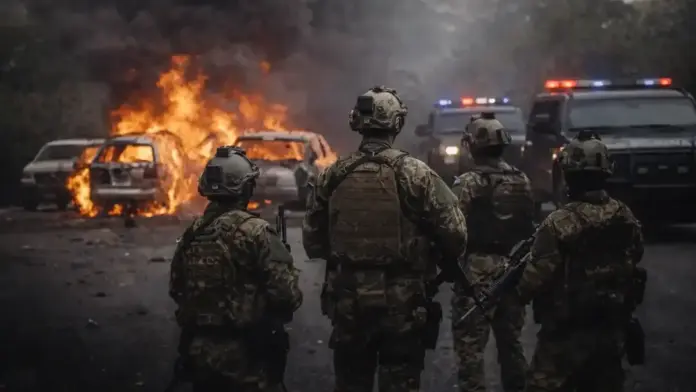
Within hours, several Mexican states saw road blockades, burning vehicles, and disruptions to transport and daily activity—a pattern that security analysts often associate with cartel retaliation designed to overload local response capacity and project fear.
This is a fast-moving security story with a high risk of exaggeration online. The only responsible approach is to separate confirmed reporting (official statements and top-tier wire services) from viral claims that can’t be verified quickly or safely.
What is confirmed so far
Reported death during an operation in Jalisco
Reuters and AP reported that “El Mencho” was killed in the context of a military operation in Jalisco. Reuters further reported U.S. intelligence support, framing the strike as one of the most significant anti-cartel actions in years.
A rapid retaliation pattern: blockades and vehicle fires
Multiple outlets reported retaliation that included highway blockades and vehicles set on fire in different areas—tactics often used to slow down security forces and disrupt movement.
Government situation update (best “anchor” for scope)
For a single authoritative snapshot on the operational situation, Mexico’s federal security ministry posted a situation note summarizing the blockades and response actions: SSPC — Tarjeta Informativa.
(In stories like this, government updates don’t automatically answer every question, but they are the most reliable baseline for “where” and “how broad” the disruptions are.)
What is still unclear (and why this matters)
Even with strong reporting, three areas remain fluid in the first 24–72 hours:
-
Geography and intensity vary sharply. “Multiple states” doesn’t mean the entire country is equally affected at the same time. Early headlines can blur that distinction.
-
Casualty reporting can shift as authorities verify incidents and consolidate information. Different credible outlets may carry different early counts.
-
What comes next inside CJNG depends on succession dynamics that do not resolve in a day. Reuters flagged the risk of internal conflict or fragmentation after a leader’s removal.
Who “El Mencho” was, and why CJNG matters
In international reporting, “El Mencho” has been described as a central figure behind the rise of CJNG into one of Mexico’s most powerful criminal organizations—an organization linked to transnational drug trafficking and known for aggressive tactics.
For readers outside Mexico, it helps to understand CJNG in three layers:
1) A territorial actor, not just a trafficking network
Cartels don’t operate only as “smugglers.” They also seek control over territory, transport corridors, and local influence. That often produces a public security footprint: blockades, intimidation, and sudden disruption of roads and commerce.
2) A communications strategy built on fear and visibility
Retaliatory blockades and vehicle fires are not random vandalism. They are a form of messaging:
-
to the state: “you will pay a price,”
-
to rivals: “we are still operational,”
-
to local communities: “we can stop normal life.”
This is why governments prioritize restoring road access quickly: it’s not only logistics, it’s legitimacy.
3) The “leadership removal dilemma”
Taking out a top leader can be a milestone. It can also trigger short-term volatility:
-
Succession fights (factions competing for resources),
-
opportunistic violence (rivals testing boundaries),
-
localized “revenge” incidents meant to restore deterrence.
That is the tension behind many “kingpin strategy” debates: the tactical win is clear, but the near-term stability outcome can vary by region and by the organization’s internal structure.
What the immediate aftermath tells us
Blockades as a system-stressor
When blockades appear across multiple points, the operational effect is disproportionate. A few burning vehicles on strategic routes can:
-
delay emergency response,
-
interrupt supply chains,
-
isolate neighborhoods or cities,
-
trigger fear-driven closures (schools, businesses, transit).
Reporting described disruptions that extended beyond a single locality, suggesting a coordinated attempt to amplify impact.
Why transport disruptions become headline events
Air and ground transport are “visibility multipliers.” Once flight schedules shift or road access collapses, the story becomes tangible to millions of people. Reuters reported disruptions affecting travel, including suspended flights to tourist areas in the immediate chaos.
How to read the information flow without getting misled
If you’re consuming this story from abroad, a disciplined approach keeps you accurate:
-
Treat dramatic videos as “unverified until sourced.” Many clips recycle older events or come from different states and dates.
-
Prioritize time-stamped reporting from wire services (Reuters/AP) and official situation notes.
-
Separate three categories:
-
confirmed events (where/when),
-
assessed motives (why, based on patterns),
-
forecasts (what might happen), which should be stated as conditional.
-
Newsio context links:
For readers who want broader context on how institutions communicate and how fast-moving events distort public understanding, these EN explainers are useful complements:
-
Electronic voting in Greece: what’s changing, what’s not, and what citizens should watch for
-
The rise of digital currencies and their impact on traditional banking
What this means for you
If you are not in Mexico, the key value of this story is understanding how high-impact security events evolve—and how to protect your decision-making from noise.
1) “Chaos” is often localized, even when it’s serious
A wave of incidents can be extensive without being uniform. The practical takeaway is to avoid country-wide conclusions from region-specific events. Reliable reporting consistently emphasizes geography (state-by-state) rather than a single national picture.
2) The first phase is retaliation; the second phase is reorganization
The immediate retaliation is often about visibility and disruption. The longer phase—days to weeks—is where the strategic outcome becomes clearer: whether the organization fragments, consolidates under a successor, or escalates to prove continuity. Reuters highlighted the risk of internal conflict after a leadership shock.
3) Watch for signals that stability is returning
The strongest indicators are operational, not rhetorical:
-
roads reopening and traffic normalization,
-
fewer reports of new blockades,
-
consistent government updates,
-
reduced transport disruption.
Mexico’s federal security situation note is a practical reference for this kind of signal-tracking.
What to watch next (without speculation)
Over the next several days, these are the highest-signal questions:
-
Do disruptions decline or “hop” to new areas?
-
Do authorities report additional coordinated actions, arrests, or seizures?
-
Is there evidence of succession moves or factional splits? (Usually reflected indirectly: changes in incident patterns, new rival clashes, or targeted intimidation campaigns.)
Summary
International reporting says Mexican forces killed “El Mencho,” widely described as the CJNG’s top leader, in an operation in Jalisco, and that incidents including road blockades and vehicle fires followed across multiple areas—an apparent retaliation pattern.
What remains uncertain is how the shock will reshape CJNG internally and whether the near-term volatility gives way to stabilization or further escalation. For scope and situational baselining, Mexico’s federal security update provides a useful official reference point.