

Table of Contents
The conflict is no longer just spreading. It is multiplying fronts and raising the risk of miscalculation.
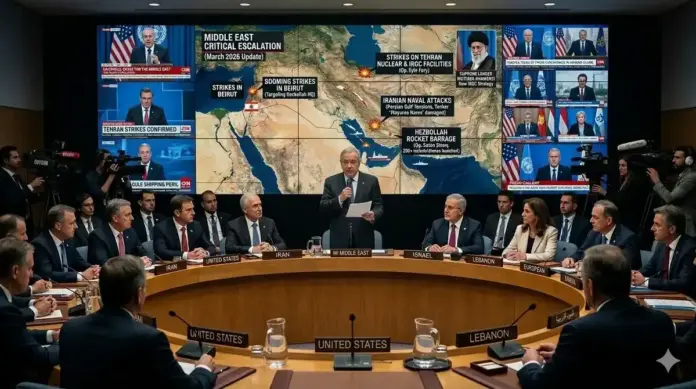
The latest developments across the Middle East point to a war that is no longer confined to a single exchange between Israel and Iran. Israel has continued striking targets in Tehran while also hitting Beirut. Iran, in turn, has extended pressure not only toward Israel but toward the wider Gulf.
At the same time, Hezbollah has entered a heavier operational phase with its largest recent rocket-and-drone barrage. The strategic danger is not just intensity. It is the widening geography of the conflict.
The most important discipline here is to separate what is verified from what is being inflated in wartime narratives. There are already confirmed strikes in Tehran, confirmed Israeli attacks in Beirut, confirmed Iranian attacks on Gulf neighbors, and a confirmed large-scale Hezbollah barrage.
What remains open is the longer-term strategic meaning of those moves and whether they mark a controlled escalation or the early shape of a broader regional war.
For readers who want a stronger verification framework behind fast-moving war coverage, Newsio has also published How to Read the News Without Being Manipulated: A Complete Guide to Fact-Checking, Sources, and Propaganda
Readers who want the broader English-language context across Newsio’s international explainers can also browse the EN Analysis section.
What is confirmed about the Israeli strikes in Tehran
Reuters reported that the Israeli military said it struck checkpoints in Tehran operated by the Basij, describing the attacks as part of an effort to weaken the rule of Iran’s clerical leadership.
A separate Reuters report said Israel intensified its campaign using intelligence from informants on the ground and targeted IRGC-related checkpoints in the capital. That means the phrase “targets in Tehran” is not vague rhetoric here. Public reporting identifies a specific target type inside the city.
That said, serious reporting still has to avoid jumping too far. Striking Basij or IRGC-linked checkpoints in Tehran does not by itself prove that the Iranian state is near collapse. It does show that Israel is now trying to hit not only military assets in the narrow sense, but parts of the internal control architecture of the regime. That is a major escalation in intent, but not the same thing as verified political breakdown.
What is confirmed about Beirut and Hezbollah
On the Lebanon front, Reuters reported that Israeli strikes hit the heart of Beirut and that the campaign signaled a longer operation against Hezbollah infrastructure. Reuters also described Israel’s expanded evacuation orders in southern Lebanon and heavy strikes on Beirut’s southern suburbs after Hezbollah’s largest recent barrage. That makes the Beirut part of the story clearly confirmed.
The Hezbollah part is where precision matters most. The user brief mentions “more than 100 rockets,” but Reuters’ more detailed reporting now points to a bigger number: Hezbollah carried out its largest barrage of the current phase with 200 rockets and 20 drones, launched simultaneously with Iran’s own operation, according to Israeli military statements cited by Reuters.
So “more than 100” is broadly true, but the stronger current newsroom wording is that Hezbollah launched roughly 200 rockets along with 20 drones in its biggest barrage so far in this round of escalation.
That does not automatically mean Hezbollah has shifted the strategic balance. Reuters also notes that despite intensified attacks, the practical damage from Hezbollah’s latest salvos has remained more limited than the scale of the barrage itself might suggest. The correct reading is not that Hezbollah has collapsed, and not that Hezbollah is suddenly deciding the war on its own. The correct reading is that it remains dangerous enough to widen the battlefield and stretch Israel’s military attention, even if it is operating from a weakened position.
Iran is not responding only against Israel. It is exporting cost across the Gulf.
One of the most serious developments in the current phase is that Iran’s response is not confined to direct pressure on Israel. Reuters reported today that the United Arab Emirates publicly said Tehran must stop attacking neighboring countries before diplomacy can move forward, and that UAE officials accused Iran of launching attacks against civilian infrastructure, including airports and hotels. That shifts the story from bilateral retaliation to regional spillover with direct implications for Gulf stability.
This matters because once Gulf neighbors are being drawn into the war space, the conflict stops looking like a contained exchange and starts looking like a region-wide risk architecture. It affects civil aviation, energy security, maritime routes, investor confidence, and the political room for regional mediation. Reuters has also reported wider disruption in the Gulf linked to the war environment, including drone incidents, damage fears, and broader market unease.
This is also where the strongest authority external framing belongs. As the U.S. Energy Information Administration explains in its analysis of global oil transit chokepoints, the Gulf — and especially the Strait of Hormuz — remains central to world oil and LNG flows. That means attacks touching the Gulf are never only military incidents. They are also global economic risk signals.
Where misinformation begins
The first distortion is compression. Viral posts often reduce a complicated multi-front war into a simple slogan: Israel is hitting everywhere, Iran is collapsing, or the “resistance axis” is suddenly surrounding Israel.
The confirmed picture is more serious and more disciplined than that. What we have is a widening conflict, heavier regional involvement, confirmed multi-front attacks, and rising risk of strategic error. That is grave enough without turning it into a cinematic final verdict.
The second distortion confuses claims with outcomes. Israeli strikes on Basij checkpoints do not automatically equal regime breakdown. Hezbollah launching 200 rockets and 20 drones does not automatically equal a strategic turn in its favor.
Iran striking or threatening Gulf neighbors does not automatically mean it can dictate the regional balance. In wartime, the scale of an incident and the scale of its strategic effect are not always the same thing.
The third distortion is the false comfort that all of this is still “regional” in a narrow sense. Once strikes stretch from Tehran to Beirut and into the Gulf, involving state and proxy actors at the same time, the war is already operating on a broader regional plane.
The question is not whether the conflict has widened. It has. The question is whether the widening remains partially containable. That answer is much less clear.
For ongoing English-language coverage of fast-moving international developments, Newsio’s EN Current Affairs section is the most natural companion hub.
Hezbollah is back as a major variable, not a side theater
Reuters’ reporting makes clear that Hezbollah, though weakened compared with earlier periods, still retains enough capacity to complicate the battlefield. Its latest barrage, coordinated with Iran, shows that the so-called Axis of Resistance can still create multi-directional pressure. That matters operationally because it forces Israel to divide resources, maintain a northern alert structure, and absorb simultaneous stress across fronts.
But that same reporting also supports restraint in interpretation. Hezbollah’s continued activity demonstrates persistence, not automatic strategic superiority. It can still destabilize. It can still raise costs. It can still amplify a regional crisis. But it has not, based on the verified public picture, produced a decisive battlefield reversal on its own. That is the kind of distinction good analysis has to keep intact.
What readers should take away
The safest conclusion today is that the war has clearly moved into a multi-front phase. There are confirmed Israeli strikes in Tehran and Beirut, confirmed Iranian attacks affecting the Gulf, and a confirmed large Hezbollah barrage toward Israel. Those are not isolated incidents anymore. They form a wider escalation pattern.
The second conclusion is that precision matters more than ever. The story is already serious without overstatement. The value of serious journalism here is not to maximize drama, but to separate what has been confirmed from what is still being inflated, inferred, or strategically spun.
The third conclusion is the one that matters most for a U.S. and international audience: this is no longer a crisis that belongs only to one border, one militia, or one capital. It now touches regional governments, maritime corridors, energy flows, and the wider stability of the Middle East.