

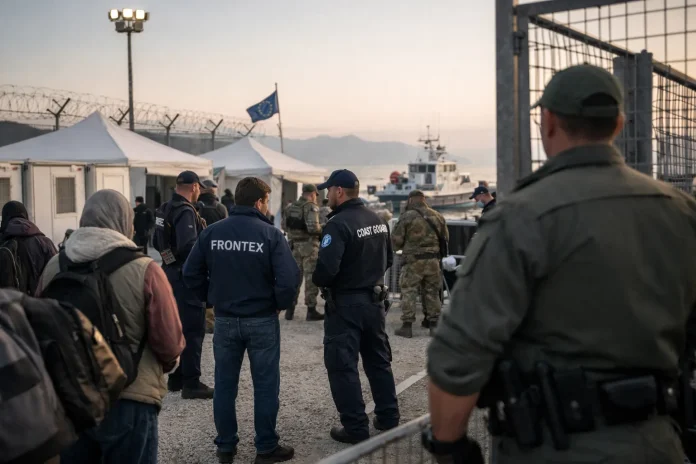
Migration as a “Stress Test” for European Policy
Migration remains a top-tier issue because it brings together three sensitive dimensions at once: border security, asylum rights, and political cohesion within the European Union. At the same time, it operates as a field of negotiation with neighboring countries, where cooperation is not guaranteed and often becomes part of a broader diplomatic trade-off.
What we are witnessing is not simply “flows.” It is sustained pressure on entire systems: public administration, social integration, diplomacy, and domestic politics. That is why any EU-level change in rules or implementation priorities can quickly affect Greece’s position inside the Union and its leverage with neighboring states.
In parallel, it is worth remembering that migration pressure often rises when states face political shocks, economic breakdown, or legitimacy crises — a dynamic you can also see in broader regional instability, such as the discussion around migration pressures in the analysis Venezuela After Maduro: The Morning After, the Medium Term, and What the U.S. Stands to Gain.
Why the Debate Never Truly Ends
There is a simple reason migration never becomes a “closed chapter”: geography does not change, while the drivers of human mobility — wars, instability, economic inequality, climate pressure, and smuggling networks — remain active.
In practice, Europe faces three parallel questions:
What Is Migration Policy Ultimately Trying to Achieve?
-
Prevent irregular crossings?
-
Speed up asylum procedures to quickly identify those entitled to protection?
-
Increase returns of those not eligible?
-
Share responsibility more fairly among EU member states?
The answer is “all of the above.” The difficulty lies in balance. Every shift toward one objective creates political costs elsewhere.
What Is Changing at the EU Level — and Why It Matters Directly
The EU’s migration and asylum reform effort aims to introduce more common procedures and reduce gaps between member states: who does what at the borders, how quickly applications are processed, when return procedures are activated, and how solidarity mechanisms function.
For frontline countries such as Greece, implementation matters more than slogans: funding, personnel, infrastructure, procedures, and — above all — cooperation with third countries. This is where migration connects directly to relations with neighbors through readmission arrangements, operational coordination, diplomatic pressure, and negotiated trade-offs.
The Triangle of “Borders – Asylum – Returns”: Where Effectiveness Is Decided
If migration management is viewed as a system, three consecutive “nodes” determine whether it functions.
1) Border Control and Registration
The objective is to reduce uncertainty: who is entering, from where, with what identity data, and under what circumstances. The faster this stage works, the faster the following stages can function.
2) Fast and Fair Asylum Decisions
Delays are not neutral. They lead to case backlogs, pressure on reception facilities, uncertainty for the individuals involved, and political costs for the state responsible for management.
3) Returns of Those Not Eligible for Protection
This is where the system’s credibility is tested. If returns do not function, the system sends the wrong signal and political debate becomes more polarized. If they function without safeguards and oversight, concerns arise regarding rights and legality.
EU “Solidarity”: Why It Is Always the Most Difficult Chapter
Across Europe there is a persistent tension: frontline states call for burden-sharing, while many Northern and Central European countries focus on deterrence and returns. The result is often a compromise designed to distribute responsibilities, yet challenged in practice by domestic political resistance.
Domestic Impact: Social Cohesion and Administrative Resilience
Social cohesion is not a slogan — it is the management of daily reality. When pressure translates into housing, healthcare, schooling, public safety, and employment, political language changes. Without a clear integration and decongestion strategy, migration becomes an easy field for exaggeration and polarization.
A Key Distinction That Often Gets Lost: “Regular” vs. “Irregular” Migration
Europe is simultaneously discussing two different policy areas:
-
Irregular flows and asylum (humanitarian dimension + border control + procedures)
-
Legal labor migration (labor market needs + demographic challenges + mobility channels)
Mixing the two leads to political confusion. That is why EU discussions increasingly emphasize clearer channels and clearer enforcement — not as a single “solution,” but as an attempt to make the system internally consistent.
What This Means in Practice for Relations with the EU and Neighboring Countries
If migration is described as a “top issue” in relations with the EU and neighbors, it is because it functions as a multiplier.
With the European Union
-
Greece seeks support (funding, personnel, infrastructure) and functional solidarity.
-
The EU expects effective implementation of rules: fast procedures, proper registration, and returns where required.
-
Any border crisis quickly becomes a European political issue, shaping summits, ministerial coordination, and broader policy trade-offs.
For the official, institutional baseline on the reform direction, the most stable reference point is the Council of the EU’s overview of the EU migration and asylum reform / Pact: EU migration & asylum reform (Pact).
With Neighboring Countries
-
Cooperation can act as a stabilizing tool when functional channels exist.
-
It can also become a tool of pressure when migration is politically instrumentalized.
-
Management requires constant diplomatic engagement: operational coordination, information exchange, readmission arrangements, and clearly defined red lines.
In wider geopolitical cycles, migration also moves with shifts in power projection and regional instability — a logic that appears, for example, in Trump’s Post-Maduro Storm: Escalation, Threats to Colombia and Greenland, and an Assertive U.S. Foreign Policy.
Where 2026 Will Be Decided: Implementation, Not Announcements
The crucial element is implementation. Rules alone are not enough. Effectiveness will depend on whether procedures actually become faster in practice and whether European cooperation mechanisms function under real pressure.
And because migration policy is tightly linked to broader cross-border coordination, it often follows the same “friction vs. cooperation” logic that appears in other global agendas — a useful parallel discussed in Davos 2026: What It Means for the Economy — 5 Themes That Can Move Markets, Businesses, and Households.
A Clear Summary
Migration remains a top-tier issue because it is not just one policy field. It is where borders, rights, social cohesion, and diplomacy intersect. The EU is moving toward a more unified framework, but the real test is execution. For Greece, the challenge is twofold: keep domestic management functional while sustaining a steady, realistic line in relations with both the EU and neighboring countries.
What deserves close monitoring going forward are two indicators:
(a) how quickly procedures operate in practice, and
(b) whether European decongestion and solidarity mechanisms work when pressure rises.