

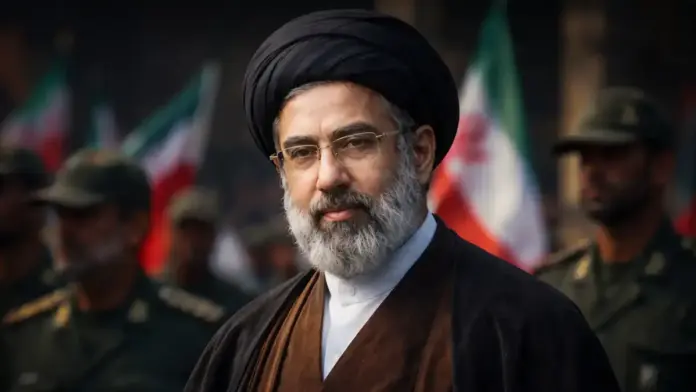
Iran’s new leader is not missing in the literal sense. But his silence is now a story of its own.
Mojtaba Khamenei emerged as Iran’s new supreme leader after the killing of his father, Ali Khamenei, yet he has not projected the kind of clear public leadership presence normally expected after such a historic transfer of power. Reuters reported that he remained publicly silent nearly 48 hours after his elevation, even as Iran moved through one of the most consequential transitions in the Islamic Republic’s history.
That makes the first fact-check essential. The safest wording is not that he is “missing” in the strict factual sense. What is established is narrower and more important: he has remained publicly silent, his public visibility has been sharply limited, and his condition was initially unclear after the strike that killed his father. Reuters reported the silence and the uncertainty; The Guardian later reported, citing Iran’s ambassador to Cyprus, that Mojtaba Khamenei was injured in the same strike and is hospitalized.
So the deeper question is not only where Mojtaba Khamenei is. The more important question is what this silence reveals about how power is now being arranged in Tehran. On the available reporting, the transition does not look centered on public legitimacy first. It looks centered on system control first, with the Revolutionary Guards moving faster and more visibly than the new leader himself.
As Reuters reported, Mojtaba Khamenei remained publicly silent after his elevation, while the Islamic Revolutionary Guard Corps was described as the decisive force behind the transition. That is not a minor detail. It is the center of the story.
What is actually confirmed about the strike, the family losses, and Mojtaba Khamenei’s condition
Several parts of this story are now clear. Reuters reported that Ali Khamenei was killed in the U.S.-Israeli strike campaign, and Reuters also separately reported that his daughter, daughter-in-law, son-in-law, and a grandchild were killed in the same wave of attacks, according to Iranian state media.
What is less straightforward is the full family-loss narrative now circulating online. Some accounts go further and claim that even more members of the family were killed, including Mojtaba Khamenei’s wife and child.
The Guardian reported, citing Iran’s ambassador to Cyprus, that six family members were killed and that Mojtaba himself was injured. But those additional family details do not carry the same level of broad, independent confirmation as the Reuters reporting on the daughter, daughter-in-law, son-in-law, and grandchild.
That distinction matters because this is exactly where misinformation starts to harden into false certainty. The available reporting supports three solid conclusions: Ali Khamenei is dead, multiple family members were killed in the strike, and Mojtaba Khamenei survived.
It also supports a carefully worded fourth point: there is now a serious public report that he was wounded, but that detail rose first through later reporting and official comment from an Iranian diplomat rather than from the earliest Reuters confirmation.
For a fact-based newsroom, that does not weaken the story. It strengthens it. The line between what is confirmed, what is strongly reported, and what remains less firmly established is exactly what protects readers from confusion.
His silence is not just a communications issue. It is a political fact.
In a more conventional transition, a newly elevated supreme leader would be expected to signal continuity quickly: a statement, a speech, a carefully staged public appearance, or at least a direct institutional message to the public and to the outside world. Here, that visible sequence has not materialized in normal form. In wartime, that absence carries political meaning of its own.
Reuters reported that the Revolutionary Guards pushed strongly for Mojtaba Khamenei’s elevation and overrode resistance from political and clerical figures. If that account is accurate, then his silence should not be read as a mere stylistic choice. It may instead reflect the deeper structure of the transition: the machinery of force moved first, and the public face of authority came second.
That is also where two false narratives have to be rejected at once. One says the silence proves the system has collapsed. The other says it means nothing at all and that everything is fully normal. Neither claim is supported by the evidence. Iran does have a named new leader. But the lack of a clear public leadership presence after his elevation is itself part of the political reality, not an empty detail.
This was not a transition built on broad public legitimacy
Mojtaba Khamenei did not rise to the top as a public politician with broad civic visibility. Reuters had already described him as a hardline backroom figure with strong ties to the Revolutionary Guards and long-running influence through his father’s office, despite never having held a formal elected government post.
That background makes today’s silence even more politically loaded. This is not the silence of a leader who already spent years building a clear public mandate. It is the silence of a man who reached the apex of the state through war, elite pressure, and institutional urgency rather than through any public political process in the ordinary sense.
Every additional day without a clear public projection from him leaves more room for one conclusion to harden: that the real center of gravity in Tehran is not the man now wearing the title, but the apparatus that placed him there.
That reading also fits naturally with Newsio’s existing English-language Iran file, including Iran: Khamenei’s death confirmed — what we know, what changes now, and what to watch next and Khamenei: repression and executions under his rule (fact-checked), which already frame both the succession and the regime’s wider record for an English-speaking audience.
The Guards are more visible than the leader, and that may be the clearest clue
Perhaps the most important detail in Reuters’ reporting is not simply that Mojtaba Khamenei was elevated. It is that the Revolutionary Guards appear more visible in the transition than the new leader himself. If the Guards are perceived as the decisive force behind his elevation while he remains publicly muted, then the natural conclusion is that Iran’s military-security core is consolidating even more power around itself.
Reuters also reported concerns among insiders that the next phase could bring both harsher domestic repression and a more hardline external posture. If that proves correct, then Mojtaba Khamenei’s silence will not look like a passing communications oddity. It will look like an early signal of a more security-dominant order in which clerical authority remains symbolically central while operational power shifts even more heavily toward coercive institutions.
This is one reason the transition matters beyond the immediate succession headline. A wounded, largely silent leader elevated by wartime pressure and backed by the Guards does not suggest a soft reset. It suggests an Iran that may become even less transparent, even more securitized, and potentially even more reactive under pressure.
The injury reports matter — but only if handled carefully
The injury story needs the same discipline. The Guardian reported, citing Iran’s ambassador to Cyprus, that Mojtaba Khamenei suffered wounds to his legs, hand, and arm and is currently hospitalized. That report is newsworthy and helps explain his absence. But it still has to be presented in the right register: as a serious reported claim from a named diplomatic source, not as a detail that was equally established across all outlets at the same time.
That distinction matters because this is the exact space where low-grade propaganda and sloppy reporting often do their worst work. It is easy to turn “reportedly injured” into “incapacitated,” or “publicly silent” into “disappeared,” or “wounded and under protection” into “the system is finished.” None of those escalations is justified by the evidence now available.
The stronger and more useful conclusion is narrower. His reported injuries may help explain his absence, but they do not by themselves tell the whole political story. The larger story is still about how the transition was engineered, who appears to dominate it, and what kind of state is now emerging from it.
Tehran wants to project continuity, but the picture is still incomplete
Iran has tried to signal continuity after the succession. Reuters’ March 9 live coverage showed that the regime publicly named Mojtaba Khamenei as the new supreme leader and moved to show that the line of command had survived the killing of Ali Khamenei. That matters, because the state clearly understands the symbolic need to present order.
But image management is not the same thing as full political legitimacy. Portraits, state announcements, and elite endorsements can tell the public that continuity exists. They cannot fully replace the political effect of a new leader stepping forward in his own voice at a moment of rupture. That is why the transition still feels incomplete. The state announced continuity, but the new leader has not yet fully embodied it in public.
This is precisely why the story remains alive. If Mojtaba Khamenei had immediately appeared, spoken, and projected command, the narrative would look different. Because he did not, the silence itself has become a measurable part of the transition.
Why this matters far beyond Iran
Mojtaba Khamenei’s public absence is not only an Iranian domestic detail. It shapes how foreign capitals, regional rivals, and financial markets read Tehran. A state that has just lost its long-ruling leader, absorbed a strike deep into the ruling family, and entered succession without a clear public projection from the new top figure inevitably produces uncertainty. And uncertainty itself is a geopolitical fact.
For the United States and Israel, this silence may be read either as fragility or as deeper hardline consolidation. For Gulf states, it may signal that Iran’s decision-making core is becoming even more opaque. For markets, it reinforces the idea that regional political risk has not been reduced simply because a successor was named.
That regional reading also links naturally with Newsio’s wider English coverage, including Strait of Hormuz: what a “closure” claim means (data-driven impact guide) and US ground troops in Iran? What’s confirmed vs. speculation (fact-checked), because succession in Tehran is unfolding inside a live strategic crisis, not in an abstract political vacuum.
The most important falsehood sits in the middle
The most dangerous falsehood here is actually a double distortion.
The first says that because Mojtaba Khamenei has not clearly appeared, the system must already be collapsing. That is not established. Reuters reported that the Assembly of Experts reached the succession decision and that he was elevated despite resistance, which means the state has at least prevented an immediate open vacancy at the top.
The second says that because the state named a successor, the silence does not matter. That is not established either. Reuters treated his silence as meaningful precisely because such a moment would normally call for visible political authority. So the silence does not prove collapse, but it also cannot be dismissed as irrelevant.
The safest conclusion sits between those distortions and is more useful than either one. There is no confirmed disappearance. There is, however, a confirmed lack of normal public leadership presence after elevation. And that fact matters because it points directly to how the new Iranian power structure may be taking shape.
What readers should keep
Mojtaba Khamenei should not, on the evidence now available, be described as “missing” in the literal, confirmed sense. He should be described as publicly silent, reportedly wounded, and still lacking a normal public leadership presence after his elevation. That is the strongest fact-based description now supported by the reporting.
What that silence may reveal is even more important than the silence itself. It suggests an Iran whose next phase may be less about clerical reassurance and more about wartime control, deeper Guard influence, and a more securitized structure of power.
That does not mean every worst-case interpretation is already true. It does mean the country’s new phase is beginning under the sign of force, opacity, and managed continuity rather than open public authority.