

Netanyahu appears outdoors with citizens in new video: what the clip actually shows
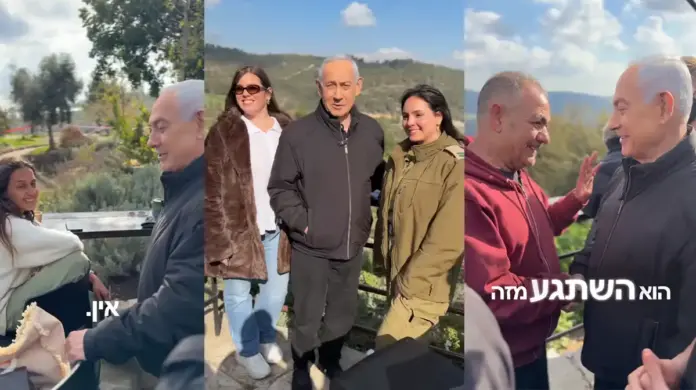
A new video circulating online shows Israeli Prime Minister Benjamin Netanyahu in a relaxed outdoor environment, speaking with citizens and briefly stopping to interact with people he meets along the way.
The footage, which was published through his official social media channels, presents a noticeably calm and informal moment: Netanyahu walks through a natural setting, exchanges a few words with passers-by, and appears approachable while security personnel remain nearby in a discreet but visible presence.
The clip is simple, almost quiet in tone, but that simplicity is precisely why it has drawn attention. In recent days, Netanyahu has appeared in several short public videos intended to demonstrate that he remains active, visible, and engaged with the public.
The new footage continues that pattern, but in a slightly different way. Instead of a city setting or a formal appearance, this time the prime minister is seen outdoors, interacting casually with citizens and acknowledging people around him.
At one moment in the video, Netanyahu stops to speak with two young women who are walking with a dog. The exchange is brief and relaxed. The tone is not ceremonial, and it does not resemble an official public event. Rather, it gives the impression of an informal encounter where the prime minister pauses to greet people and respond to them naturally while continuing his walk.
Security agents can also be seen around him, which is expected given the role and the current regional context. However, their presence is not overwhelming. They remain close enough to ensure safety, yet far enough in the frame that the interaction between Netanyahu and the citizens remains the focus of the scene.
That broader context matters because modern political visibility is no longer just about speeches. It is also about short-form optics, controlled public presence, and image correction in a fast-moving information environment.
Newsio has already examined how visual narratives shape political understanding in our fact-check on the Khamenei repression narrative, where the gap between what circulates online and what is actually verified becomes politically decisive.
A continuation of a broader communication strategy
The importance of this video lies less in the setting itself and more in the context in which it appears. Over the past period, Netanyahu’s public visibility has become a topic of discussion online, particularly after waves of misinformation circulated on social networks. Earlier footage — including a widely shared clip showing him ordering coffee and speaking casually in public — served to counter those claims and demonstrate that he was active and present.
שומרים על ההנחיות ומנצחים ביחד >> pic.twitter.com/HC5w3PqKuV
— Benjamin Netanyahu – בנימין נתניהו (@netanyahu) March 16, 2026
That earlier phase was independently grounded by Reuters’ reporting on Netanyahu’s previous public video appearance, which placed the footage in the context of online death rumors and the effort to visually rebut them.
The new outdoor video continues the same broader pattern: showing the prime minister in everyday situations rather than exclusively in formal political environments. In communication terms, such images often serve a clear purpose. They present a leader not only as a decision-maker inside government offices but also as someone visible within ordinary public spaces.
That strategy becomes easier to understand when placed inside a wider media and geopolitical framework. In our explainer on public trust, institutional systems, and political visibility, Newsio has already shown how legitimacy today is shaped not only by policy but also by how leaders are seen, tracked, and interpreted by citizens in real time.
This type of imagery is common in modern political communication. When leaders appear walking among citizens, exchanging greetings, or engaging in small conversations, the visual message is often one of accessibility and normalcy. The setting itself — parks, streets, cafés, or rural areas — can reinforce that message by placing the leader in an environment that feels familiar to the public.
What the video clearly shows — and what it does not claim
At the same time, it is important to describe the clip accurately and avoid exaggeration. The video does not show a large organized public gathering, nor does it present a formal public event. There is no indication that it was a staged political rally or a structured meeting with citizens.
Instead, the footage captures a series of brief interactions in an open environment. Netanyahu walks, stops momentarily to greet people, exchanges a few words, and continues moving while his security detail remains nearby.
This distinction matters because the strength of the video lies in its simplicity. It is not dramatic or theatrical. It does not rely on speeches or symbolic gestures. The scene works precisely because it appears natural and informal.
The human element of the moment
Beyond politics, the clip also carries a softer human dimension. The conversation with the women and the presence of the dog create a moment that feels ordinary and relatable. In contrast to highly choreographed political appearances, the interaction seems spontaneous, which often resonates more strongly with viewers.
In an era when political communication frequently happens through short videos and social media clips, such moments can shape perception quickly. A few seconds of informal interaction can convey a message that might otherwise require a long statement: that the leader is present, active, and approachable.
Why the footage resonates
Ultimately, the new video does not introduce dramatic new developments in Israeli politics. Instead, it reinforces an existing narrative of public presence. By appearing in everyday surroundings and engaging briefly with citizens, Netanyahu presents an image of continuity and accessibility.
The clip also fits a wider pattern in which political leadership is increasingly mediated through short visual moments rather than long formal statements. That is part of a broader transition Newsio has explored in our analysis of structural change and public perception in fast-moving systems, where visibility, trust, and interpretation increasingly shape how audiences process authority.
For viewers, the takeaway is straightforward. The footage shows a prime minister moving through a public outdoor setting, greeting citizens, and interacting briefly with people he encounters along the way. It is a calm scene — one that emphasizes visibility and normal public contact rather than political spectacle.
In the context of modern media dynamics, that quiet approach can sometimes speak louder than a formal speech.