

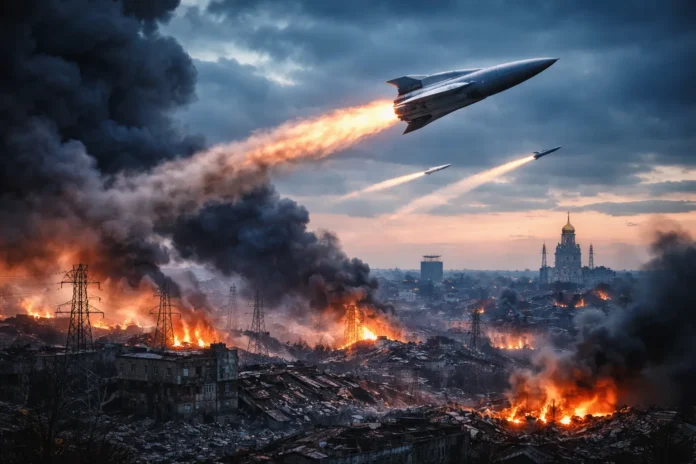
Russia’s “Oreshnik” claim in a massive strike on Ukraine — why the signal can matter more than the blast
This story is not simply about another night of drones and missiles over Ukraine. It is about the kind of message Moscow chooses to project when it says it used a nuclear-capable, hypersonic ballistic system—“Oreshnik”—in a large overnight strike. Even when such weapons are used with conventional warheads, they carry a strategic shadow. They change how leaders, publics, and allies assess risk, escalation, and the durability of support.
According to international reporting, Russia said it launched the Oreshnik as part of a broad attack that caused damage to critical infrastructure in western Ukraine, including areas near the Lviv region, close to the Polish border. Ukraine rejects Russia’s stated justification and describes the strike as another attempt to raise the cost of resistance by targeting systems that keep daily life functioning—electricity, heat, transport, and other essentials. (Authority source: Reuters)
At the center of the episode is a truth that modern conflicts make unavoidable: war unfolds in two arenas at once. There is the physical arena—craters, outages, casualties, repairs. And there is the arena of meaning—signals, narratives, fear, deterrence, and political pressure. When a nuclear-capable system is emphasized publicly, the second arena can become as consequential as the first.
What happened — and what readers should treat as claims
International coverage describes the strike as a combined assault: multiple waves of drones and missiles, designed to complicate interception and overwhelm air defenses. Ukrainian officials reported damage to critical infrastructure, including in western regions.
Russia’s defense ministry stated that the Oreshnik was used in the strike and framed the operation as retaliation for an alleged Ukrainian drone attempt targeting a residence used by President Vladimir Putin in late 2025—an allegation Ukraine denies. That point matters, because it illustrates a recurring pattern of wartime messaging: each side offers a framing meant to shape what outsiders feel compelled to do next.
Two basic rules help the general public read this responsibly:
-
Separate damage from justification. A strike can be real, destructive, and tragic—while the rationale offered by the attacker remains disputed or unverified.
-
Watch what changes the strategic conversation. The appearance—or claimed appearance—of a “special” weapon system can alter perception, even if it does not immediately alter front lines.
This is why the Oreshnik claim attracts attention. It is not only about whether a specific missile was used. It is also about why Moscow wants that possibility to be widely discussed.
Why western Ukraine, and the Lviv corridor, carries extra weight
For many readers abroad, “western Ukraine” sounds like distance—away from the worst of the fighting. In practice, western Ukraine is something else: it is a strategic corridor that connects Ukraine to Europe. That corridor matters for transportation routes, logistics, humanitarian flows, and the broader networked reality of war: how supplies move, how equipment is repaired, how people relocate, how commerce survives.
When strikes occur near this corridor, even limited physical damage can produce outsized effects:
-
Operational pressure: disruptions to transport nodes or energy networks can slow repairs, reroute supplies, and create bottlenecks.
-
Civic pressure: outages and infrastructure stress reduce quality of life and deepen fatigue—especially in winter.
-
Symbolic pressure: proximity to NATO territory, especially Poland, increases the emotional and political resonance in Europe.
That symbolic layer is not superficial. European governments must keep their publics aligned for long-term support. A strike near Ukraine’s western edge can intensify domestic debates: “How close is this getting?” “How sustainable is support?” “What happens if there is an accident or miscalculation?”
This is not alarmism. It is how political systems work under stress. Geography shapes perception, and perception shapes policy.
What is “Oreshnik,” and why its public “appearance” matters
Oreshnik is described in reporting as a hypersonic, intermediate-range ballistic missile system that is nuclear-capable by design. The technical terminology can be confusing, so here is the simple takeaway:
-
Ballistic missiles follow a high-arc trajectory and can be difficult to intercept depending on speed, altitude, and defenses.
-
Hypersonic describes extremely high speeds that can compress reaction time and complicate interception.
-
Nuclear-capable means the system is designed to carry a nuclear payload, even if used conventionally.
But the more important point is psychological and political: nuclear-capable systems exist in a space where military action blends into deterrence messaging. Even when used with conventional warheads, they can be used to raise uncertainty—about what is possible, what is next, and what risks leaders are willing to take.
That is why analysts often say such weapons are not only hardware. They are also language. They “speak” in the vocabulary of deterrence, and that vocabulary is designed to make opponents and allies think carefully about escalation.
Strategy versus spectacle: why the signal can outsize the damage
A key distinction helps readers avoid both panic and complacency:
-
A strike can be operationally significant without being strategically decisive.
-
A strike can be strategically significant even if its operational damage is limited.
If a weapon’s main value is signaling—testing boundaries, intimidating decision-makers, raising uncertainty—its “impact” is measured not only in physical destruction. It is measured in reactions: emergency meetings, shifts in aid priorities, changes in air defense deployments, and changes in the public mood.
For Russia, emphasizing a “special” system may serve several goals at once:
-
Project escalation options without necessarily changing the ground war immediately.
-
Pressure Western cohesion by adding fear of “what could happen next.”
-
Amplify psychological strain inside Ukraine, especially through infrastructure warfare.
-
Reinforce domestic narratives of strength, initiative, and retaliation.
For Ukraine, the goals are the mirror image:
-
Reduce panic and preserve societal resilience.
-
Strengthen the case for more air defenses and infrastructure protection.
-
Expose manipulation in Russia’s justification.
-
Keep attention on the human cost rather than the attacker’s framing.
Understanding those incentives is not cynicism. It is media literacy in wartime.
Infrastructure warfare: when the “front line” moves into everyday life
In a long war, the front line is not only where soldiers face each other. It is also where electricity is restored, where heating systems survive winter, where hospitals keep operating, where families maintain routines, and where cities prove they still function.
That is the cold logic of infrastructure attacks. They are designed to produce cascading effects:
-
outages that disrupt health and safety,
-
logistical strain that slows recovery,
-
economic damage that reduces state capacity,
-
psychological fatigue that erodes morale.
Behind the phrase “critical infrastructure” are homes, hospitals, schools, and the daily rhythms that keep dignity intact during crisis. A strike that causes blackout conditions is not just a technical event. It is an emotional one: a night that turns cold, a city that falls silent, a hospital that depends on generators, a family that measures time by how long the power stays on.
This is why the Oreshnik claim matters even to readers who do not follow technical weapons debates. It sits at the intersection of infrastructure pressure and deterrence theater.
Europe’s anxiety: escalation is not only a mistake—it is accumulated risk
Escalation is not only the nightmare scenario of a missile landing “in the wrong place.” Escalation can also be the slow, dangerous accumulation of risk:
-
strikes that occur closer to NATO borders,
-
rhetoric that becomes more theatrical,
-
weapons with nuclear associations highlighted in public messaging,
-
growing chances of miscalculation or misinterpretation.
In geopolitical crises, some of the most dangerous moments occur when multiple sides think they are “sending a message” while underestimating how that message can be read. That is especially true when the message touches the nuclear shadow.
European security planners typically view these episodes through three lenses:
-
Deterrence: does the signal reduce or increase the chance of further escalation?
-
Defense capacity: do air defenses match the evolving threat mix?
-
Political cohesion: will publics remain aligned for long-term support?
The war has already reshaped Europe’s energy debate, defense spending, industrial policy, and political polarization. Another escalation signal near western Ukraine can intensify those pressures.
The narrative battle: “retaliation” versus “pretext”
Russia frames the strike as retaliation. Ukraine describes that framing as a pretext.
For the reader, the practical question is not which slogan is more emotionally compelling. It is: what outcome is each side trying to produce?
Russia’s narrative incentives often include:
-
justify escalation as reactive rather than aggressive,
-
shift attention toward alleged provocations,
-
deter deeper Western involvement,
-
maintain domestic legitimacy.
Ukraine’s narrative incentives often include:
-
prevent panic and preserve resilience,
-
rally international support for air defense and infrastructure protection,
-
depict Russia’s framing as manipulation,
-
keep focus on continued threat and the need for pressure on Moscow.
This is why these events are often described with intensity on all sides. The battle is over meaning as much as it is over territory.
What to watch next: the next 48 to 72 hours
Four developments will clarify whether this episode remains a single “signal” or becomes part of a sustained escalation pattern:
-
Additional confirmation and technical assessment
Expect more cautious statements and analysis as trajectories, debris, and impact sites are assessed. -
Western response, especially on air defense
If allies read this as escalation, urgency around interceptors, layered defense, and infrastructure protection may grow. -
Energy and infrastructure recovery
Restoration speed matters. Rapid repair limits psychological impact. Prolonged disruption magnifies it. -
Diplomatic temperature
Even when talks look frozen, signaling can be used to shape bargaining positions indirectly—by shaping perceived costs and urgency.
Why this matters to U.S. audiences
For American readers, it can be tempting to treat the war as a distant tragedy punctuated by occasional headlines. But European stability is not a remote variable for the United States. It connects to NATO credibility, deterrence norms, energy markets, supply chains, and the broader question of whether force can rewrite borders.
When a nuclear-capable system is highlighted in a conventional strike, it also touches something deeper: the global boundaries around nuclear signaling. Even without nuclear use, the normalization of “nuclear-shadow messaging” can erode the guardrails that have helped reduce catastrophic escalation for decades.
Conclusion: a political message with a military shell
If Russia’s reported use of Oreshnik is accurate, the episode functions as a warning wrapped in an operational strike. It is not only about what was hit. It is about how Moscow wants Ukraine and the West to interpret what could be possible next.
That does not automatically mean a fundamentally new phase—unless it becomes a pattern. But it does mean the strategic atmosphere is being shaped intentionally, with fear and uncertainty as tools.
In moments like this, serious journalism has one responsibility above all: precision without spectacle. Because the public does not need louder noise. It needs clearer meaning.