

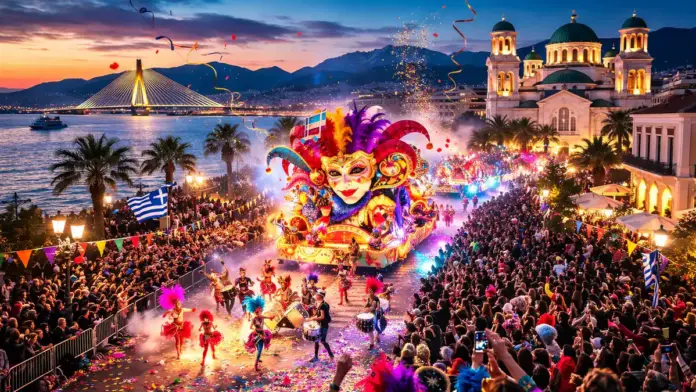
Patras Carnival 2026: Grand Parade day, city measures, and the practical guide that keeps your day smooth
Patras Carnival’s Grand Parade is not “just a celebration.” On the ground, it’s a large-scale urban event where crowd flow, transit pressure, and real-time changes can turn a great day into a stressful one—unless you plan like a local.
The key is simple: make three decisions early (how you arrive, where you watch from, how you leave), then stay flexible as the city’s movement patterns change throughout the day.
This guide focuses on what helps most: where congestion typically builds, what to carry, how to avoid getting separated, and how to follow updates without falling into rumor cycles.
What Grand Parade day looks like in practice
On Grand Parade day, the city effectively runs in “zones,” even if nobody labels them that way:
-
Core zone (center + main arteries): highest density, frequent flow changes, the slowest movement.
-
Access zone (outer entry points): where your day is won or lost—smart drop-off and a clear walking plan.
-
Exit zone (post-finale dispersal): where most people lose time, patience, and their group.
You don’t need perfect knowledge of every street. You need a strategy that works under pressure.
The three decisions that prevent most problems
1) Arrival decision: don’t chase “close parking”
If you’re driving, the biggest mistake is trying to get “as close as possible.” That usually costs time and creates dead ends.
A better approach:
-
choose a reasonable distance,
-
expect a walk,
-
and treat walking as part of the plan, not a failure.
2) Viewing decision: choose a fixed meeting point
Crowds separate people fast. Decide in advance:
-
a specific meeting point,
-
a specific “if we get split” rule,
-
and a time window to regroup.
This matters even more if you’re with kids or older family members.
3) Exit decision: plan your departure before the peak bottleneck
Most delays happen at the end. The cleanest options are:
-
leave slightly before the peak exit wave, or
-
wait for the first heavy wave to pass, then move calmly.
Either option beats “everyone leaves at the same minute from the same spot.”
What to carry (the minimal kit that actually helps)
Keep it practical and light:
-
fully charged phone + small power bank
-
water and a small snack (especially for families)
-
light rain layer / windbreaker (weather and wind are typical wildcard factors)
-
comfortable footwear (this is a walking day)
If you want a no-nonsense safety baseline for crowded environments, you can also use this as a quick reference: Earthquake Now in Greece: Official Updates & Safety Guide. It’s not about carnival specifically—it’s about staying functional and calm under disruption.
City measures, crowd flow, and how to stay informed without getting misled
Big events run on dynamic operations. Police and municipal services adjust:
-
access routes,
-
local closures,
-
and flow directions based on density and safety needs.
The most useful mindset is:
expect changes, and don’t build a plan that collapses if one street is closed.
How to follow updates efficiently
Use a two-layer approach:
-
Primary: official announcements and major outlets
-
Secondary: what you see on the ground (signage, barriers, staff direction)
Avoid relying on:
-
anonymous social posts,
-
“my friend said,”
-
or screenshots without context.
If you want a practical way to train yourself and your team to separate signal from noise, this explainer is built for exactly that: How to Read the News Without Being Manipulated.
Crowd safety basics that work every time
Keep the group together with simple rules
-
Visibility rule: keep line-of-sight in dense moments.
-
No gaps rule: don’t let people drift between you.
-
One meeting point rule: agree on a single regroup location.
If you’re with children
-
keep contact details accessible
-
set “stop-and-wait” rules if separated
-
choose viewing spots with space, not maximum proximity
If you’re with older family members
-
build in rest time
-
avoid peak-density choke points
-
prioritize comfort over “best view”
If something unexpected happens: the calm protocol
You don’t need heroics. You need structure.
-
move toward a less dense area
-
follow staff and official guidance
-
keep your group together
-
don’t run unless directed—running creates secondary hazards in crowds
For official, practical guidance on emergency calls in Greece, the national portal provides the baseline information here: 112 — European emergency number.
Where an “authority” check helps (and when it doesn’t)
For event context and official framing, the Greek national tourism portal is a reliable reference point: Patras Carnival. Use it to confirm the event’s official identity and general framing, but rely on local operational guidance (official local announcements and on-the-ground direction) for mobility and access on the day.
What this means for you
If you want a great Grand Parade day without turning it into a logistics fight, keep it simple:
-
Plan arrival, viewing, and exit before you start moving.
-
Use a fixed regroup point—especially with families.
-
Carry the minimal kit that prevents small problems from becoming big ones.
-
Expect route changes and adapt calmly.
-
Don’t amplify rumors. Use primary sources and what you see on the ground.
These steps don’t remove crowds. They remove the chaos around crowds.
Summary
Grand Parade day in Patras is a city-scale event that rewards basic planning. Three early decisions—how you arrive, where you watch, and how you leave—shape almost everything that follows. If you add a simple regroup plan and follow verified updates, you protect your time, your group, and your experience.