

Table of Contents
Pepper Prices Tell the Story: A Neighborhood Field Report From Thessaloniki
This is not a story about the Strait of Hormuz
It is not a story about oil prices, missile strikes, or distant geopolitical shocks used as a ready-made explanation for every jump at the checkout. Those questions matter, and they can be analyzed separately.
This report is about something far more immediate: the reality recorded on the ground, far away from where rockets fall. It is about the shelf, the label, the price, and the gap from one store to the next.
In the wider Polichni area of Thessaloniki, on-the-ground price checks and photographic documentation recorded peppers selling from €4.49 to €7.22 per kilo within a very small local shopping radius. This was not a modeled estimate or a desk analysis. It was a field report built from what was physically posted in stores on the day of the check.
That spread matters because peppers are not a luxury item. They are part of the everyday food basket. When a basic fresh product moves across that kind of range from one nearby store to another, the issue is no longer inflation as an abstract term. It becomes a question of how unstable the consumer experience has become at the neighborhood level.
What the field check recorded
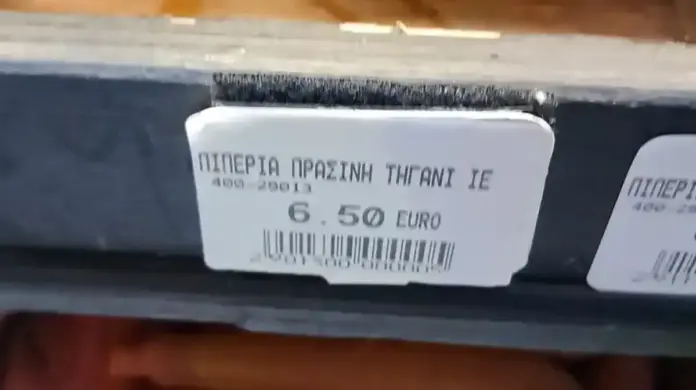
The first check was carried out at a grocery shop on Kifisias Street in Meteora, Polichni, where frying peppers were listed at €6.50 per kilo.
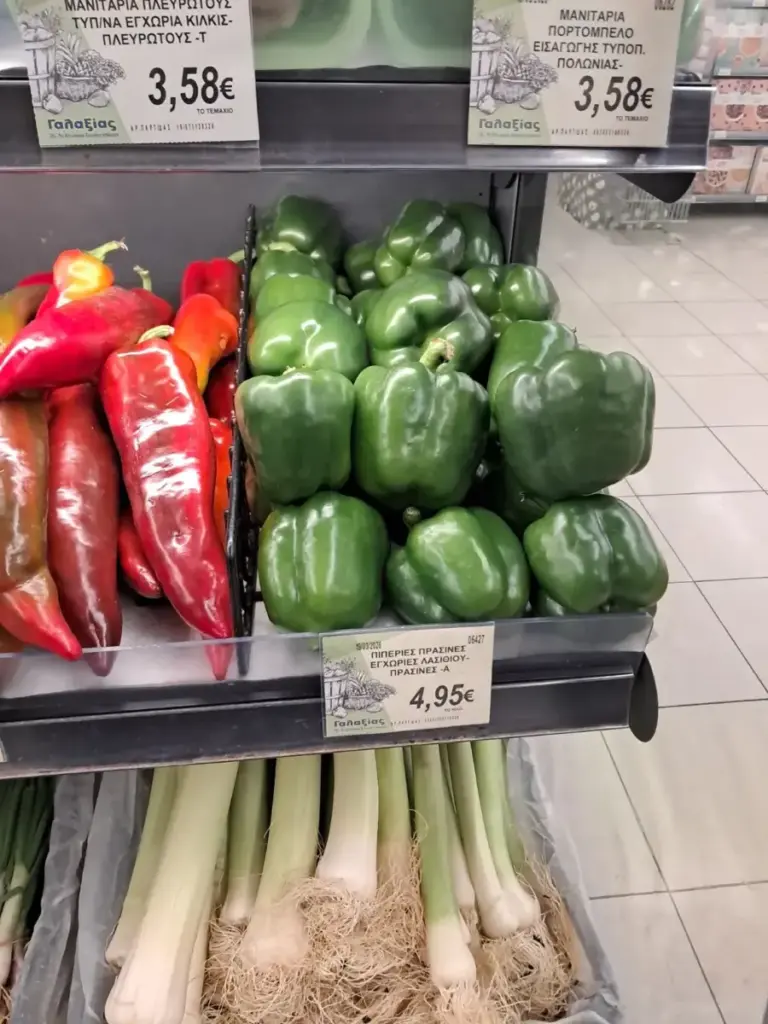
At another nearby point of sale, frying peppers were recorded at €5.40 per kilo, while peppers for stuffing were listed at €5.50 per kilo.
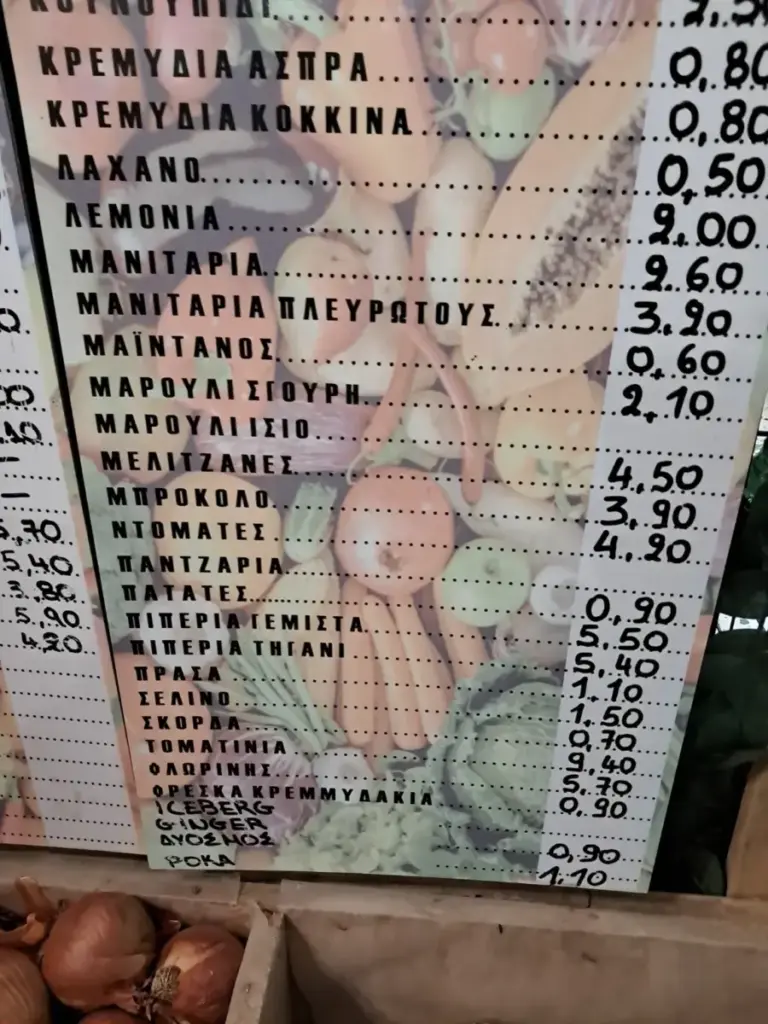
In a supermarket, stuffed peppers from Veria were found at €7.22 per kilo, the highest price recorded during the reporting.
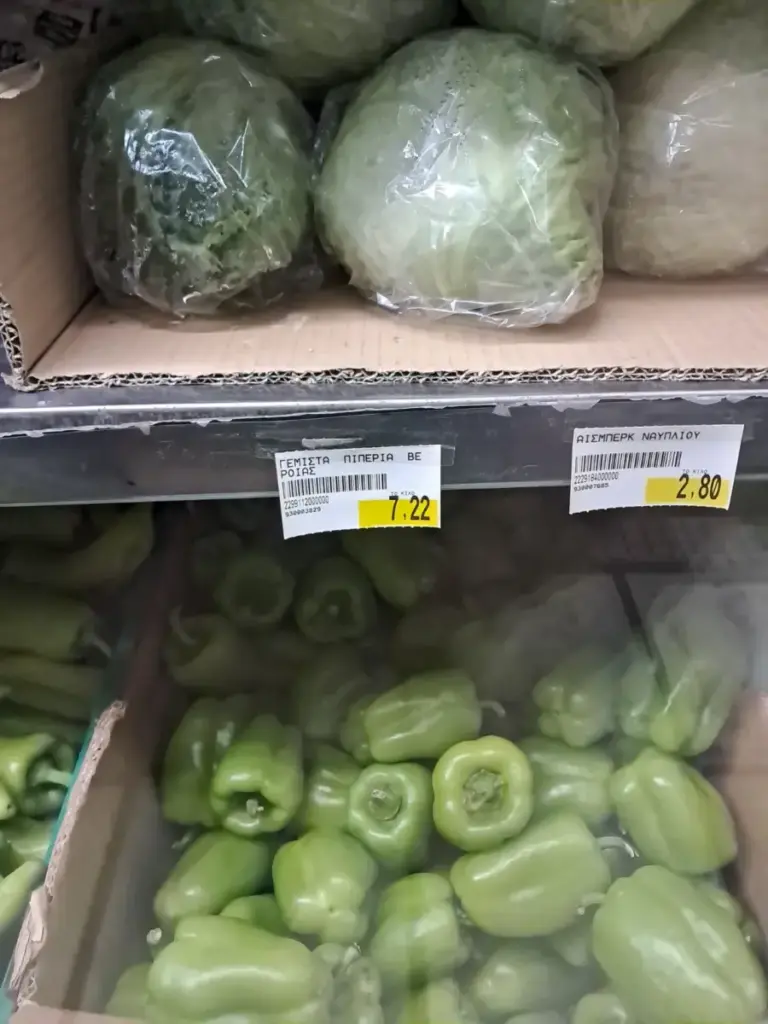
At a Galaxias store, domestic green peppers from Lasithi were listed at €4.95 per kilo.
At a Masoutis store, peppers for stuffing were recorded at €4.55 per kilo.
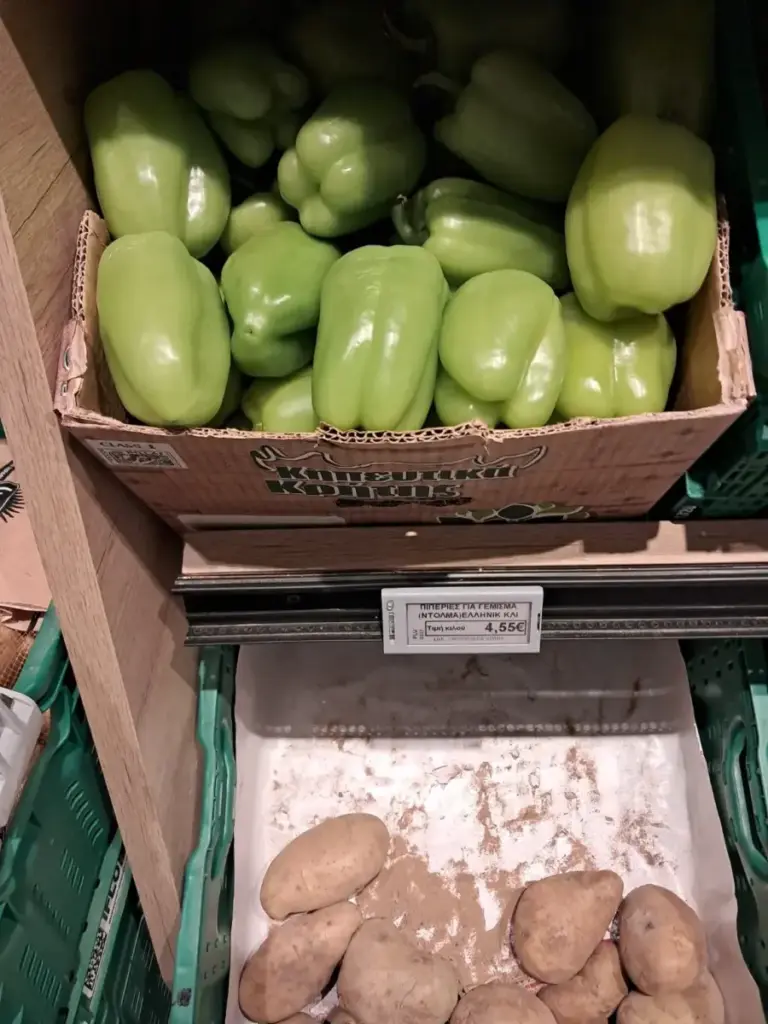
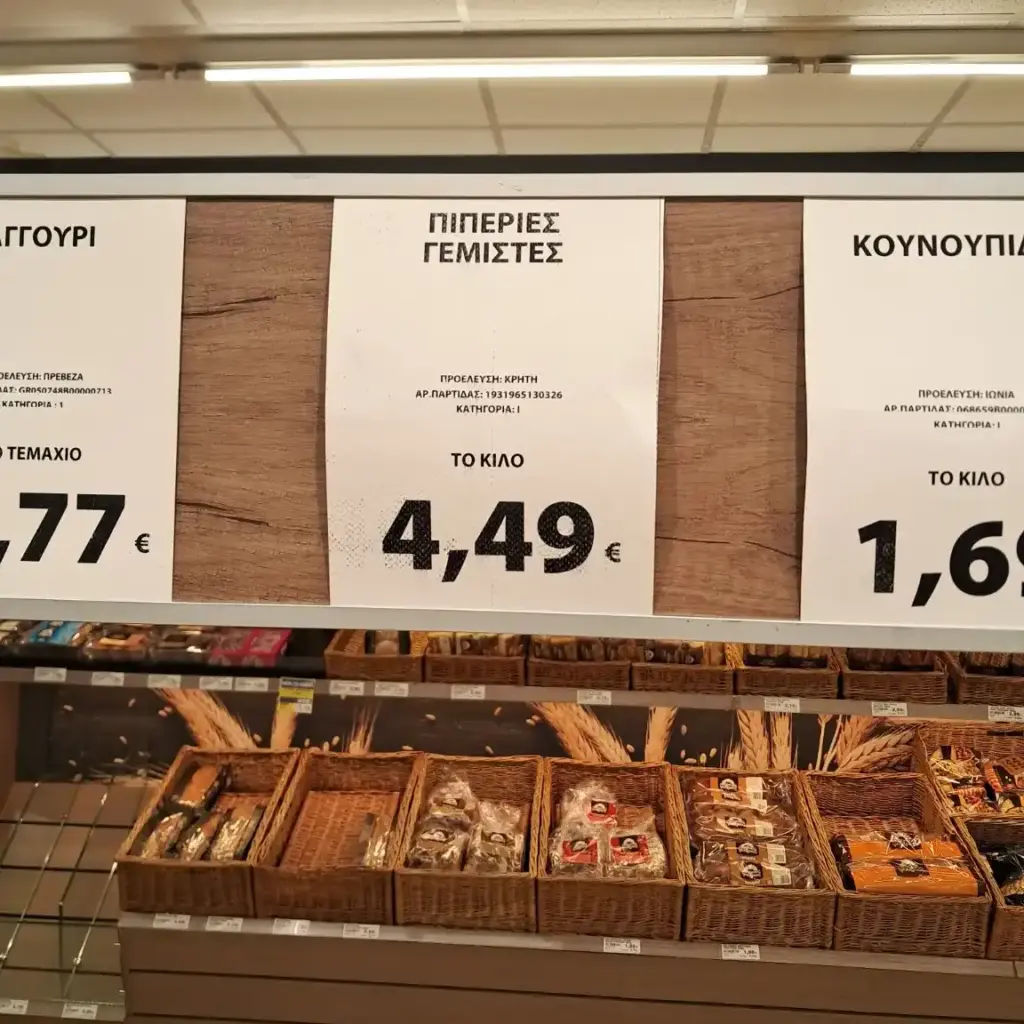
At another retail point, stuffed peppers from Crete were listed at €4.49 per kilo, the lowest price recorded in the field check.
Taken together, the documented price points were clear:
- €4.49 per kilo
- €4.55 per kilo
- €4.95 per kilo
- €5.40 per kilo
- €5.50 per kilo
- €6.50 per kilo
- €7.22 per kilo
That is a difference of €2.73 per kilo from the lowest to the highest observed price.
Why this goes beyond one vegetable
A price gap like that does not become important only because it looks dramatic in a headline. It becomes important because it reflects something structural in daily life.
A household does not encounter inflation as a chart first. It encounters inflation as friction. A parent walks into one store and sees one price. A few streets away, the same family finds a sharply different number for a closely related product. The result is not just higher spending. It is uncertainty.
That uncertainty changes behavior. It pushes people to compare more, move more, calculate more, and second-guess more. It turns ordinary grocery shopping into a form of defensive strategy.
And when that starts happening with a basic fresh product, the broader message is hard to ignore: price instability is no longer a distant economic concept. It is embedded in the local consumer landscape.
Not every pepper is identical, but the spread is still real
Precision matters here.
Not every pepper documented in this reporting was listed under the exact same commercial category. Some were labeled frying peppers. Others were listed as peppers for stuffing. Some included origin labels such as Veria, Crete, or Lasithi. Those distinctions matter, and any honest report has to acknowledge them.
But those differences do not erase the central finding.
The central finding is that within the same broader product family, inside a tight local shopping zone, consumers were confronted with a wide and meaningful price spread in an everyday food item. That is not an invented impression. It is what the shelf labels showed.
The shelf is where the truth becomes visible
Too many discussions about the cost of living drift upward into slogans. Prices rise, people struggle, markets are under pressure. All of that may be true, but it often becomes too general to feel real.
The shelf does not speak in general terms. The shelf speaks in posted numbers.
That is why field reporting matters here. It restores proportion. It removes abstraction. It shows how the same neighborhood can produce very different financial outcomes for a customer buying roughly the same kind of item. That is where the truth becomes harder, cleaner, and more difficult to dismiss.
No one needs a complicated theory to understand the significance of paying €4.49 in one place and seeing €7.22 in another for a closely related fresh product. The numbers already carry the argument.
A local finding inside a broader cost-of-living squeeze
This field report does not stand alone. According to the latest ELSTAT Consumer Price Index release, Greece’s annual inflation rate reached 2.7% in February 2026, while the Food and non-alcoholic beverages category rose 5.2% year over year. That does not mean every pepper in every store moved by the same rate. It does mean the broader food environment remains under pressure.
Inside that already pressured environment, fragmented retail pricing, different store strategies, product origin, and category labeling all shape what the customer actually faces at the shelf. That is how a simple neighborhood purchase becomes a small economic test.
For readers who want the broader English-language context around household pressure, disposable income, and the cost of everyday essentials, this report connects naturally with The 8 “Invisible” Fees That Shrink Your Paycheck Without You Noticing, Rent: How to Negotiate Effectively and What to Watch for in a Lease Agreement and Greece Real Estate: Objective Values vs Market Prices.
This is a local story with international meaning
The details of this report are local. The implications are not.
Because what is happening here is recognizable far beyond one district in Thessaloniki. Across many countries, consumers are facing the same deeper problem: daily essentials are no longer experienced as stable. The question is not only whether prices are high. The question is whether ordinary people can still predict what “normal” looks like.
That is where the story becomes international.
Not because a pepper in one Greek neighborhood suddenly becomes a global event on its own, but because the pattern is familiar across many strained economies: fragmented pricing, uneven retail behavior, pressure on the fresh-food basket, and a public that increasingly feels it has to investigate the market just to buy basic goods responsibly.
The local shelf becomes a readable signal of a much wider cost-of-living reality.
What the reader should keep
This field report does not prove that every store is overpricing. It does not claim that all peppers are identical. It does not flatten differences in origin, category, or retail model.
What it does show, clearly and directly, is this:
Within a very small shopping radius, the price of a basic fresh product moved from €4.49 to €7.22 per kilo. That is a substantial spread. It is real. It was documented on the ground. And it reflects a consumer reality that cannot be softened by vague language.
This is not a story about distant explosions.
It is a story about what remains when you strip away the noise and look at the shelf. And the shelf, in this case, said enough.