
Table of Contents
Pezeshkian’s Letter to Americans and the Regime’s Double Language: Why the Message Collapses Against the Facts
If the regime wanted to speak honestly, it would not have started with America. It would have started with the people of Iran.
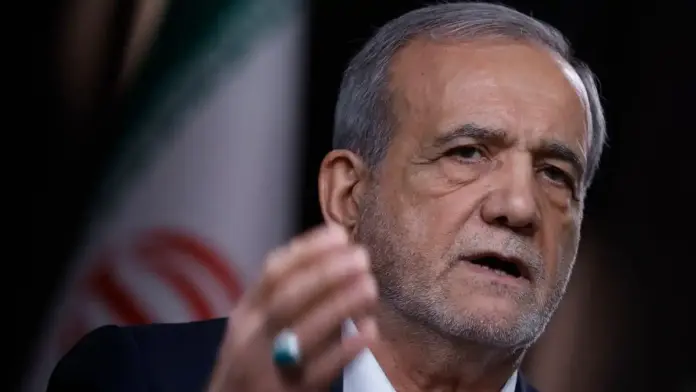
Masoud Pezeshkian did send a letter to the American people. That part is real. In that letter, he said Iran holds no hostility toward “ordinary Americans” and argued that portraying Iran as a threat does not match history or present reality. But the problem is not whether the letter exists.
The problem is that its central claim breaks apart the moment it is placed next to the facts on the ground. Reuters reported the letter on April 1, while also documenting a regional conflict in which U.S. forces have been hit and Iranian authorities have deepened internal repression.
That is why this is not a story about diplomacy alone. It is a story about narrative control. A regime that speaks softly to a foreign audience while governing harshly at home is not revealing a new character. It is changing tone for a different audience.
Readers who want the broader architecture behind this kind of messaging can connect this article with Newsio’s English reporting on Iran and Lebanon Enter a More Dangerous Phase: Pressure in the Gulf, Political Strain Around Hezbollah and The Network of Violence Behind the Regime in Tehran, because the letter only makes sense when placed inside the regime’s wider model of pressure, proxies, and external messaging. Reuters’ recent coverage supports that broader picture of regional escalation and hard-power leverage.
The first place the letter fails is the battlefield: if there is no hostility, why were U.S. bases hit?
This is the clearest point in the entire story. Reuters reported on March 27 that 12 U.S. troops were wounded, two seriously, in an Iranian strike on Prince Sultan Air Base in Saudi Arabia. The same report said that more than 300 U.S. service members had been wounded in the conflict and 13 had been killed. That is not symbolic tension. That is physical, recent, measurable harm to American military personnel.
That matters because American troops are not abstractions. They are sons and daughters of American families, stationed on U.S. installations across the region. So when the president of the regime tells the American public there is no hostility toward them, the statement does not collide with a theory. It collides with wounded troops. It collides with actual strikes on American positions. And that is where the message begins to lose credibility.
For readers following Newsio’s broader geopolitical line, that contradiction also sits naturally beside What the targeted killings of Ali Larijani and Gholamreza Soleimani really mean, because the same regional crisis that produced the letter is the one that has already produced direct military consequences. Reuters’ reporting on the wounded U.S. troops is the strongest external anchor in this section because it cuts straight through the “no hostility” claim with a recent, concrete event.
The second place the letter fails is history: this regime did not build a public culture of friendship toward America
Even if someone tried to ignore the current strikes, the historical record still creates a deep credibility problem. The slogan “Death to America” is not foreign to the political culture of the Islamic Republic. It has been part of the regime’s ideological ecosystem for decades. Reuters fact-checked a recycled video showing Iranian lawmakers chanting “Death to America” in 2020, clarifying that it was old footage being recirculated misleadingly as new. But the fact that the video was old did not erase the deeper issue. It underlined it: this rhetoric was real, public, and organically tied to the regime.
That distinction matters. The strongest case against the letter does not depend on a mislabeled video. It depends on the long historical gap between what the regime says to foreign audiences when it needs room, and what it has taught, normalized, and weaponized across decades of ideological politics. A soft letter does not erase a hard tradition. It only tries to temporarily outshine it.
The third place the letter fails is the interior of Iran: no regime can speak gently abroad while ruling through fear at home and expect to be believed
Reuters reported on March 31 that Iranian authorities warned of the death penalty and asset seizures for those accused of spying or aiding enemy states. The same report said Iranian media had reported more than 1,000 arrests in the previous month. Even sharing images or videos that might be useful to hostile powers could be treated as intelligence collaboration. That is not the profile of a transparent state extending a sincere olive branch. It is the profile of a regime tightening its grip.
And this is where the moral center of the article lies. If there was one letter that should have been written first, it was not to the American people. It was to the people of Iran. To the society that came into the streets before the current U.S. strikes and paid a devastating price.
Reuters reported in January on an official Iranian claim of more than 5,000 deaths linked to the protests, while the human rights group HRANA documented 4,519 verified deaths and 9,049 additional deaths under review. Reuters also reported this week that Iran executed a man arrested over the January protests, part of a broader crackdown the agency described as among the harshest in the Islamic Republic’s history.
That is the truth weighing down the letter. A regime that first drenched its own domestic crisis in blood and repression now attempts to speak in a gentler tone to a foreign audience as though it were simply misunderstood. That is not credibility. It is image management.
The letter also works as propaganda in two directions at once
The message is not only aimed outward. It is politically useful because it can serve two audiences at the same time. Abroad, it tries to blur the regime’s responsibility, soften its image, and encourage Americans to see the problem as Washington’s leadership rather than Tehran’s behavior.
At home, in an environment where information is restricted, internet access has been curtailed, and state-aligned media dominate the narrative, the same letter can be presented as proof that the regime is reasonable, peaceful, and unfairly demonized. Reuters reported during the January unrest that Iran imposed broad internet restrictions during the crackdown, making information control a central part of the state response.
That dual use is what makes the letter politically valuable to the regime but not persuasive to anyone seriously comparing message to reality. It is not merely a diplomatic gesture. It is a narrative instrument. It asks foreign readers to detach Tehran’s words from Tehran’s conduct, and it invites domestic audiences to see a “peaceful” leadership that the regime’s own behavior keeps disproving.
Why messages like this appear now
The timing is not accidental. Regimes under simultaneous external pressure and internal fear often do not change their nature. They change their packaging. They try to influence foreign publics, blur moral clarity, and present themselves as rational actors even when their conduct on the battlefield and at home points the other way. Reuters’ recent coverage of both the regional war and the intensified crackdown inside Iran fits that pattern closely.
That is what makes the letter politically useful now. But usefulness is not the same thing as truth.
Anyone who wants to dismantle the lie does not need exaggeration. They need to put the message next to the fact.
The journalistic lesson here is simple.
On one side: no hostility toward ordinary Americans.
On the other side: U.S. bases hit, U.S. troops wounded.
On one side: a calm letter to the outside world.
On the other side: over 1,000 arrests in a month, threats of death sentences, and expanded coercive powers at home.
On one side: a non-threatening public image.
On the other side: thousands dead in the protest crackdown before the current U.S. strikes.
Once those columns are placed side by side, the lie does not need to be theatrically denounced. It strips itself.
What readers should keep
Yes, the letter is real. But the fact that it was sent does not make it an honest picture of the regime. The more closely it is read against current events, the more clearly it looks like political image work rather than truthful self-description.
The public should keep one thing firmly in mind: this is not evidence that the regime changed. It is evidence that the regime adjusted its tone for a specific audience.
And that is the cleanest conclusion of all:
Pezeshkian’s letter to Americans does not prove change. It proves the regime’s double language: one for foreign audiences, one for its own people, and another on the battlefield, where the facts are already speaking for themselves.