

Table of Contents
The pipelines that bypass Hormuz are not a footnote — they are the Gulf’s real defense line against Iranian pressure
When tension rises around Iran and the Strait of Hormuz, the public conversation fills up fast with half-accurate claims, mislabeled pipelines, and numbers detached from the actual infrastructure. The core reality is much more serious. Saudi Arabia and the United Arab Emirates do have real land-based routes that bypass Hormuz and allow part of their oil exports to leave the Gulf without crossing the world’s most exposed energy chokepoint. But those routes are not identical, they do not carry the same volumes, and they do not erase the wider strategic threat.
That matters far beyond the Gulf. If Iran can threaten Hormuz, it can threaten a central artery of the global energy system. If Saudi Arabia and the UAE can move meaningful volumes outside the Strait, they reduce part of that pressure. They do not neutralize it. They reduce it.
That distinction is the difference between a system under stress and a system in outright shock. The International Energy Agency says only Saudi Arabia and the UAE currently have operational crude pipelines that could reroute flows around Hormuz, with limited alternative capacity overall.
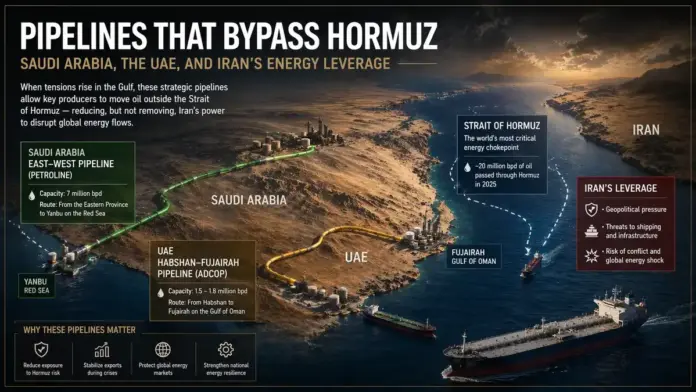
The most important correction comes at the start. The figure of roughly 1.8 million barrels per day matches the UAE’s bypass route to Fujairah. The giant Saudi route is the East-West Pipeline, also known as Petroline, and Reuters reported on April 12, 2026 that it was restored to its full 7 million barrels per day capacity after recent attacks. So when people merge those figures into one vague “Arab pipeline,” they are flattening two different strategic systems into one confused story.
Why Hormuz still sits at the center of the global energy map
The Strait of Hormuz is not just another narrow waterway on a map. It remains the main export route for oil produced by Saudi Arabia, the UAE, Kuwait, Qatar, Iraq, Bahrain, and Iran. The IEA says nearly 15 million barrels per day of crude oil moved through the Strait in 2025, representing about 34% of global crude oil trade, while the broader regional energy system remains deeply tied to the passage.
That is why bypass pipelines matter so much. They are not side infrastructure. They are strategic shock absorbers. Every barrel that leaves the region outside Hormuz slightly weakens Tehran’s ability to turn maritime risk into global economic pressure. Every barrel still trapped inside the Hormuz dependency keeps that leverage alive.
Reuters reported this week that Iran’s recent Hormuz gamble has already forced Gulf states and global consumers to reassess just how exposed the region remains when one narrow passage becomes a battlefield, a pressure point, or both at once.
For readers who want the broader Newsio English frame on why the Strait itself remains the central transmission belt of cost and risk, Strait of Hormuz: What a “closure” claim really means and Strikes on energy infrastructure and a ship hit in the Strait of Hormuz sit naturally inside the same picture.
The first major route: Saudi Arabia’s East-West Pipeline
Saudi Arabia’s key bypass system is the East-West Pipeline, widely known as Petroline. It links the Kingdom’s oil-producing east to Yanbu on the Red Sea. Strategically, that matters for one simple reason: cargo can leave through the Red Sea without having to sail through the Strait of Hormuz.
Reuters reported on April 12 that Saudi Arabia restored the pipeline to its full 7 million barrels per day capacity after attacks had previously reduced throughput by about 700,000 barrels per day.
That restoration is not just an operational detail. It is a signal to the market that Riyadh is trying to reinforce the one overland export valve that most clearly reduces its exposure to Hormuz. Reuters also reported that during the recent closure of the Strait, the East-West Pipeline became Saudi Arabia’s only crude export route. That gives the infrastructure an importance far beyond normal energy logistics. It becomes a national resilience asset under crisis conditions.
At the same time, the existence of Petroline should not be confused with full strategic immunity. Saudi Arabia may be able to reroute major volumes westward, but its energy system is still vulnerable to missile strikes, drone attacks, industrial disruption, repair delays, market fear, and insurance pressure.
Reuters reported that recent attacks also hit wider energy infrastructure across Riyadh, the Eastern Province, and Yanbu Industrial City. In other words, bypass capacity reduces one chokepoint risk, but it does not erase the wider war-risk environment.
That wider frame also connects directly with Newsio’s English-language analysis Iran, Qatar, and Saudi Arabia: Why the LNG Strike Matters, because the real story is not only about moving crude. It is about whether energy infrastructure itself is becoming a standing target inside a more openly militarized Gulf.
The second major route: the UAE pipeline to Fujairah
The UAE’s key bypass route is the Habshan–Fujairah system, often referred to as the Abu Dhabi Crude Oil Pipeline. This is the line that moves oil from inland fields to the Fujairah export terminal on the Gulf of Oman, outside the Strait of Hormuz. The U.S. Energy Information Administration says this pipeline has a capacity of 1.8 million barrels per day.
This is where one of the most common public errors begins. People often see the 1.8 million barrels per day figure in social media posts or rushed summaries and then attribute it loosely to Saudi Arabia, to the Gulf as a whole, or to some generic “anti-Hormuz pipeline.”
That is not accurate. The 1.8 million figure belongs to the UAE bypass route. Saudi Arabia’s main bypass route is larger, structurally different, and tied to an entirely different geography.
The EIA adds an important nuance here. Because the UAE has already been using this route more intensively in day-to-day operations, the extra spare capacity available for emergency rerouting is more limited than headline figures may suggest. That means the pipeline is real, important, and strategically useful — but not a magic switch that can absorb any disruption at Hormuz. Its presence helps. Its limits still matter.
So what actually “opened” or was activated?
The cleanest answer is that there is no single mysterious pipeline that suddenly solved the problem. What happened is more important and more concrete.
In Saudi Arabia, the East-West Pipeline was restored to full throughput after recent attacks, according to Reuters. In the UAE, the Fujairah bypass route remains the established operational line that allows exports to avoid Hormuz. So the real story is not about one newly discovered corridor. It is about two distinct strategic systems that become far more important every time Iran raises the pressure around the Strait.
This matters because it changes the way Gulf resilience should be described. The region is not standing still in the face of Hormuz risk. Saudi Arabia and the UAE have spent years building partial alternatives precisely because they understood that the Strait could become a pressure point in a crisis. But those alternatives remain partial, uneven, and insufficient to make Hormuz irrelevant.
Why Iran’s leverage has not disappeared
This is the most important point in the entire analysis. Even with Saudi Arabia’s East-West Pipeline and the UAE’s Fujairah route, the bypass capacity is limited relative to the scale of the energy system that normally depends on Hormuz. The IEA says available capacity on alternative export routes is only around 3.5 to 5.5 million barrels per day. That is meaningful, but it is still far below the total flow that usually depends on the Strait.
Put more plainly, Saudi Arabia and the UAE can soften part of the shock. They cannot make Hormuz strategically disposable. That is why Iran’s leverage remains real even when bypass infrastructure is functioning. Tehran does not need to permanently shut every shipment to create damage.
It only needs to prove that it can inject enough uncertainty, cost, delay, and fear into the system to make markets, insurers, shipowners, and governments react. Reuters reported today that this is exactly what the recent phase has done: it has ushered Gulf energy into a more unstable “new normal,” even after ceasefire talk and partial stabilization.
That same mechanism is why price pressure can outlive the most dramatic headlines. Markets do not price only current physical barrels. They price disruption risk, shipping behavior, insurance cost, rerouting friction, and the possibility that the next strike could hit before the current backlog clears.
The EIA’s latest Short-Term Energy Outlook said Brent-WTI spreads widened as Middle East conflict raised shipping costs and reduced oil flows, and it expects elevated prices to persist while Hormuz traffic only gradually resumes.
For readers who want the direct economic bridge from Gulf instability to household and business pressure, Fuel Prices Surge: How wars move oil markets and what the data says about what comes next belongs naturally here.
Why this is not just a Gulf story
One of the laziest ways to read this story is to treat it as a regional fight over regional infrastructure. That is not what it is. Hormuz sits inside a chain that touches fuel prices, transport costs, shipping insurance, industrial margins, inflation pressure, and strategic planning from Asia to Europe and beyond.
The IEA says most crude leaving Hormuz goes to Asian countries, while Reuters has shown that disruption in the Strait quickly reshapes revenue, vulnerability, and market behavior across the wider region.
That is also why a strong external authority belongs inside this article not as decoration, but as part of the factual spine. The International Energy Agency’s Strait of Hormuz assessment is especially useful because it makes the core point with institutional clarity: only Saudi Arabia and the UAE currently have meaningful operational crude routes that can bypass the Strait, and even those routes offer limited alternative capacity compared with the total scale of normal flows.
The deeper strategic meaning
Iran’s leverage over Hormuz has always been bigger than a simple military threat. It is a systems threat. It reaches into economics, logistics, shipping confidence, and the political psychology of markets. That is why Saudi and Emirati bypass routes matter so much. They are not just pipelines. They are attempts to reduce how much strategic blackmail can be extracted from geography.
But geography still wins more often than slogans do. The Strait of Hormuz remains one of the world’s central energy chokepoints. Saudi Arabia and the UAE can reduce part of the risk through Petroline and Fujairah. They cannot make the chokepoint disappear. That is the line serious readers should keep in mind when they see exaggerated claims online. The Gulf has partial defenses. It does not have full immunity.
What readers should keep
The first thing to keep is that the two pipelines are real, but they are not the same. Saudi Arabia’s East-West Pipeline is the large Red Sea bypass route and Reuters reported it is back at 7 million barrels per day. The UAE’s Fujairah route is the roughly 1.8 million barrels per day bypass line described by the EIA.
The second is that these routes matter precisely because they reduce part of Iran’s leverage over the Strait of Hormuz. They are serious infrastructure, not rumor material. They change the crisis map.
The third — and most important — is that they do not cancel the wider threat. Hormuz still matters. Iran’s ability to create risk still matters. And the global economy is still exposed to what happens when one narrow passage remains too important to replace quickly.