

Table of Contents
The regime celebrates “victory” — but Hormuz shows who is actually holding the initiative
Sometimes geopolitics speaks through images
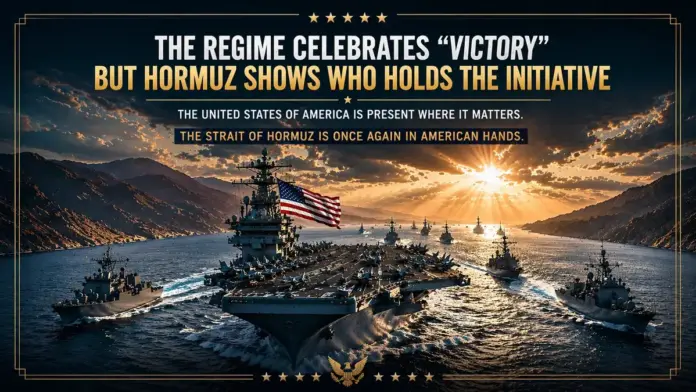
There are moments when geopolitics does not speak only through communiqués, maps, and negotiations. It speaks through images. And the image of a U.S. fleet moving through the Strait of Hormuz while Tehran continues to sell a narrative of “victory” is one of those moments.
The symbolism is heavier than the frame itself. On one side, the regime is trying to persuade its domestic audience and the outside world that it endured, bent Washington, and entered negotiations from a position of success. On the other, the United States is publicly saying it moved into Hormuz to reopen it, restore shipping, and prevent one of the world’s most critical energy corridors from remaining under Iranian coercive pressure. \
Reuters reported that Donald Trump said U.S. forces were “clearing” the Strait of Hormuz, while two U.S. warships transited the passage and CENTCOM described the mission in terms of restoring safe navigation.
That is the first point readers should keep in mind: the regime may shout “victory,” but Hormuz does not respond to slogans. It responds to force, control, freedom of navigation, and the practical ability to impose order on the passage.
And so far, the strongest public signals suggest that Washington is trying to turn military pressure into operational initiative at the most important point in the crisis.
Hormuz is the real test of “victory”
Iran’s internal narrative may function politically inside a controlled information environment. But internationally, the question is brutally simple: if the regime truly won, why is the United States speaking and moving like a power that is re-entering the passage to reopen it?
Why are the first supertankers returning under exactly that framework? Reuters reported that three supertankers passed through Hormuz, the first since the Iranian blockade began, showing that something has shifted on the water in practical terms.
That does not mean the problem is solved. It means the reality on the ground is no longer matching Tehran’s triumphal self-portrait. Instead, it looks more like a regime trying to keep its narrative alive while the strategic initiative is being contested in the most sensitive corridor of the confrontation.
And that is the key point. Hormuz is not a side detail. It is the center of gravity. It is where energy, shipping, deterrence, and strategic credibility all intersect. The International Energy Agency’s analysis of the Middle East and global energy markets explains why any instability there hits energy security and the wider global economy.
That is why whoever appears to be restoring navigation in Hormuz does not merely score an operational point. That actor gains symbolic weight, market relevance, and geopolitical credibility.
Tehran speaks in slogans. Washington speaks in movement.
The difference matters.
Tehran is investing in language, symbolism, and domestic consumption. Washington is investing in movement on the water, demining claims, tanker passage, and negotiations framed by continued force posture. Trump said Hormuz would be reopened “fairly soon,” and Reuters reported that the U.S. entered talks with maritime access and Iranian compliance at the core of the agenda.
That is exactly what gives the fleet image its broader meaning. It is not just a military visual. It is a message. It says that while Tehran is trying to manufacture a story of triumph, Washington is trying to demonstrate that it remains capable of restoring the functioning of the most important strategic bottleneck in the crisis.
It also says that the negotiations are not happening in a vacuum. They are happening while one side tries to turn ambiguity into propaganda and the other tries to turn presence into control.
This article therefore fits naturally into Newsio’s English internal network, especially The United States has entered Hormuz to reopen it — what has been confirmed, what changed on the ground, and why the crisis is not over, Trump did not buy peace — he bought time from a position of strength, and The U.S. strategy toward Iran: the pressure points that could shape the next phase. Each piece covers a different layer of the same strategic reality.
This does not mean full normality. It means initiative.
Precision matters here. It is not yet accurate to say Hormuz is under full U.S. control or that normal conditions have fully returned. Reuters reported that traffic remained far below normal levels, and earlier reporting showed only 15 vessels moving through the strait compared with roughly 138 before the crisis.
But something else can be said, and it is powerful enough on its own: the United States appears to have retaken the operational initiative in Hormuz. Politically and symbolically, that is enormous.
Because the regime may still win in its own broadcasts, its own channels, and its own propaganda loop. But when the opposing power shows up in the decisive waterway of the crisis with warships, with a reopening mission, and with the first tankers moving again, the word “victory” begins to look less like a strategic result and more like a narrative of need.
During negotiations, the symbolism becomes even heavier
The symbolism gets stronger precisely because all of this is happening while talks are already under way. Reuters and AP reported that the United States and Iran entered direct talks in Islamabad under a fragile pause and deep mistrust.
That means the image of the fleet in Hormuz translates easily into a wider message: negotiations do not erase power; they are framed by it. In that context, the U.S. presence in the strait acts as a reminder that diplomacy is unfolding while Washington still wants to show it can shape the most important pressure point in the crisis.
This is where the symbolism touches the phrase you want to capture: never mess with the United States. Not as a cheering slogan, but as an image of power saying something very simple: you can build narratives of victory, but if the other side appears at the central maritime artery of the crisis and starts reopening it, reality has a way of cutting through propaganda.
The broader English angle also connects naturally with Tehran says “victory” and talks about $6 billion — but Washington denies it and the talks have only just begun, because both stories revolve around the same deeper pattern: Tehran trying to convert uncertainty into triumph before the strategic picture is actually settled.
Newsio should say this plainly
For readers who do not live inside think tanks or military planning rooms, the point has to stay simple:
The regime celebrates “victory.”
The talks continue under mistrust.
And then, in Hormuz, the U.S. fleet appears and begins reshaping the field.
That is the symbolism.
Not that the crisis is over.
Not that everything is solved.
But that Tehran’s total triumphal messaging collides with an image in which the opposing power still appears able to impose motion, restoration, and strategic pressure exactly where it matters most.
The conclusion
The regime may celebrate “victory” and broader international gains. It may project that everywhere. It may say it louder than anyone else. But the image of the U.S. fleet moving through Hormuz says something else:
The victory sold in words is not always the same as the reality being written on the water.
And right now, the water is showing that the United States is reappearing where the crisis is truly decided.
Not in theory.
In the passage.
In the channel.
In Hormuz.
The United States does not operate only through political language. It operates through action, outcomes, and tangible changes on the ground. It does not settle for talking about power. It wants to demonstrate it, translate it into facts, and secure it in practice. Where others try to build a narrative, Washington seeks to build reality. And in Hormuz, that is exactly what this moment symbolizes.