

Table of Contents
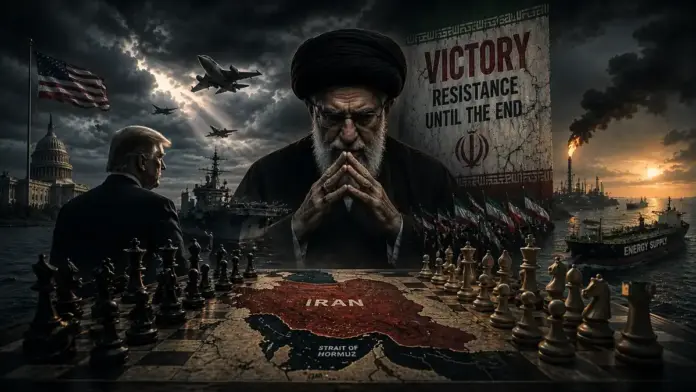
The regime does not speak like a power that wants peace, but like a power that wants victory — even when it is losing
This is the first truth of the moment
The clearest way to begin is also the hardest for propaganda to survive: the regime in Tehran does not speak like a power that wants peace. It does not sound like a government preparing real de-escalation. It does not sound like a system trying to cool the region, calm the rhetoric, and stabilize the next phase. It sounds like a regime trying to sell victory, preserve its internal narrative, and carry the crisis into its next stage on its own terms. That matters because if the starting point is wrong, the entire analysis collapses with it.
The two-week pause is real, but it is not the same thing as peace. Reuters reported that President Donald Trump said U.S. military forces, ships, aircraft, and personnel with extra weapons and ammunition would remain around Iran until Tehran complies with the agreement, while also warning that the pressure could return if it does not. That is not the language of closure. It is the language of conditional suspension under pressure.
The pause exists, but peace does not
The public temptation in moments like this is always the same: take a temporary pause and inflate it into reconciliation. That is exactly the mistake readers should avoid now.
A real peace process requires at least three things: stable terms, a visible will to de-escalate, and some return to normal behavior in the strategic spaces where the conflict was actually fought. None of those conditions exists in full here.
Washington is still speaking in the language of compliance and force posture. Tehran is still speaking in the language of conditions, leverage, and triumph. Hormuz is still constrained. The region is still unstable. The crisis has not ended. It has changed shape.
That is why the strongest and most accurate sentence remains this: the regime does not speak like a power that wants peace, but like a power that wants victory — even when it is losing.
“Victory” is everywhere. That is exactly the problem.
One of the most revealing features of the current phase is the regime’s victory narrative. Tehran’s machine is trying to present the pause as proof of strength, endurance, and even strategic success. That is politically useful for a regime under pressure. It is not the same thing as proof.
Reuters’ broader reporting describes Iran as bruised while still retaining leverage through the Strait of Hormuz, not as a clean strategic winner that imposed a new balance on the United States. That difference is everything. A regime that must turn a fragile pause into a loud public triumph is not necessarily displaying confidence. It may be displaying need.
That is why the propaganda has to work so hard. In authoritarian systems, survival is often sold as triumph. A tactical escape from the immediate worst outcome can be repackaged as proof that the enemy blinked first. The louder the narrative becomes, the more carefully it should be tested against the actual structure of events.
The leader is absent. The slogans are not.
This is where the regime’s narrative begins to look thinner than it sounds.
If the victory is truly historic, where is the leader to embody it clearly and publicly? Why does the noise feel more visible than the authority behind it? Why do the slogans appear stronger than the image of leadership itself? Those are not theatrical questions. They are analytical ones.
There has already been credible international reporting pointing to uncertainty around the public visibility and authority structure at the top. That does not automatically prove internal collapse. It does, however, show why propaganda becomes so necessary. When a regime needs to project certainty more loudly than it can naturally display it, something is already under stress. The message keeps speaking because the system cannot afford silence.
And that leads to the sharpest line in the article: when “victory” is everywhere but the leader is absent, the regime is not proving peace. It is trying to preserve its story.
The U.S. military did not withdraw from the field
This is the second major pillar of the analysis.
The current U.S. posture does not support Tehran’s narrative of triumph. It does not look like retreat, resignation, or strategic surrender. Reuters reported that Trump said U.S. forces would remain around Iran until compliance is achieved, and that he threatened fresh action if Tehran fails to follow the deal. That is not a government behaving as though the crisis is over. It is a government using time as an instrument of leverage.
That distinction matters because the military dimension tells readers more than the slogans do. A superpower that freezes the fire but keeps the force in place is not sending a peace signal alone. It is sending a warning wrapped in a pause. Washington is not acting like a side that has left the field. It is acting like a side that believes it still holds the larger strategic geometry.
This article therefore connects naturally with Newsio’s earlier English reporting, including Trump did not buy peace — he bought time from a position of strength, Trump–Iran: The 10–15 Day Window and Strike Claims Explained, and The U.S. strategy toward Iran: the pressure points that could shape the next phase. The same pattern runs through all of them: time here is not empty. It is strategic time.
Hormuz remains the real test of reality
If there is one place where truth becomes harder to fake, it is the Strait of Hormuz.
Reuters reported that only 15 ships had passed through the strait since the ceasefire, compared with a pre-conflict average of about 138. That is not a return to normality. It is a controlled, restricted, politically charged corridor operating far below normal levels. A regime cannot seriously sell peace while the central maritime artery of the crisis remains so constrained.
The toll issue makes the contradiction even more visible. Reuters reported that the International Maritime Organization said any toll on using Hormuz would be a “dangerous precedent,” stressing that international law protects transit passage through international straits. That means the crisis has not moved into a relaxed diplomatic phase. It remains tied to one of the world’s most important energy chokepoints.
This is exactly why the strongest external authority link in this article belongs here: the International Energy Agency’s analysis of the Middle East and global energy markets helps explain why disruption in Hormuz affects global shipping, energy security, and the broader world economy. It also fits naturally into Newsio’s English internal coverage, especially Strikes on energy infrastructure and a ship hit in the Strait of Hormuz and Fuel Prices Surge: How wars move oil markets and what the public should actually watch. One crisis. Several angles. One coherent explanation.
The regime is not the people of Iran
This distinction must stay absolutely clear.
The people of Iran are not the same thing as the regime that rules them. They are not the propaganda machine. They are not the controlled slogans. They are not the state narrative being projected through loyalist channels. A serious article cannot collapse an entire population into the political interests of the system controlling it.
That matters even more because the visible U.S. posture, as reported publicly, is framed around compliance, maritime access, pressure, and strategic behavior. It is not publicly framed as a war against the Iranian people as such. That distinction is not softness. It is precision.
For Newsio readers who want that moral line kept sharp, this piece also belongs alongside The Regime in Tehran, the Billions It Reached, and the People It Never Chose to Build and Iran: no new mass uprising confirmed this week. One explains the structure of the regime. The other helps clarify how internal political reality can be distorted under pressure.
Free communication is part of the deeper truth
There is another reason the regime’s rhetoric should be treated with suspicion: truth does not circulate freely under systems like this.
In freer societies, communication is close to ordinary life. A phone. A signal. A message. A photograph. A disagreement. A correction. The ability to receive information and send it back into the world. Under authoritarian conditions, that becomes political territory. The regime’s ability to flood the public with triumphal imagery depends on its broader power to shape visibility, suppress contradiction, and dominate the flow of reality.
That is one reason the current victory narrative should be read so carefully. It does not emerge inside a fully free public square. It emerges inside a political environment where power has strong incentives to decide what the public sees first, how it sees it, and what emotional meaning it attaches to it.
So this article is not only about geopolitics. It is also about communication as a form of freedom. A system that fears open information does not celebrate truth. It manages perception.
What is really at stake now
Three things remain at stake at the same time.
First, Washington wants to know whether military and coercive leverage can produce a clearer political result. The pause only benefits the White House if it yields something tangible: freer passage, clearer compliance, or stronger evidence that pressure worked.
Second, the credibility of U.S. power is on the line. This is not just about one bilateral confrontation. It is about whether a superpower that claims to defend maritime order can actually restore confidence in one of the world’s most important shipping corridors. Reuters reported that Trump was pressing for commitments on Hormuz and arguing that the strait would be reopened. That shows how large the issue has become.
Third, the global economy remains exposed. The pause may have reduced immediate panic, but it did not restore normal conditions. Hormuz remains constrained. Shipping remains abnormal. Energy sensitivity remains high. The system has taken a breath, not found safety.
The conclusion the public should remember
The regime in Tehran does not speak like a power that wants peace. It speaks like a power that wants victory, even when the structure of reality around it is more fragile than the slogans it produces.
That is the real shape of this moment:
The pause exists.
The pressure remains.
The military stays.
Hormuz is still constrained.
The leader is harder to see than the slogans.
And the propaganda is trying to run faster than reality.
That is why the strongest conclusion is also the simplest:
The regime does not speak like a power that wants peace, but like a power that wants victory — even when it is losing.