

Table of Contents
The Network of Violence Behind the Regime in Tehran: Which Armed Groups It Founded, Backed, or Funded — and Why the Region Does Not Feel Safe
This is not about the people of Iran. It is about the regime that rules over them and hides behind them.
Any serious analysis has to begin with a basic distinction: the people of Iran are not the same thing as the regime ruling from Tehran. Reuters has reported that the ruling system fears internal unrest, has escalated repression, and has responded to pressure with arrests, harsher penalties, and a wider domestic crackdown.
That matters because the same power structure that suppresses its own people is the one that spent decades building external leverage through armed proxies across the region.
That distinction is not cosmetic. It is the moral and analytical foundation of the article. The regime in Tehran has repeatedly tried to present pressure on itself as pressure on the Iranian people, but the people of Iran are often among its first victims.
The more accurate question is not whether “Iran” created instability. It is how the regime in Tehran turned ideology, money, the Islamic Revolutionary Guard Corps, and the Quds Force into a regional network of coercion that keeps multiple fronts permanently volatile.
For readers following the wider Newsio line in English, this article naturally connects with Iran: What the targeted killings of Ali Larijani and Gholamreza Soleimani really mean — and why the crisis has entered a more dangerous phase and Iran and Lebanon Enter a More Dangerous Phase: Pressure in the Gulf, Political Strain Around Hezbollah, because the proxy question only makes sense inside that broader regional framework.
The first fact-check correction matters: not every armed group was literally founded by Tehran.
If the article is going to be strong, it also has to be precise. It is not accurate to say that every armed group tied to Tehran was directly created by Tehran. The more defensible and more serious conclusion is that some organizations were indeed founded with direct Iranian involvement, while others were pre-existing movements that were later funded, armed, trained, and integrated into the wider “axis of resistance” promoted by the regime. That correction does not weaken the argument. It makes it harder to attack.
So the real conclusion is not “Tehran founded everything.” It is that the regime in Tehran built and sustained a regional architecture of proxy warfare — one made up of groups with different origins but increasingly aligned with its strategic goals.
That architecture gives the regime options: deniability, pressure without full direct exposure, and the ability to export insecurity well beyond its own borders. Reuters’ broader investigative reporting on Iraqi militias makes this pattern especially clear.
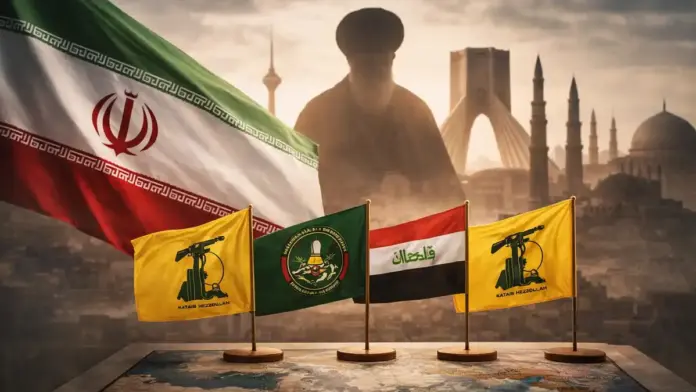
Hezbollah is the clearest case of a group founded by the Revolutionary Guards.
Hezbollah in Lebanon is the most direct and most documented example. Reuters has reported that Iran’s Revolutionary Guards founded Hezbollah in 1982, in the context of the Lebanese civil war and Israel’s invasion of Lebanon, as part of Tehran’s effort to export the Islamic Revolution and build an armed ally on Israel’s northern front. Reuters has also repeatedly described Hezbollah as Iran’s long-time ally and proxy, and noted Tehran’s continuing role in supplying the group with money, weapons, and support.
That makes Hezbollah much more than a local Lebanese actor. It became the prototype of the regime in Tehran’s regional model: an organization that combines armed force, political leverage, ideological discipline, and long-term strategic value for Tehran. It is not just one proxy among many. It is the most mature and successful external instrument of the regime’s power projection.
Palestinian Islamic Jihad was not founded by Tehran, but it has long depended on Tehran’s backing.
Palestinian Islamic Jihad is a different kind of case. Reuters has described it as an Iranian-backed militant group based in Gaza, and in multiple reports has referred to it as one of the armed organizations receiving support from Tehran. That matters because it shows how the regime in Tehran operates even when it did not create a movement from the ground up: it can still make that movement part of its wider leverage system through funding, weapons, and political backing.
That distinction is important for credibility. Tehran did not need to invent every group in order to use it. Its strategy was often to identify existing actors that could serve a broader anti-Israel, anti-U.S., and anti-Western pressure architecture. Palestinian Islamic Jihad fits that pattern very clearly.
Hamas is not a creation of Tehran, but it has received long-term support from Tehran.
Hamas is also not a group founded by Tehran. But Reuters has reported that Hamas openly acknowledged that Tehran has paid a price for its long-term support of armed groups in Gaza, and Hamas leaders have publicly thanked Iran for military and financial backing. That does not turn Hamas into a simple Iranian puppet. It does, however, place Hamas firmly inside a wider strategic ecosystem that the regime in Tehran has helped sustain.
That relationship matters because the regime in Tehran does not need full organizational ownership to gain strategic benefit. Long-term support, weapons flows, coordination, and shared political positioning can be enough to turn separate movements into pieces of a larger destabilizing system. In practical regional terms, that still means the regime in Tehran is helping keep multiple fronts open.
The Houthis are one of the clearest examples of a local movement transformed into a regional lever.
The Houthis in Yemen are another major case. Reuters has described them as aligned with Iran and has repeatedly reported on their willingness to escalate in coordination with wider regional conflict involving Iran and its allies. Their attacks on shipping in the Red Sea and their ability to threaten international routes show how a local armed movement can become a global pressure point once it is connected to Tehran’s broader strategy.
That is what makes the Houthi case so important. Even where the regime in Tehran did not literally create a movement, it helped turn that movement into a tool with regional and international consequences. The result is not only a Yemeni issue. It becomes a shipping issue, an energy issue, a Gulf security issue, and a global economic risk.
Iraq is where the regime’s proxy architecture becomes fully visible.
Nowhere is Tehran’s wider method easier to see than in Iraq. Reuters’ investigative reporting has described how Iran spent years fostering proxy and allied militias in Iraq, creating a broad armed ecosystem that includes groups such as Kataib Hezbollah, Asaib Ahl al-Haq, Harakat Hezbollah al-Nujaba, and the Badr Organization. This is not a fringe detail. It is central to understanding how the regime in Tehran built strategic depth outside its own territory.
Kataib Hezbollah is one of the clearest examples. It is widely described in Reuters reporting as an Iran-backed Iraqi militia and was designated by the United States as a foreign terrorist organization years ago. Asaib Ahl al-Haq has likewise been described in Reuters reporting as heavily financed and trained by Iran’s Quds Force. These groups are not random militias floating in the region. They are part of a system the regime in Tehran cultivated over time.
Harakat Hezbollah al-Nujaba and Badr fit the same broader pattern. One is commonly described in Reuters coverage as a radical militia aligned with Iran, while Badr is one of the oldest and most politically embedded Iran-linked armed forces in Iraq. Together, these groups demonstrate that Tehran’s regional influence was never built through one organization alone. It was built through layers of armed networks, some ideological, some opportunistic, but all useful to the regime’s survival and leverage.
This is why neighbors do not feel safe: proxies are not a side effect of the regime’s strategy. They are the strategy.
The deeper problem for neighboring states is not only that there are armed groups with ties to Tehran. It is that the regime made those ties part of its permanent operating model. Reuters has reported that Gulf states are no longer satisfied with temporary de-escalation and want Iran’s missile, drone, and proxy capacity degraded because they see those capabilities as a standing threat to their energy infrastructure, their civilian systems, and the wider regional order.
That is the real security picture. The regime in Tehran can pressure adversaries without always stepping into the foreground first. It can create instability, stretch fronts, threaten trade routes, and raise the cost of any confrontation far beyond its own territory. That is why insecurity across the Middle East is not an emotional overreaction. It is a rational response to a system that was built to make instability useful.
For a strong external authority link inside the article, the best anchor is Reuters’ Iraq investigation — Iran spent years fostering proxies in Iraq. Now, many aren’t eager to join the war — because it connects the money, the militia system, and the strategic logic in one place.
What readers should keep
First, it is not accurate to say that every armed group in the region was literally founded by Tehran. It is accurate to say that the regime in Tehran founded some, most notably Hezbollah, and funded, armed, trained, or politically sustained many others, including Palestinian Islamic Jihad, Hamas, the Houthis, and multiple Iraqi militias.
Second, this is not a loose collection of isolated relationships. It is a proxy architecture that gives the regime in Tehran reach, deniability, and the power to export insecurity across multiple fronts at once.
Third, the people of Iran should not be confused with that strategy. The regime that built these networks is the same regime Reuters and others have described as fearing its own public, expanding internal repression, and tightening coercion at home.
Fourth, the region does not feel unsafe by accident. It feels unsafe because the regime in Tehran turned armed proxies into a long-term instrument of survival, influence, and pressure.