

Table of Contents
Did the Regime in Tehran Really Shoot Down a U.S. Warplane? What Is Confirmed, What Remains a Claim, and Why the Development Changes the War
This is no longer just wartime noise. It is a confirmed American aircraft loss.
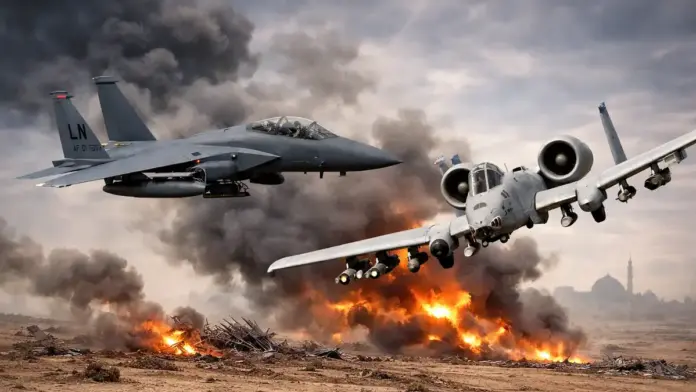
For days, the regime in Tehran pushed out triumphant claims about downing U.S. aircraft, and at first those claims sat inside the usual gray zone of war: state media messaging, dramatic headlines, incomplete evidence, and a clear need for verification. That phase has now changed. Reuters reported that a U.S. F-15E Strike Eagle was shot down over Iran, with one crew member rescued and another still missing. The Associated Press went further in framing the significance, calling the loss of U.S. military aircraft by enemy fire the first such event in more than 20 years.
That means the question is no longer whether the regime in Tehran merely claimed to have done something. The harder question now is what exactly has been confirmed, what still remains propaganda or inference, and what this incident reveals about the real state of the war. For readers who want a clean internal baseline on how escalation claims evolve before facts lock into place, Newsio’s Trump–Iran: The 10–15 Day Window, Strike Claims, and What We Actually Know fits naturally here because it shows how wartime timelines and public claims often outrun verification before the picture sharpens.
The highest-confidence fact is the F-15E downing.
The strongest verified core of the story is the F-15E Strike Eagle. Reuters reported that the aircraft was brought down over Iran, that one of the two crew members was rescued, and that a search-and-rescue operation began for the second crew member behind enemy lines. Reuters also reported that aircraft involved in the rescue effort came under fire, while the regime circulated images of wreckage and encouraged civilians to help locate the missing American.
That alone is a major development. In modern air warfare, the loss of a fighter is never just a technical incident. It becomes political cost, operational strain, rescue risk, and symbolic damage to the image of control. Once the United States is forced to send rescue assets back over hostile territory to recover or search for crew, the public narrative of effortless air dominance becomes harder to sustain. For the broader political logic behind how the regime in Tehran converts survival into threat projection, Newsio’s When the Regime in Tehran Fears Collapse is the natural internal companion.
The regime is already selling a “new air defense system” story. That part still requires caution.
The next layer of the story is where analysis has to stay disciplined. Reuters also reported that the regime in Tehran said it had used a new air defense system to target the American fighter, through a statement attributed to Khatam al-Anbiya. But the same Reuters report made something very important clear: no details were provided showing how effective the system was or whether that specific system definitively caused the downing. In other words, the existence of the aircraft loss and the regime’s explanation for how it happened are not the same kind of fact.
That distinction matters because war propaganda often works by attaching an inflated explanatory narrative to a real event. The real event gives credibility to the rest of the story, even when the rest has not yet been independently established. Here, the careful line is simple: the F-15E loss appears confirmed; the “new system” explanation remains a claim by the regime, not a fully verified technical conclusion. That is exactly the kind of separation serious readers need to keep in mind in any live conflict. Newsio’s Dubai: Reports of Explosions Amid Gulf Alert — What’s Confirmed and What Isn’t speaks to the same discipline from a different angle.
There were broader and louder claims, but not all of them survived scrutiny.
This is another place where precision matters. Once the regime in Tehran had a real tactical success to point to, it had every reason to amplify, embellish, and expand the story. That is how wartime messaging works. Early claims and online chatter pointed to even more dramatic scenarios, but the later international reporting narrowed the picture around the F-15E and a separate A-10-related loss rather than validating every earlier headline. The Guardian noted that earlier claims about an F-35 did not hold up once the wreckage and aircraft type were assessed more carefully, while the aircraft most solidly identified was the F-15E.
This is a useful lesson in itself. A regime that gains one real success will often try to convert it into a larger myth of reversal, technological surprise, or strategic breakthrough. That does not mean every associated claim should be accepted. In serious war coverage, the fact that one part of a story turns out to be true does not automatically validate the rest of the regime’s narrative package. That is exactly why fact-checked war reporting must move more slowly than triumphalist state media.
The A-10 matters too, because it suggests this is not just one isolated air loss.
The Associated Press did not stop with the F-15E. It also reported the loss of an A-10, placing both aircraft in the context of the first U.S. military planes downed by enemy fire in more than two decades. That does not automatically mean the two events were identical in mechanism or significance, but it does matter because it widens the picture beyond one aircraft and one dramatic rescue operation. It suggests that the United States is operating in an air environment where losses are no longer theoretical.
That does not erase the enormous overall U.S. military advantage. It does, however, undermine any easy suggestion that the skies over this war are fully sanitized or cost-free for Washington. Even a militarily dominant power can be strategically embarrassed if it is visibly taking losses in a campaign publicly framed as controlled, overwhelming, and technologically superior.
For the wider operational and market implications of a war that is no longer neatly contained, Newsio’s Strait of Hormuz: Energy Infrastructure Strikes and a Ship Hit is an important internal read because it shows how military escalation quickly spreads into the economic bloodstream of the region.
The biggest shift is psychological and political: the image of total U.S. air safety has been cracked.
The most important part of this story may not be the metal that fell, but the image that broke with it. For weeks, the dominant public narrative suggested near-total U.S. air control over the conflict. That broader military edge still exists. But once an F-15E is downed over hostile territory, one crew member is missing, and rescue aircraft come under fire, the phrase “air superiority” starts sounding less absolute in public ears. Reuters’ reporting makes exactly that point by emphasizing the danger and difficulty of the rescue operation.
This matters for two different audiences. In Washington, it complicates the political story that a high-intensity campaign can be run with minimal visible cost. For the regime in Tehran, it offers a rare and valuable piece of wartime symbolism: proof that it can still impose pain, still challenge the sky, and still disrupt the image of invulnerability surrounding its adversary. That does not amount to strategic equality. But in war, proving you can impose cost is often enough to reshape the tone of the conflict. For the wider war-and-economy connection, Newsio’s Fuel Prices Surge: How Wars Move Oil Markets and What the Data Say is the relevant internal bridge.
The regime will now try to turn one air loss into a larger political weapon.
It is almost certain that the regime in Tehran will try to use this incident for more than military morale. Internally, it will present the downing as proof that it has not been broken and that its defensive capacity still survives under pressure. Regionally, it will send a message to Gulf states, Israel, the United States, and its own proxy ecosystem that it remains dangerous enough to demand caution. Reuters’ reporting on the “new air defense system” claim already shows the start of that messaging strategy.
This is why readers should not look at the event only as a battlefield incident. It is also a political instrument. The regime in Tehran is not merely trying to win an argument about one aircraft. It is trying to prove that even after repeated strikes and sustained pressure, it can still reach upward, impose losses, and force the other side to react. That is a survival message as much as a military one. Newsio’s The Regime in Tehran, the Billions It Reached, and the People It Never Chose to Build helps frame the deeper pattern: power structures under pressure often turn every tactical gain into a broader instrument of internal and external control.
This does not reverse the war by itself. But it changes how the war has to be read.
It would be an exaggeration to say one downed F-15E changes the whole strategic balance. It does not. The United States still holds overwhelming overall military advantages. But it would be just as wrong to minimize the incident as if it were a mere side note. The downing shows that the regime in Tehran retains enough residual capability to impose real military and political costs, even after absorbing major blows. That matters in war far beyond the tactical scorecard.
The correct reading sits between propaganda and dismissal. The regime in Tehran has not suddenly won the air war. But it has demonstrated that the air war is not costless for the United States. That is a much harder and more important truth than either side’s easy slogans. For the strongest external authority baseline on how these military developments flow directly into wider economic and strategic pressure, Reuters’ energy coverage remains the most valuable ongoing reference.
What readers should keep
First, this is no longer just a claim by the regime in Tehran. Reuters has reported that a U.S. F-15E was shot down over Iran, with one crew member rescued and another missing.
Second, the Associated Press also reported an A-10-related loss, placing both aircraft in the context of the first U.S. combat aircraft downed by enemy fire in more than 20 years.
Third, the regime’s claim that a new air defense system caused the downing remains a regime claim, not a fully verified technical conclusion.
Fourth, the strategic meaning is not that the regime in Tehran has reversed the war, but that it has cracked the image of risk-free U.S. air dominance and proved it can still impose serious cost.