

Table of Contents
When a Sermon Speaks of Jihad, Caliphate, and an Islamic Europe, the West Should Listen Carefully
Europe makes two serious mistakes when it faces hard truths about extremist rhetoric. The first is denial. The second is indiscriminate blame. Both distort reality. Both make serious analysis harder. And both prevent societies from seeing the actual issue in front of them.
The issue is not religion in the abstract. It is not the private faith of millions of ordinary Muslims. It is not peaceful worship, lawful religious expression, or the right of communities to live openly and freely under democratic law. The issue begins when a speaker stops talking about coexistence and starts talking about dominance.
That is exactly what makes the sermon examined here so important.
Based on the Arabic transcript, the speaker is not calling for equal participation within a pluralist society. He is not speaking about mutual respect, legal equality, or peaceful civic life within Europe. He speaks instead about bringing Islam to the peoples of the West “through jihad for the sake of Allah,” about a coming caliphate, and about a future in which not only France, but all of Europe and ultimately the world, will live under “the justice and mercy of Islam.” That language is not neutral. It is not merely devotional. It is ideological, political, and expansive.
This is not a demographic argument. It is a power argument.
One of the most revealing parts of the sermon is that the speaker explicitly moves beyond demographics. He does not simply say that Muslim populations in Europe may grow over time. He says that demographic change is not the main basis for the transformation he envisions. What matters, he says, is the existence of a state that will carry Islam to the peoples of the West through jihad.
That point matters enormously.
If a speaker were only making an observation about population trends, the discussion would be different. But this is not passive demographic speculation. It is an active political vision. It is the language of mission, expansion, and eventual supremacy. The speaker is not describing a multicultural future in which different communities share the same civic framework. He is describing a reordered future in which Europe is brought under a different civilizational authority.
That is why the sermon should be taken seriously. Not because it proves that every Muslim shares the same ambition. It does not. But because it reveals, in unusually direct language, how a certain current of Islamist thought understands Europe, power, and history.
The reference to a coming caliphate removes any doubt about the political horizon
The sermon becomes even clearer when the speaker invokes “the coming state of the caliphate.” That phrase is not a poetic flourish. It is not a vague spiritual symbol. It is a historically loaded political concept tied to the idea of unified Islamic rule.
Once that reference is placed alongside repeated mentions of jihad, the West, and a future Islamic Europe, the structure of the worldview becomes unmistakable. This is not the vocabulary of coexistence. It is the vocabulary of authority.
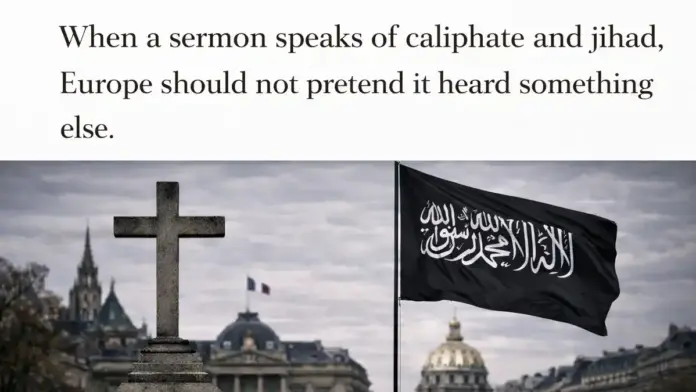
Europe should not pretend otherwise.
A society that hears talk of caliphate, ideological conquest, and civilizational submission, then rebrands it as “just another form of religious expression,” is not showing tolerance. It is showing confusion. Liberal democracy has a duty to protect freedom of religion. It does not have a duty to be naive about political movements that use religion as a vehicle for future domination. The legal framework for freedom of religion in liberal democracies protects belief and public manifestation of belief, but it does not erase the need to recognize when rhetoric moves from faith into power politics. That distinction remains essential in open societies.
The real problem is not Islam as a faith. It is Islamist expansionism as a project.
This distinction matters because intellectual laziness destroys serious debate. Collective blame is easy. It is also false. Not every Muslim thinks in these terms. Not every believer identifies with caliphal rhetoric. Not every mosque, imam, or religious community is part of an expansionist worldview.
But it is equally false to act as though no such worldview exists.
The serious position is to separate religion from Islamist expansionism, personal faith from political theology, religious liberty from ideological conquest. That is exactly what many European debates fail to do. One side refuses to confront explicit statements of supremacy and treats every warning as hysteria. The other side collapses all Muslims into the same category and calls that realism. Neither side is thinking clearly.
What the sermon shows is narrower and more precise, but still deeply important: there are preachers and ideological circles that do not view Europe as a place for pluralistic coexistence. They view it as territory to be transformed.
That is not a theory imposed from outside the text. It is the implication of the text itself.
Europe’s democratic error is often not intolerance, but misrecognition
Modern Europe has invested enormous moral energy in building societies that reject religious persecution. That is a civilizational achievement worth defending. But tolerance becomes self-defeating when it loses the ability to distinguish between protected belief and anti-pluralist ambition.
This matters even more because Europe is already struggling with questions of religious hatred, identity conflict, social fragmentation, and mutual distrust. Anti-Christian incidents are real and documented across the OSCE region, just as anti-Muslim hatred is also real and documented by European institutions. Serious analysis requires enough maturity to say both things at once. It requires rejecting both denial and collective demonization.
That same maturity should apply here. A sermon like this should not be used to smear every Muslim community in Europe. But it also should not be buried under euphemism. It should be named accurately for what it is: a form of Islamist rhetoric that envisions not coexistence within the West, but eventual rule over it.
That is a legitimate public concern. In fact, it would be irresponsible to pretend otherwise.
Why accuracy matters more than panic
In an era of manipulated clips, selective edits, and viral outrage, the only sustainable response is disciplined accuracy. It is not enough to be alarmed. It is not enough to be angry. The public has to know what was actually said, in what language, in what context, and with what ideological meaning.
That is why careful translation and verification matter. The public space is already flooded with misinformation, sensational framing, and bad-faith amplification. Reuters, for example, has shown in fact-checking work how easily emotionally charged narratives around religion and Europe can be exaggerated or misrepresented online. That is precisely why the answer to extremist rhetoric must be clarity rather than panic.
This is also where prior Newsio reporting becomes relevant. Newsio’s analysis on who really governs in Iran explored how opacity, ideological power, and public confusion create fertile ground for manipulation and misreading. Its fact-check on deepfakes and false assassination claims made a related point from a different angle: when the material is explosive, precision matters more, not less.
That same standard should apply here. The sermon is serious enough without embellishment. It does not need distortion in order to be troubling.
The West should hear the difference between coexistence and submission
A pluralist democracy can absorb disagreement. It can absorb conservatism. It can absorb theological confidence. It can even absorb harsh criticism of secular modernity. What it cannot safely ignore is a political-religious rhetoric that openly frames Europe as a civilizational object to be brought under a rival sovereignty.
That is the difference between coexistence and submission.
The speaker in this sermon does not say: let us live freely among others. He does not say: let us respect the law where we reside. He does not say: let us preserve our identity while sharing a common civic order. He says something closer to the opposite. He speaks of jihad, a coming caliphate, and a future in which Europe is brought under Islamic justice and mercy.
A democratic society should not need help recognizing the significance of that shift.
The deeper challenge is moral and civilizational, not only security-related
There is a temptation to reduce everything to security. That is understandable, but incomplete. The deeper challenge is civilizational confidence. Does Europe still believe strongly enough in pluralism, liberty, reciprocity, and constitutional order to defend them when they are challenged by explicitly anti-pluralist visions? Does it still have the conceptual confidence to distinguish tolerance from surrender? Can it defend freedom without dissolving into either fear or denial?
Those are harder questions than the usual arguments on social media. But they are the real questions.
Because the ultimate issue raised by this sermon is not whether every Muslim thinks this way. Clearly, not every Muslim does. The issue is whether free societies still know how to identify and confront a worldview that does not seek equal standing within democratic life, but historical superiority over it.
That is the question Europe cannot afford to evade forever.
Conclusion
This sermon matters not because it proves everything, but because it reveals something many institutions and publics still hesitate to say clearly: a portion of Islamist rhetoric is not oriented toward peaceful coexistence inside the West. It is oriented toward expansion, supremacy, and eventual political transformation.
That fact does not justify hatred. It does not justify collective guilt. It does not justify paranoia.
But it does justify vigilance, seriousness, and clarity.
Peaceful coexistence only works when coexistence is genuinely the goal. When a speaker openly declares a horizon of jihad, caliphate, and an Islamic Europe, a democratic society should not answer with hysteria. But it should not answer with self-deception either.
It should answer with the one thing free societies cannot survive without: moral clarity.
For broader context on the European debate over religious freedom, targeted religious hostility, and the need for fact-based analysis, see the OSCE material on anti-Christian hate crime, the European Commission’s work on anti-Muslim hatred, and Newsio’s related reporting on political opacity in Iran and deepfakes in high-tension information environments.