

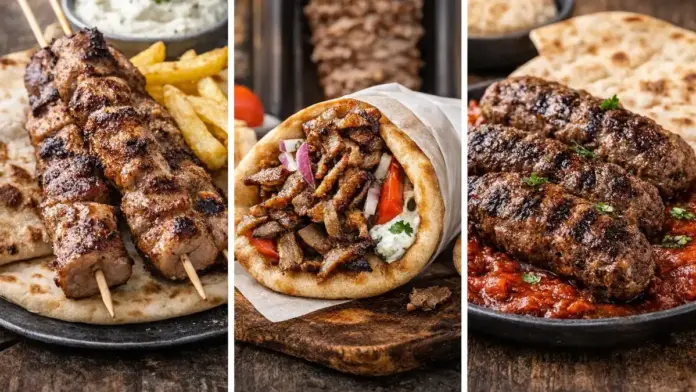
Souvlaki, Kalamaki, or Gyros?
The simple truth people in Athens, Thessaloniki, and anyone coming to Greece should know
There are topics that seem small, but really are not small at all. Whether people in Athens say kalamaki and people in Thessaloniki say souvlaki sounds like a cute local difference. In practice, though, it has been causing confusion for decades. It confuses Greeks traveling from one city to another. It confuses tourists. It confuses foreigners visiting Greece. And in the end, it even confuses the country’s own explanation of its most famous street food.
So if this is ever going to be settled in a clear and useful way, it has to be said simply.
The food does not change as much as the words do.
That is the first and most important thing anyone reading this should keep in mind. We are not talking about several identical things with random names. We are talking about different foods, different cooking methods, and then, on top of that, different local naming habits. That is where all the confusion begins.
If we want to solve it properly, we have to start with the basics.
Readers who enjoy clear, practical breakdowns like this can also explore more stories in Newsio’s EN Explainers section, where everyday questions are unpacked in a simple and useful way.
🎧 Watch or listen to the analysis in video format
What souvlaki is
Souvlaki is small pieces of meat placed on a small spit or skewer and grilled over fire or on a grill. That is the core meaning. Not automatically a wrap. Not generally “whatever I get from a Greek grill shop.” Not the whole category of Greek street food. The basic, literal meaning is this: meat on a skewer.
That is why the word souvlaki makes sense. It comes from the idea of the spit itself. So the name describes the food clearly.
That is why the word souvlaki makes sense. It comes from the idea of the spit itself, and standard reference material on Greek souvlaki reflects that basic meaning.
This is the first principle that should stay in people’s minds:
souvlaki = meat on a skewer
What kalamaki is
Kalamaki is not a different food. It is not a different recipe. It is not another cooking style. It is the word that became common mainly in Athens and southern Greece for the exact same thing: souvlaki on a skewer.
In other words:
In Athens, kalamaki = what people in Thessaloniki usually call souvlaki.
So the basic truth is very simple:
kalamaki is not a different food from souvlaki.
It is the same thing, with an Athenian local name.
That means Athenians are not “speaking Greek wrong.” But it also means Thessalonians are not “speaking Greek wrong.” Each side is using real, living Greek through its own local habit.
And that is the whole secret.
The local word changes.
The food itself does not.
What gyros is
This is where the second major confusion begins, because many people think souvlaki and gyros are just two versions of the same thing. They are not.
Gyros is something different. It is meat cooked on a vertical rotisserie, turning continuously, and shaved off in thin slices from the outside.
So:
souvlaki = pieces of meat on a skewer
gyros = sliced meat from a vertical rotisserie
That difference is essential. It is not regional. It is about the food itself.
Wherever you are in Greece, if you say gyros, you are talking about something different from souvlaki on a skewer.
This is the second truth people need to understand clearly:
gyros is not souvlaki, and souvlaki is not gyros.
What soutzoukaki is
And because Greek food terminology gets even more confusing if nobody explains it clearly, soutzoukaki also needs to be put in its place.
Soutzoukaki is neither souvlaki nor gyros. It is a completely different food. It is a ground-meat preparation, usually elongated or oval-shaped, seasoned with spices, and historically linked to the Smyrna-style tradition.
So if we say it with absolute clarity:
souvlaki = pieces of meat on a skewer
gyros = slices from a vertical rotisserie
soutzoukaki = spiced ground meat, a different food
Once these three things are clearly separated in people’s minds, half the confusion is already gone.
Why Athens says “kalamaki”
The explanation is not as mysterious as people think. Athens did not wake up one day and randomly decide to rename the food. Over time, the word souvlaki in Athens started being used more broadly. It could refer not only to the skewer itself, but to the whole category of grilled fast food: the shop, the wrap, the general meal.
At that point, a more specific word was needed to describe the plain meat on a stick. That is where kalamaki took root.
So the word connected to the stick itself became the everyday word for the food on the stick.
That is not irrational.
It is local linguistic economy.
But it is not a nationwide rule.
Small differences like this reveal how language, food, and local identity evolve together — something that often appears in Newsio’s Greece coverage as well.
Why Thessaloniki says “souvlaki”
Because in Thessaloniki, the word stayed closer to its literal meaning. Souvlaki is what is on the spit. Simple as that.
Meanwhile, kalamaki remained closer to its ordinary everyday meaning: a straw.
That is why if an Athenian goes to Thessaloniki and says, “I want two kalamakia,” there is a good chance people will pause or ask for clarification.
Nobody is wrong.
Each city simply kept a different linguistic habit.
Where the real confusion begins
The biggest problem is not just Athens versus Thessaloniki. The real problem is that Greece has never clearly taught even its own people — let alone foreign visitors — the basic vocabulary of its own street food.
So we end up with four layers of confusion:
-
One person says souvlaki and means meat on a skewer.
-
Another says souvlaki and means the whole category of Greek grilled street food.
-
A third says kalamaki and someone else thinks they mean a straw.
-
A foreign visitor hears souvlaki, gyros, kalamaki, pita, wrap and assumes all of them are different foods.
That is exactly why this needs a proper explanation.
Not so one city can “win.”
But so people can stop misunderstanding each other.
The simple guide for ordering correctly
If you are in Athens:
-
Ask for kalamaki if you want meat on a skewer.
-
Ask for gyros if you want shaved meat from a vertical rotisserie.
-
Ask for a wrap, or say exactly “pita with gyros” or “pita with kalamaki,” if that is what you want.
If you are in Thessaloniki:
-
Ask for souvlaki if you want meat on a skewer.
-
Ask for gyros if you want gyros.
-
If you use the word kalamaki for the food, expect confusion.
If you are a foreign visitor and want to be completely safe anywhere in Greece:
-
Say: I want meat on a skewer for souvlaki/kalamaki
-
Say: I want gyros for gyros
-
Say: I want a pita wrap with gyros or with souvlaki for the wrapped version
That is the clean, practical solution.
What people should remember
If this entire discussion should leave readers with five clear truths, they are these:
-
Souvlaki is meat on a skewer.
-
In Athens, that same thing is often called kalamaki.
-
In Thessaloniki, kalamaki usually means a drinking straw, not the food.
-
Gyros is a different food from souvlaki.
-
Soutzoukaki is also a different food.
If those five points become clear in people’s minds, most of the national misunderstanding is over.
The most honest conclusion
Athens does not need to win.
Thessaloniki does not need to win.
What needs to win is clarity.
The mature conclusion is not:
“we say it correctly and they say it wrong.”
The mature conclusion is this:
The real name of the food is souvlaki.
Athens also uses the local word kalamaki.
Thessaloniki keeps the word souvlaki.
Gyros is something different.
Soutzoukaki is something different.
That is not surrender.
That is clear thinking.
And if Greece wants to stop confusing itself over a piece of meat on a stick, this is the simplest, fairest, and most human starting point.
Greek street food is one of the country’s most recognizable everyday experiences, and it continues to evolve in ways that also connect naturally with Newsio’s Lifestyle coverage.
Because at the end of the day, a person standing at a counter does not want to take a language exam.
They want to ask for what they want —
and receive what they actually mean.
That is the whole point.
And in the end, that is enough.