

Table of Contents
Storm ERMINIO in Greece: Where It Hits, When It Peaks, and Why Readiness Matters More Than the Name
ERMINIO is not just a weather shift. It is a readiness test for infrastructure, services, and daily life.
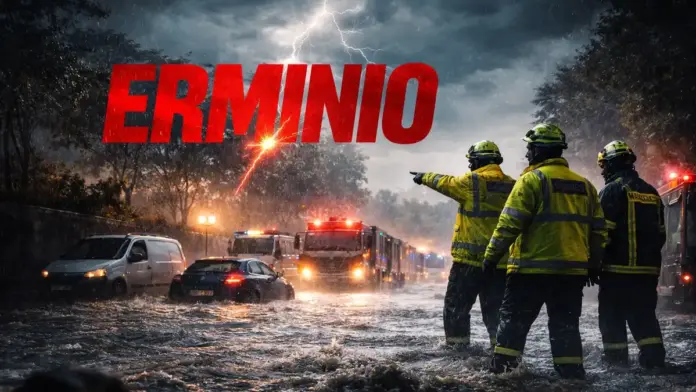
Storm ERMINIO is being treated by Greek authorities as a serious multi-region weather event, not as a routine passing disturbance. Greece’s National Meteorological Service, EMY, issued an emergency bulletin warning that Wednesday, April 1, and Thursday, April 2, 2026 would bring long-duration and high-intensity rain and thunderstorms across large parts of the country, with possible localized hail, gale-force winds, and dense snowfall in mountainous areas. EMY also notes that the system was named by the Italian meteorological service under the Central Mediterranean naming group.
What raises the significance of the event is not only the forecast itself, but the level of warning attached to it. Greece’s Civil Protection authority placed several areas under red alert, the highest warning tier, for parts of Wednesday and Thursday. That means the public conversation should move beyond “bad weather is coming” and toward a more serious question: whether exposed regions are prepared to absorb the pressure on roads, urban drainage, public services, and emergency response.
That is the real frame for this story. The name ERMINIO may dominate headlines, but names do not flood roads, disrupt ferries, overwhelm local response systems, or expose weak points in urban readiness. What matters is the combination of timing, geography, wind strength, rainfall duration, and how quickly official warnings are translated into practical action.
For readers who follow how Newsio handles practical public-risk explainers in English, the internal piece Aegina Declares a State of Emergency After Underwater Pipeline Failure Cuts Drinking Water Supply is relevant because it shows how everyday infrastructure stress in Greece quickly becomes a wider resilience issue when emergency conditions hit.
Where the worst weather is expected on Wednesday
According to Civil Protection’s latest update, the most severe conditions on Wednesday begin in the Ionian Islands from the early morning hours, then intensify across eastern Peloponnese, eastern Central Greece, Evia, Thessaly, and the Sporades from before noon into late night. Attica is also included in the high-risk belt from midday onward. Later in the day, the storm spreads into the northern Cyclades, eastern Aegean islands, Dodecanese, and eastern Crete.
The warning is not only about rainfall. Civil Protection says east-southeast winds of 8 to 9 Beaufort are expected in eastern Greece on Wednesday, reaching 10 Beaufort locally in the Dodecanese. At the same time, heavy snowfall is forecast in the mountains of Epirus and Macedonia. That combination matters because it widens the nature of the disruption: it is not a single-hazard event, but a layered weather system affecting land transport, island connections, and local operating conditions at the same time.
This is one reason the red-alert map matters more than general weather talk. A storm that hits one region can often be managed as a local disruption. A storm with strong impact windows across multiple regions becomes a network problem. Roads, ferries, municipal services, emergency crews, commuting patterns, and school-day routines all come under pressure together.
Thursday is not the end of the story. The system shifts and keeps pressure alive.
On Thursday, the focus shifts rather than disappears. Civil Protection says the most dangerous weather is expected in western and southern Peloponnese, eastern Thessaly, parts of Central Macedonia including Pieria, Imathia, Halkidiki, and Serres, as well as Crete, the eastern Aegean islands, and again the Dodecanese. In other words, the country is not dealing with one dramatic burst followed by a clean exit. It is dealing with a system that moves and sustains pressure across successive zones.
That distinction matters for public behavior. A storm that “moves on” in one city may still be intensifying elsewhere. It also matters for response fatigue. Municipal and regional systems do not have to survive only the worst hour of rain. They have to remain operational across a broader sequence of high-risk windows.
Attica matters because a dense metro area under red alert is never just a weather story
Attica stands out because it combines a red-alert warning with the weaknesses of a large urban region: heavy traffic, dense built-up areas, fast runoff, and the possibility that local flooding and transport disruption can spread faster than people expect. Civil Protection specifically places the strongest Attica window from midday Wednesday until late at night.
That is exactly where severe weather stops being a “forecast item” and becomes a city-function issue. The question is not whether rain is expected. The question is whether the metro area can keep moving without cascading failures in roads, local drainage, emergency access, and routine movement. In major urban regions, rainfall intensity is only part of the risk. The speed with which it collides with infrastructure is the other half.
The real fact-check: the issue is not the storm’s branding, but the official warning level
In weather events like this, public attention often gets trapped in the naming of the system itself. That is the wrong place to focus. The meaningful issue is that official Greek authorities have issued high-level danger bulletins, and those warnings are specific about both time windows and exposed regions. The evidence of seriousness is not the name ERMINIO. It is the fact that EMY and Civil Protection have already defined areas under red alert and described the expected hazards in operational terms.
That means the public question should not be “Will it really be that bad?” in some vague sense. The more useful question is: “What do we do when the official agencies responsible for weather and emergency coordination are already warning of prolonged severe phenomena?” That is where the article earns its value. It should move readers from passive weather consumption to practical seriousness.
For the strongest external authority reference in the article, the best baseline is EMY’s official emergency bulletin from the Hellenic National Meteorological Service, because that is where the state-level forecast framework begins and where any credible summary should ultimately trace back.
Civil Protection will be judged less by statements than by preparation
When a severe weather event is announced in advance, Civil Protection is not judged mainly by what officials say after the fact. It is judged by whether warnings were translated into practical readiness before the worst conditions began. Greece’s Civil Protection authority explicitly called on local and regional authorities in the affected areas to convene operational coordination structures immediately. That is the right signal. The harder question is whether the local system responds with enough speed and seriousness.
This is where public trust is won or lost. People do not remember the wording of a warning bulletin nearly as much as they remember whether roads flooded, whether public messaging was clear, whether dangerous points were known in advance, and whether the response felt proactive instead of improvised. In storm coverage, infrastructure and coordination often matter more than rhetoric.
Newsio’s English-language public-risk coverage has already touched that logic from another angle. In Aegina Declares a State of Emergency After Underwater Pipeline Failure Cuts Drinking Water Supply, the core lesson is the same: emergency headlines mean little unless operational systems move fast enough to convert warning into protection.
What people should actually watch in the next hours
For readers in red-alert regions, the most important shift is mental, not dramatic. This is not the time for panic, but it is also not the time to treat the event as ordinary rain. Avoidable travel should be reconsidered during the official danger windows, especially in places where urban flooding, mountain travel, island transport, or exposed road sections are already known risks.
The second point is that severe rain does not threaten only visibly low-lying river areas. In dense urban zones, local trouble can develop quickly through blocked drains, road underpasses, runoff concentration, and traffic paralysis. The third point is maritime exposure: winds reaching up to 10 Beaufort in the Dodecanese can create operational strain well beyond rainfall itself.
The public does not need fear language. It needs hierarchy. Follow official updates. Watch the strongest time windows. Reduce unnecessary movement in red-alert areas. Treat flood-prone and infrastructure-sensitive zones with more seriousness than usual. That is what preparedness looks like at citizen level.
What readers should keep
Storm ERMINIO is an officially recognized dangerous weather event expected to affect much of Greece on Wednesday, April 1, and Thursday, April 2, 2026, with heavy and prolonged rain, thunderstorms, strong winds, and mountain snowfall.
The most serious warnings include parts of Attica, eastern Peloponnese, eastern Central Greece, Evia, Thessaly, the Sporades, the Dodecanese, Crete, and later parts of Central Macedonia, depending on the day and time window.
The deeper issue, however, is not only weather severity. It is whether those official warnings are being matched by practical readiness at the level of roads, municipalities, emergency coordination, and household behavior. That is where the real story of ERMINIO will be decided.