

Table of Contents
Strait of Hormuz: What Happened in the Last 24 Hours and Why the Crisis Is Entering a New Phase
The last 24 hours did not reopen Hormuz. They exposed a new model of controlled passage.
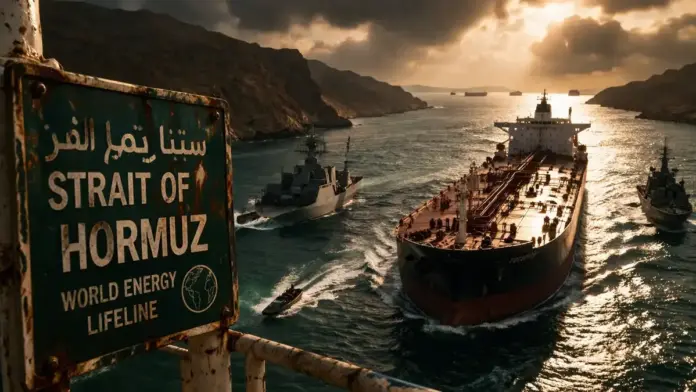
The most important development in the Strait of Hormuz over the last 24 hours was not a clean reopening of shipping. It was the emergence of a more fragile and politically managed pattern: limited ship movement, diplomatic bargaining, and a clearer sign that the crisis is shifting from shock to controlled leverage. Reuters reported today that Pakistan hosted talks with Turkey, Egypt, and Saudi Arabia in Islamabad, with the reopening of Hormuz to maritime traffic at the center of the discussions.
That matters because two misleading claims spread easily in moments like this. The first says the strait is “open again.” The second says “nothing is moving.” Neither is accurate. What exists right now is a narrow, selective, politically filtered system in which some vessels are being allowed through while the wider structure of free navigation remains unstable.
For readers who want the wider energy-market mechanics behind why Hormuz matters so much beyond the Gulf itself, Newsio’s English explainer, Fuel Prices Surge: How wars move oil markets and what the data says about what comes next, fits naturally here because it explains how shipping risk becomes price pressure far from the battlefield.
The key confirmed move: Pakistan says Iran agreed to let more ships pass
The clearest confirmed development of the day is Pakistan’s statement that Iran agreed to allow 20 additional Pakistani-flagged ships to transit the Strait of Hormuz, at a pace of two ships per day. Reuters reported that announcement directly from Pakistani Foreign Minister Ishaq Dar as part of the broader diplomatic effort now underway in Islamabad.
That is not the same thing as a normal shipping lane resuming business as usual. It is a negotiated exception, and that difference is the heart of the story. Iran is signaling that passage is possible for vessels it does not classify as hostile, but that still leaves the strait operating under political permission rather than under a restored sense of neutral, predictable maritime access.
Reuters also reported that proposals now under discussion include ideas resembling Suez-style shipping tolls and even a possible consortium model for managing flows. Those ideas are not agreements yet. But their mere appearance shows that the conversation has moved beyond immediate disruption and into a struggle over terms, control, and strategic authority over one of the world’s most critical chokepoints.
What actually changed in shipping traffic
The clearest operational picture is not one of full restoration. It is one of selective passage under pressure. Public reporting today indicates that some vessels are moving again, but not in a way that supports the claim that free and normal navigation has returned. Reuters’ reporting over recent days has already shown that some ships attempted passage and turned back despite Iranian assurances, underscoring that confidence in safe transit remains weak.
That is the key correction to the noisy version of this story. A few successful transits do not equal a reopened strait. They show that access is being filtered, negotiated, and calibrated. The crisis has become more managed than chaotic, but it has not become normal.
For readers who want a parallel Newsio piece about how fast uncertainty can be distorted online during regional escalations, Dubai explosions: what’s confirmed vs unconfirmed is useful because it explains how misinformation expands when security events outrun verified facts.
The core fact-check: this is not free passage, but Iranian filtering
This is where precision matters most. The present situation should not be described as open transit in the ordinary sense. Iran has been signaling that non-hostile ships may pass under coordination and conditions, while the broader system remains shaped by its political and security judgments. In practical terms, that means the strait is functioning less like a neutral corridor and more like a controlled gateway in which access depends on Tehran’s current strategic logic.
That difference is not semantic. It changes the entire meaning of the crisis. A true reopening would imply a return to predictable maritime norms. What exists instead is selective transit under pressure, with the possibility of further changes depending on diplomacy, retaliation, and Iran’s evolving calculations.
For the broader institutional framework of why the Strait of Hormuz is not just a regional passage but a question of international navigation, the most valuable authority reference is the International Maritime Organization’s safe-passage framework briefing. The value of that reference is not rhetorical. It places the issue where it belongs: in the domain of maritime safety, crew protection, and the integrity of global commercial flows.
Were there major new attacks in the last 24 hours?
The public picture in the last 24 hours has been defined more by diplomacy, warnings, and economic fallout than by one dominant newly confirmed shipping attack inside the strait itself. AP’s latest live coverage focused on regional military warnings, continuing escalation around Iran, and the broader fallout spreading across the Gulf rather than on a single new headline incident in Hormuz that would redefine the day’s shipping picture.
That does not mean risk has disappeared. It means the last 24 hours were marked less by one dramatic fresh incident and more by a hardening structure of selective access, military tension, and regional bargaining. In crisis reporting, that distinction matters. Quiet does not always mean safe. Sometimes it means the struggle has moved from explosion to negotiation without removing the danger underneath.
Why the last 24 hours matter far beyond the Gulf
Reuters reported that before the current disruption, the Strait of Hormuz handled roughly a fifth of the world’s oil and LNG flows. That is why even partial disruption or politically filtered passage is not a local maritime problem. It is a global energy, shipping, inflation, and supply-chain story.
AP’s reporting today pushed that point even further, warning that the longer the conflict and disruption drag on, the deeper the pain could spread through fuel costs, fertilizer supply, growth forecasts, and broader inflation. In other words, Hormuz is not just a map location in this story. It is one of the transmission belts through which regional conflict turns into global economic stress.
That is also why readers should not reduce this to oil headlines alone. Insurance premiums, freight costs, route reliability, and timing risk all matter. A narrow waterway under political filtering can shape the cost of energy even without a permanent formal closure.
What readers should keep
The last 24 hours in the Strait of Hormuz produced four core takeaways.
First, serious regional diplomacy is now underway, with Pakistan hosting talks centered on how shipping might resume under less dangerous conditions.
Second, Iran has allowed additional Pakistani-flagged ships through, which confirms selective movement but does not prove a return to normal maritime freedom.
Third, the strait is functioning under political filtering rather than under a fully restored, neutral passage model. That is the most important fact-check point in the entire story.
Fourth, the global significance remains enormous because Hormuz sits at the center of oil, LNG, shipping, and inflation risk far beyond the Gulf itself.
Bottom line
The Strait of Hormuz did not return to normal in the last 24 hours. It moved into a more controlled, more political, and potentially more deceptive phase. Some ships are moving. Diplomacy is active. But the system now visible is one of permission, leverage, and strategic filtering—not full restoration.
That is why the right reading of the moment is neither panic nor false relief. It is disciplined attention. The crisis has not disappeared. It has become more structured, and that may be even more important for what comes next.