

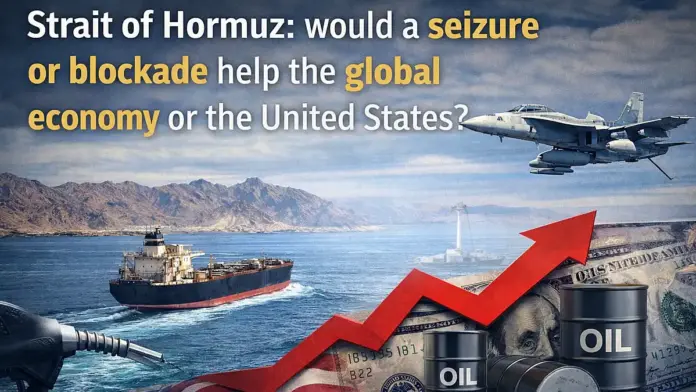
The core false claim is simple: a seizure or prolonged blockade of the Strait of Hormuz would not help the global economy
If someone claims that a violent seizure, blockade, or prolonged disruption of the Strait of Hormuz would somehow benefit the global economy, that claim collapses under the weight of the evidence. The Strait is one of the world’s most important energy chokepoints. The U.S. Energy Information Administration says large volumes of oil move through it and that there are very few practical alternatives if flows are disrupted. The International Energy Agency likewise describes Hormuz as one of the world’s most critical oil transit chokepoints, with around 20 million barrels per day moving through it in 2025 and limited bypass capacity.
That matters immediately because the economic shock begins before any side can claim “victory.” Reuters reported today that Saudi Aramco warned of “catastrophic consequences” for global oil markets if the Strait remains blocked, while AP reported that the war-related disruption has already put pressure on energy infrastructure, shipping, and prices across the region. In other words, the market does not read a Hormuz crisis as a prosperity event. It reads it as a global shock.
The more serious question, then, is not whether the United States has military weight. It does. The real question is whether a Hormuz seizure or blockade would create net economic gains for the U.S. or the wider world. On the evidence available, the answer is no. At best, Washington may prove more resilient than more import-dependent economies. That is not the same thing as benefiting from the crisis.
Why Hormuz matters so much
The Strait of Hormuz links the Persian Gulf to the Gulf of Oman and the Arabian Sea. That geography gives it global importance far beyond the region. EIA says the passage is wide and deep enough for the world’s largest crude tankers and remains one of the most important oil chokepoints anywhere. The same EIA analysis stresses that alternatives are limited if flows are interrupted.
The importance is not limited to crude oil. The IEA says that in 2025, almost 90% of LNG exported through Hormuz went to Asia, which means disruption there does not just hit fuel markets. It can feed directly into electricity generation, industrial costs, shipping, and wider inflation across multiple economies at once.
That is also why this piece fits naturally inside Newsio’s existing English-language ecosystem. For readers who want the wider data frame first, this earlier Newsio explainer on Strait of Hormuz closure claims and the real data provides useful background before moving into the harder geopolitical and economic argument developed here.
The fact-check at the center: chaos is not an economic strategy
This is where the false narrative has to be hit directly. There is a shallow line of argument that says: if the United States ultimately prevails militarily, then the crisis must also be economically useful. That does not follow.
AP reported that oil prices jumped sharply as the war widened and shipping through Hormuz became unsafe, with consumers already feeling the impact at the pump. Reuters reported that the damage would not be confined to oil alone; shipping, insurance, aviation, agriculture, and manufacturing would all feel the effects if disruption persisted. That is not a picture of healthy economic gain. It is a mechanism for transmitting damage across sectors.
The same logic applies to inflation. Once energy spikes, the pressure spreads outward: transport costs rise, supply chains tighten, and consumer prices feel the strain. Even if markets later stabilize, the initial disruption is real and costly. That is why the phrase “it could help the global economy” is not just too optimistic. It points in the wrong direction entirely.
Would it help the United States itself?
The United States is in a stronger position than many other economies because its energy profile is more resilient than that of import-heavy regions. But resilience is not the same as profit. Higher prices may offer limited upside to parts of the U.S. energy sector, especially producers that benefit from higher crude prices. Yet that comes with direct pressure on gasoline costs, transport, inflation expectations, and household budgets. AP’s reporting makes that consumer angle especially clear.
Reuters’ reporting points in the same direction from the global market side. Even when oil prices jump, the broader picture is not one of clean American gain. The market has to price geopolitical risk, shipping insecurity, insurance stress, and the possibility of wider escalation. That is why a crisis in Hormuz does not function like a neat American economic win. It functions like a high-volatility shock in which some sectors may gain temporarily while the wider economy absorbs costs.
So the honest answer is more disciplined than the slogan. The U.S. may be better positioned than others to withstand a Hormuz shock. That still does not mean the shock is economically good for America.
Who gets hit hardest
The heaviest damage would likely fall first on economies that depend most on Gulf energy flows and Hormuz-linked LNG. The IEA’s figures make clear that Asia is especially exposed on the LNG side, while the wider oil market impact would reach far beyond one region. That means the economic pain would not be distributed evenly, but it would still be global.
AP’s reporting broadens the picture further by showing that the damage is not only about crude cargoes. Energy infrastructure, terminals, export routes, and industrial feedstocks are all part of the same risk chain. Once those are hit, the economic story expands from tankers to factories, fertilizer, food systems, and financial confidence.
That is why the claim that Hormuz turmoil could “help the global economy” fails so badly. The actual evidence points to the opposite: tighter energy markets, higher costs, wider volatility, and more fragile growth.
Military superiority does not erase economic damage
There is another misleading leap in this debate. It assumes that because the United States has overwhelming naval and military capacity, the economic problem would therefore be short-lived or easy to solve. That is too simplistic.
Reuters reported that even with talk of U.S. naval escorts, the operational environment remains constrained by wider military commitments and by market perceptions of risk. In crises like this, the issue is not only whether a route is technically open. The issue is whether shipping companies, insurers, traders, and charterers believe the route is safe enough to use at scale. If they do not, then the economic damage continues even before any legal or military “reopening” is declared.
That means Hormuz is not merely a military problem. It is also a shipping problem, an insurance problem, a market-confidence problem, and a global pricing problem. A state can project force. It cannot instantly force normal commercial trust back into a war-risk corridor.
Where the misinformation actually sits
The misinformation here usually works by taking one true element and stretching it into a false conclusion.
The true element is that the United States has greater military reach and greater energy resilience than many of its counterparts. The false conclusion is that a Hormuz crisis would therefore be economically beneficial to the U.S. or the world. That conclusion ignores what the evidence shows about oil prices, LNG disruption, inflation pressure, shipping insecurity, and wider spillovers across industries.
The clearer and more useful conclusion is this: Washington may decide that preventing a permanent blockade is strategically necessary, but strategic necessity is not the same thing as economic benefit. A country can be compelled to act in a crisis without the crisis being good for its economy.
What readers should take away
If the question is whether a seizure, blockade, or prolonged military crisis in the Strait of Hormuz would help the global economy, the answer is clear: no. It would intensify energy stress, raise inflation risk, complicate shipping, and spread instability through the wider economic system.
If the question is whether the United States could emerge more resilient than some other economies, the answer is yes. But if the question is whether that resilience amounts to a net economic gain for America, the answer remains no. The shock itself is large enough to undermine the fantasy of a “useful” Hormuz crisis.
As Reuters reported, the consequences for oil markets could be catastrophic if the closure persists. That line captures the core reality better than any slogan does: a Strait of Hormuz crisis may force strategic decisions, but it does not create economic health. It creates pressure, cost, and risk.