

Table of Contents
Tehran says “victory” and talks about $6 billion — but Washington denies it and the talks have only just begun
The first battle is over reality itself
What is happening right now is not only a negotiation. It is also a fight over who gets to define reality first.
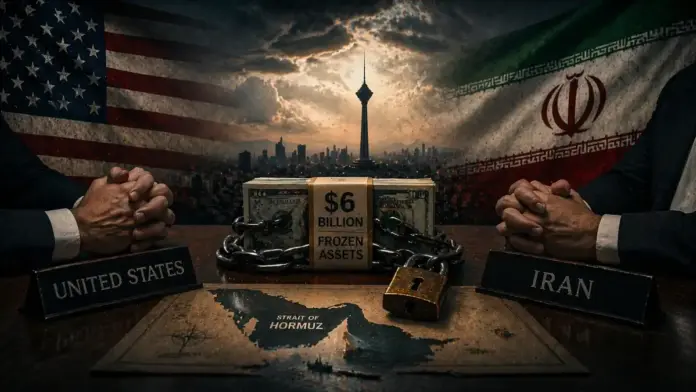
Iranian sources are saying the United States agreed to unfreeze Iranian assets and release $6 billion held abroad. Iranian and pro-regime media are already turning that into a political story of strength, leverage, and victory. But Washington is publicly denying that any such agreement exists.
Reuters reported that a senior Iranian official claimed the U.S. had agreed to unfreeze Iranian assets held in Qatar and elsewhere, with a second Iranian source putting the amount at $6 billion, while a U.S. official flatly denied that there was any such agreement.
That gap matters. It means this is not a calm diplomatic phase where both sides are describing the same progress in different words. It is a tense phase where one side is trying to present a major concession as already secured while the other side says it has not agreed to it. That is not stability. That is a negotiation already under strain.
What Tehran is trying to sell
From the regime’s perspective, the message is obvious and politically useful.
If Tehran can convince its domestic audience that the United States is already moving toward unfreezing billions of dollars in Iranian assets, then it can package the opening of talks as proof that its pressure worked. It does not need a final agreement to start selling the story.
It only needs enough ambiguity to create the impression that Washington blinked first. Reuters’ reporting shows exactly that structure: the Iranian side is linking frozen assets and Hormuz to the talks, while also trying to frame the moment as a diplomatic gain.
That is why this is not just a money story. It is a regime-narrative story. The number itself matters, but the political use of the number matters even more. If the regime can turn uncertainty into triumph before anything is signed, it gains internal propaganda value immediately.
What Washington is saying instead
Washington’s public line is very different.
A U.S. official denied that the United States had agreed to release the frozen funds. At the same time, Reuters reported that talks between senior U.S. and Iranian officials have begun in Islamabad, with key issues including the Strait of Hormuz, frozen assets, sanctions relief, and broader regional files. That means the issue is clearly on the table, but not settled.
This is the key analytical point: there is a difference between an issue being discussed and a concession being agreed. Tehran is trying to collapse that difference. Washington is trying to keep it open.
That alone tells readers a great deal about the current atmosphere. The talks may have started, but the mistrust has not gone anywhere.
Yes, the talks have begun. No, they do not look peaceful.
It would be inaccurate to say the negotiations have not started. They have.
Reuters reported that senior U.S. and Iranian officials held direct talks in Islamabad on April 11, the highest-level meeting between the two sides in decades. AP also reported that negotiations had begun in Pakistan after indirect progress and under a fragile ceasefire.
But it would be just as inaccurate to describe this as a peaceful or settled negotiating environment. The talks began under a two-week pause that still looks fragile, with Iran maintaining red lines and demands, continued instability in Lebanon, and the Strait of Hormuz still central to the dispute.
That is not the mood of normal reconciliation. It is the mood of a confrontation that has moved into a diplomatic room without leaving the battlefield psychology behind.
The regime is trying to claim victory before there is a result
This is the real core of the story.
Tehran is not waiting for a final outcome to present itself as the stronger side. It is trying to build the victory narrative now. The $6 billion claim fits perfectly into that logic. So does the broader message that the United States is now negotiating under pressure and that Iran forced the conversation onto its own terms.
But the public facts still point somewhere else. Reuters reported that Trump said U.S. forces were “clearing” the Strait of Hormuz and claimed that American forces had already destroyed all 28 of Iran’s mine-laying vessels.
Whether every battlefield claim holds up in full is a separate question, but the broader point is unmistakable: Washington is not speaking like a side that believes it has surrendered leverage. It is speaking like a side that believes it is still imposing it.
That is why the regime’s “victory” story should be read for what it is: not proof of a settled diplomatic win, but an effort to turn uncertainty itself into political theater.
Why the $6 billion claim is politically explosive
The six-billion-dollar figure is not just a financial headline. It is a symbolic prize.
If Tehran can persuade its public that it extracted the release of frozen assets from the United States, then it can say its strategy worked. It can say sanctions pressure did not break it. It can say the system held, forced movement, and delivered something tangible. That is a powerful story for a regime that constantly needs to project endurance.
For Washington, however, the public image of handing over billions before a clear deal is politically toxic. That helps explain why the denial came so quickly. This is not only a dispute about money. It is a dispute about who appears to be winning before the talks even have time to mature.
Hormuz remains the real test
If readers want to know where reality will reveal itself more clearly than rhetoric, they should watch the Strait of Hormuz.
Reuters reported that the talks in Islamabad were closely tied to access through Hormuz, and that Trump publicly claimed U.S. forces were working to clear the strait. AP likewise identified Hormuz as one of the central issues in the negotiations.
As long as Hormuz remains mined, politically contested, or exposed to renewed pressure, the word “peace” remains too generous. This is one reason the article should connect naturally to Newsio’s English internal coverage, including Trump did not buy peace — he bought time from a position of strength, The U.S. strategy toward Iran: the pressure points that could shape the next phase, and Strikes on energy infrastructure and a ship hit in the Strait of Hormuz.
The strongest external authority link belongs here too: the International Energy Agency’s analysis of the Middle East and global energy markets explains why instability in Hormuz has direct consequences for energy security, shipping, and the global economy.
Washington openly expects tactical games
The suspicion that Tehran may try to manipulate both the public and the negotiation itself is not only a commentator’s impression.
The Guardian reported that Vice President JD Vance warned Iran not to “play” the United States as talks began. Reuters and AP reporting also show that both sides entered the talks carrying hard conditions and deep mistrust.
That is important because it confirms the broader frame: Washington does not appear to see Tehran as a straightforward peace partner entering a calm diplomatic process. It appears to see Tehran as a regime capable of tactical bargaining, public manipulation, and pressure politics, even while talks are under way.
That makes the current phase easy to misunderstand if one only watches the headlines and not the structure underneath them.
The people of Iran are not the regime’s narrative
This distinction remains essential.
When regime media speak of “victory,” they are not speaking for every Iranian citizen. They are speaking for a power structure that needs control, legitimacy, and internal discipline. A serious analysis cannot confuse the propaganda needs of the regime with the lived interests of the people living under it.
That is why this article also belongs alongside Newsio’s The Regime in Tehran, the Billions It Reached, and the People It Never Chose to Build and The regime does not speak like a power that wants peace, but like a power that wants victory — even when it is losing. The first explains the structure of power. The second explains the logic of the messaging. Together, they help readers see why the “victory” narrative should not be taken at face value.
What readers should keep in mind
The clearest sentence is still this:
Tehran is talking about $6 billion and “victory,” but Washington denies that any such agreement exists — and the talks have only just begun.
That means the current moment should not be read as a settled diplomatic success for Iran. It should be read as a fragile negotiating phase marked by leverage, mistrust, Hormuz, and competing attempts to control the narrative before the facts are even fully formed.
And that leads to the real conclusion:
The regime is trying to turn uncertainty into triumph. But as long as Washington denies the concession, Hormuz remains contested, and the talks are still running on distrust, Tehran’s “victory” looks far more like narrative warfare than a finished political result.