

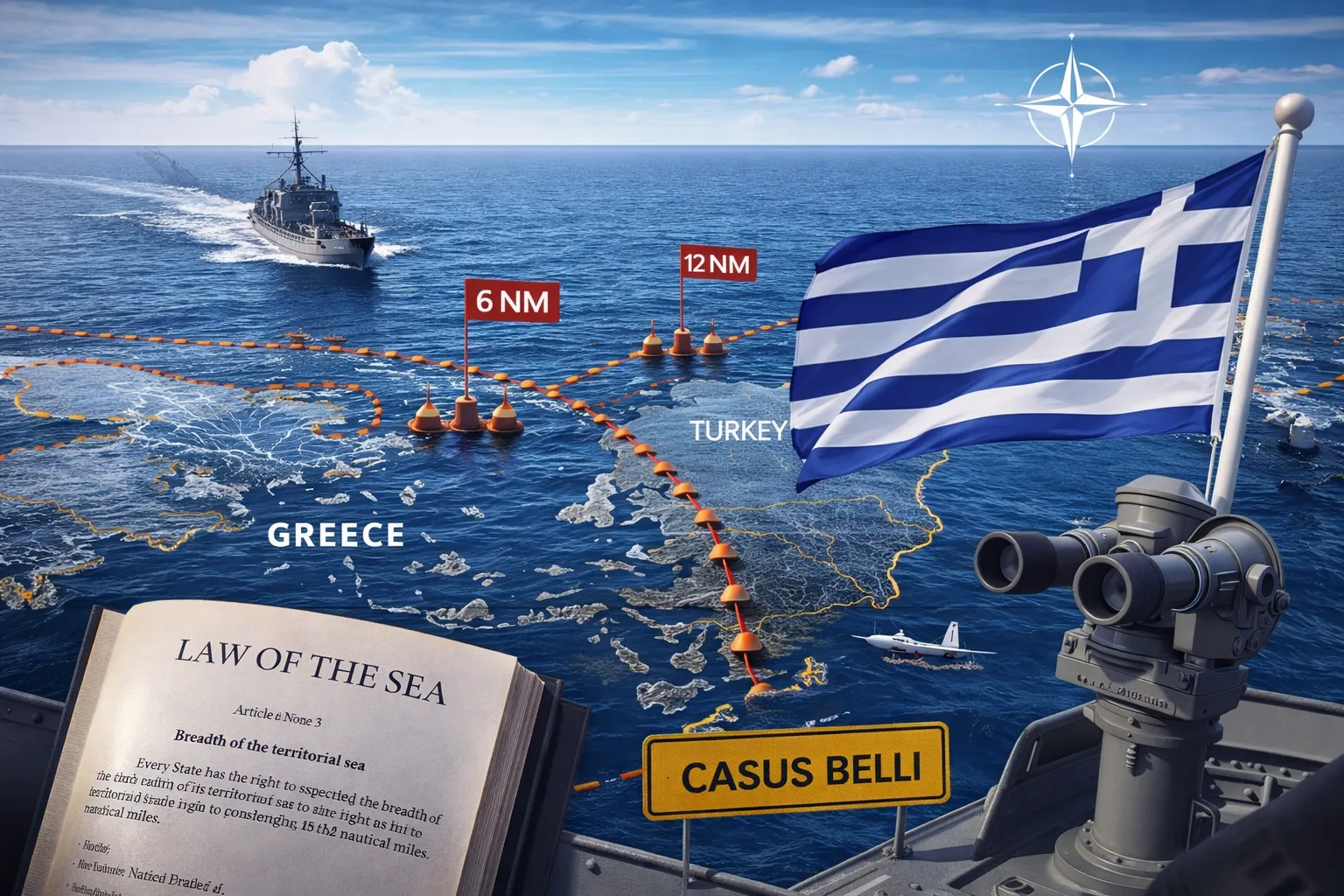
Territorial Waters Extension: What It Means Under the Law of the Sea and the Realistic Scenarios for Greece
The public debate on the extension of territorial waters is often politically charged. Yet, at its core, this is a subject with two distinct layers: a legal one and a geopolitical one. If we want to discuss it seriously, we must start with definitions and rules—and only then move to scenarios, calmly and without rhetorical shortcuts.
What territorial waters are, in plain terms
Territorial waters—also called the territorial sea—are the maritime zone in which a coastal state exercises sovereignty, comparable to the sovereignty it exercises on land. This sovereignty coexists with specific international obligations, including the right of innocent passage for foreign vessels. But the essential point remains: within territorial waters, state authority is sovereign in nature.
The legal rule that structures the debate
The international legal framework is clear. The United Nations Convention on the Law of the Sea (UNCLOS) provides that a state may establish a territorial sea up to twelve nautical miles from its baselines. That is the upper limit recognized by the Convention.
This must be the first reference point before any political or strategic discussion: what the rule allows and what the rule does not.
What Greece has already done
Greece has already exercised this right in a specific maritime area: the Ionian Sea, where the territorial sea was extended up to twelve nautical miles through national legislation. This is important for a practical reason: it shows the issue is not theoretical. It is a sovereign instrument that can be implemented selectively, depending on geography and broader strategic considerations.
Why the Aegean is a more complex equation
In the Aegean, the discussion is not only about legal capacity. It is also about strategic signaling, perceptions, and the management of escalation risks.
The Aegean is not merely a map. It is a dense maritime geography of islands and sea lanes, with economic activity, fisheries, tourism, and strong strategic sensitivities. In such an environment, the extension of territorial waters is interpreted not only through law, but also through the prism of deterrence, diplomacy, and crisis management.
This is the key distinction:
-
The legal right exists as a rule of international law.
-
The timing, method, and scope of exercising that right belong to the realm of policy—where the objective is to serve national interest while avoiding unnecessary instability.
Three realistic pathways are often discussed
Without predetermining any decision, public discussion typically gravitates toward three broad approaches:
Scenario 1: Gradual, geographically segmented exercise of the right
Extension by geographic units, backed by technical preparation and careful diplomatic groundwork. The emphasis is on sequencing, clarity, and risk management.
Scenario 2: Maintaining the current Aegean status quo while strengthening other maritime policy tools
Focus on surveillance capacity, mapping, maritime spatial planning, and administrative readiness—without immediately changing the breadth of territorial waters in the Aegean.
Scenario 3: A decisive move in a “window of political opportunity”
A more substantial step at a time when international conditions and alliances are assessed as more favorable, reducing escalation risk and strengthening the country’s position.
Across all serious approaches, one principle holds: this is not a topic for triumphalist rhetoric. It is a topic for institutional precision, technical preparation, and strategic composure.
A practical guide for readers: how to separate analysis from noise
To avoid being pulled into headlines and simplifications, keep five filters in mind:
-
Territorial waters are not the same as the continental shelf or the Exclusive Economic Zone. These are different legal concepts with different rules.
-
Look for state action, not only statements—law, decree, official publication—rather than commentary alone.
-
Ask, “Where exactly?” Geography changes the operational and strategic picture.
-
Ask, “What changes in practice?” Consider navigation, enforcement, fisheries regulation, and administrative competencies.
-
Be wary of absolute certainty. In international affairs, words like “certainly” and “inevitably” often indicate rhetoric—not careful analysis.
FAQs
Is Greece “obliged” to extend territorial waters to 12 nautical miles?
No. Under international law, it is a right a state may exercise; it is not an obligation.
Has Greece already extended territorial waters anywhere to 12 nautical miles?
Yes—Greece has implemented a 12-nautical-mile territorial sea in the Ionian Sea through national legislation.
Why is the Aegean treated differently in public debate?
Because the Aegean combines dense geography and strategic sensitivities. The question is not only what the law permits, but also how policy manages risk, diplomacy, and regional stability.
Closing thought
Territorial waters extension is a matter of sovereignty with a clear legal anchor in international law, but it also carries genuine geopolitical consequences. Greece has already shown it can exercise its right in a targeted, institutional manner in specific areas. The Aegean, however, is a more complex equation—one that requires strategic discipline, diplomatic preparation, and choices built to endure over time.