
Maduro’s Gold Strategy: How Venezuela’s Gold Reserves and Turkey Alliance Shape Geopolitics
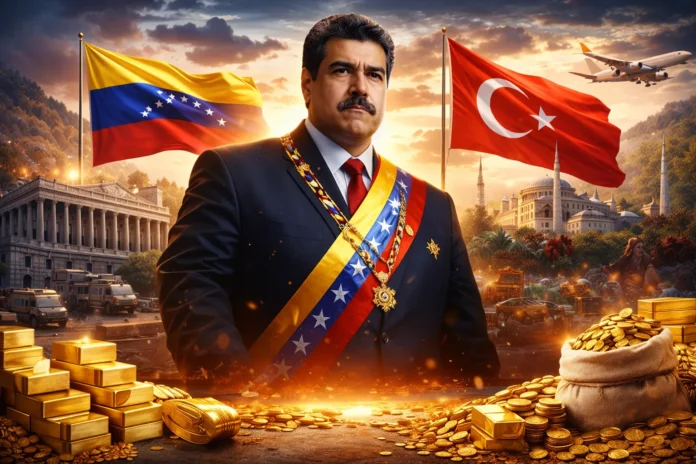
For nearly a decade, Venezuela has been at the center of global political and economic analysis, not only due to its massive oil reserves but also because of the critical role gold plays in the Maduro regime’s efforts to support an economy under sanctions, devaluation, and international pressure.
Unlike oil, gold can change hands more quietly, be moved more swiftly, broken into smaller amounts, transferred through intermediary hubs, and converted into immediate liquidity or used as a medium of exchange. Thus, the story of Venezuela’s gold is not simply an economic matter; it is a chapter of geopolitics, survival, and realignment of alliances.
1. Venezuela’s Gold Reserves and Economic Strategy
Venezuela is among the countries with the largest gold reserves in the world, and within its borders, there are extraction zones that are treated by the regime itself as strategic “buffers” against isolation.
When the economy is under pressure, the chains of imports break, and access to international finance is restricted, precious metals become a sort of time currency. In other words, they buy time for a regime, fund mechanisms, sustain agreements, create alternatives in an environment where the traditional banking system may be closed or under scrutiny.
“Venezuela is among the countries with the largest gold reserves in the world, with reports indicating approximately 161 metric tons of official gold reserves (Gold Flows from Venezuela).”
2. The Role of Gold in Venezuela’s International Relations
In this context, the movements of gold from Venezuela abroad — whether as exports, as transport for refining, or as exchanges in commercial agreements — are seen as acts of strategy.
There are periods when the country utilized international refining hubs because the “raw” or unverified product often needs to go through standardization, purity checks, and transformation into forms that are accepted in the global market. However, when sanctions and political restrictions increase, these routes become more difficult, and trade shifts to alternative channels and new partnerships.
3. Turkey’s Role in Venezuela’s Gold Trade
This is where Turkey comes into the picture. Ankara, at various points in time, has emerged as a partner offering more than just a typical commercial relationship: access to refining capabilities, commercial networks, and a political bridge that is not dictated by the same logic governing Western markets.
For Venezuela, such a relationship acts as a double tool: on one hand, it serves as an economic valve, and on the other, it sends a message that the regime can build alternative alliances when traditional paths are closed.
The Venezuela-Turkey relationship surrounding gold is not limited to the idea of a “sale.” It is linked to the ability to process, to development agreements, to product exchanges, to covering liquidity during times of intense pressure, and to a broader narrative of independence from the constraints imposed by sanctions.
In such collaborations, gold does not behave like a simple tradable commodity: it becomes a geostrategic tool, a resource that can be converted into influence, into bargaining power, and into political resilience.
4. The Darker Side of Gold Mining in Venezuela
At the same time, the issue of gold in Venezuela also has a darker side that involves the very nature of extraction. In many countries, gold extraction is tied to parallel economies, informal trade chains, environmental destruction, labor exploitation, and conflicts over control of the production areas.
When state power tries to maintain control while urgently needing revenue, the temptation for “quick solutions” grows. This creates a landscape where the lines between the official economy and informal mechanisms blur, and the international transactions involving gold take on multiple interpretations: economic, legal, ethical, and geopolitical.
5. Global Interest and Geopolitical Implications
International analysts’ interest in the gold transfers is not merely about numbers. It involves the question: what does it mean when a state turns gold into a “survival platform”? What are the implications when sanctions lead to circumvention through third-party countries? And how sustainable is a model that relies on a high-value resource but carries profound political and social consequences?
6. Gold as a Symbol and a Tool of Sovereignty
At the core of this story lies a fundamental truth: gold is simultaneously a symbol and a tool. It is a symbol of sovereignty because a state that holds reserves can invoke them as a shield against uncertainty. It is a tool because it can be converted into liquidity, into imports, into exchanges, into political agreements.
For Maduro, gold became one of the mechanisms through which the regime tried to stabilize its internal system and maintain international bridges when the traditional route was narrowing.
7. Golden Bridges: Venezuela’s Diplomatic Strategy
And here lies the essence of the matter: the “golden bridges” are not a metaphor for a journalistic headline. They are real trade and political pathways, built through agreements, exchanges, refining routes, diplomatic ties, and choices that often aren’t recorded in the same way a conventional commercial transaction would be.
8. Conclusion: Gold as Geopolitical Capital
In the end, the story of Venezuela’s gold sheds light on something larger than the country itself. It shows how natural resources can be turned into geopolitical currency, how states seek alternative pathways when official markets close, and how a partnership — like that with Turkey — can function as both an economic solution and a political message. And if there is one evergreen takeaway, it is this: when gold becomes “state strategy,” we are not just talking about a metal. We are talking about power.
“Would you rather listen to the audio version of this article? Watch/listen to it on YouTube”