

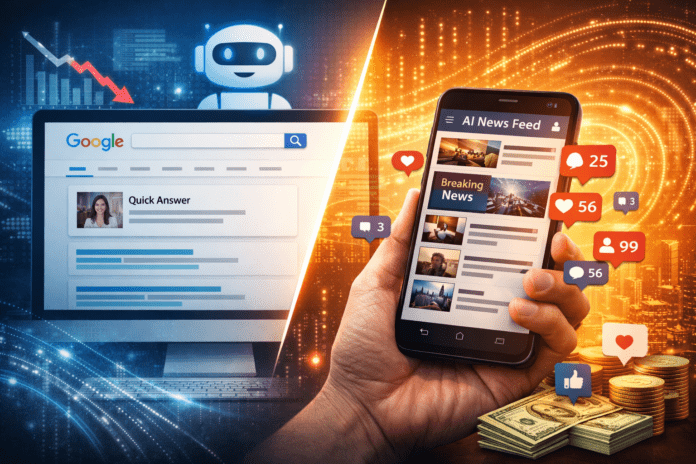
Part A / The shift you can feel: the internet stops being “search-first”
Introduction
People don’t say it out loud, but they behave as if the internet has changed.
A few years ago, the default routine looked simple: you searched, you clicked, you read. Search acted like the front door of the web. Publishers built entire businesses on that habit. Readers built trust—site by site—through repeated visits.
Now the routine bends.
People still search, but they don’t travel the same way. They consume more information inside feeds, inside apps, inside platform “previews,” and increasingly inside AI responses that deliver a summary before a click ever happens.
This isn’t a technical tweak. It’s a behavioral reset.
And once behavior changes, everything else follows: traffic, revenue, editorial strategy, and the shape of public attention.
A Pew Research Center analysis found that when Google shows an AI-generated summary, users are less likely to click on links to other websites — a signal that the “search → click” habit is weakening.
The new expectation: “Give me the answer here”
The biggest change isn’t the tool. It’s the expectation.
In the old model, search returned options. You chose a source, opened it, and spent time inside it. That path carried friction, but it also carried value. You discovered new outlets. You absorbed context. You learned who you trusted.
In the new model, users want outcomes without detours.
They want the gist, the key points, the “what matters,” and the “what should I do.” If a platform offers that directly—through snippets, panels, or an AI response—many users stop right there.
This doesn’t mean users became lazy.
It means users became overloaded.
When the web produces more content than anyone can realistically read, the winner becomes the interface that removes friction and makes decisions on your behalf.
Why feeds win: attention turns into a subscription
Feeds don’t win because they are morally better than search.
Feeds win because they behave like habit.
Search demands intent. You need to know what you’re looking for.
A feed flips the relationship. It delivers what it predicts you’ll want—before you ask. It creates a private stream of attention that updates constantly and feels effortless to consume.
AI strengthens that dynamic.
It doesn’t just guess what you’ll click. It learns when you pause, when you scroll, what holds you, what repels you, and what pulls you back tomorrow. It trains the feed to feel “right,” even when it narrows your world.
That’s why attention starts behaving like a subscription.
You don’t earn it with one strong article. You earn it with repeated presence inside the same ecosystem, at the same cadence, with the same signals the algorithm recognizes.
What it means for publishers: fewer visits, more expensive loyalty
From a publisher’s perspective, this shift creates a double squeeze.
On one side, “easy traffic” weakens. Readers don’t click as often from search results, social previews, or platform summaries.
On the other side, the value of a returning reader rises sharply. A loyal reader becomes rarer. That reader carries higher lifetime value: more time, more trust, more conversions, more stability.
So the strategic dilemma changes:
Do you chase reach inside platforms you don’t control?
Or do you build a smaller but sturdier audience inside your own domain?
In reality, you need both.
But you can’t rely on them the way you used to. A publisher now has to treat platforms as distribution, not home—without pretending platforms don’t matter.
The hidden cost: an internet with fewer discoveries
A quieter consequence matters just as much.
When people consume answers without clicking, they stop discovering new sources. Smaller outlets struggle to surface. New voices find fewer entry points. The ecosystem becomes more concentrated, more predictable, and more dominated by intermediaries.
Feeds show you what fits you.
Search, imperfect as it always was, often pushed you beyond your bubble. It forced you to see different sources, different framing, different angles.
When that discovery layer shrinks, the web doesn’t merely lose traffic patterns.
It loses variety.
And when variety fades, public debate narrows.
A short bridge to Part B
The “new internet” doesn’t kill the web. It reorganizes it.
The core question isn’t whether search will survive or whether feeds will win. Both will exist.
The real question is: who controls the path from information to understanding—and under what incentives?
In Part B, the picture gets concrete: what this shift does to SEO, Discover, newsroom economics, and the long-term independence of publishing.
Part B / The mechanics: zero-click, SEO after AI, and the money behind attention
1) Zero-click isn’t a trend. It’s the new operating system.
People treat “zero-click” like a new annoyance.
In practice, it’s a new baseline.
Search results increasingly deliver the payload on the results page. Platforms summarize, preview, and “extract” the useful bits. Apps keep users in-app. AI interfaces produce a response that feels complete enough to end the journey.
From the user’s perspective, this feels like progress.
From the publisher’s perspective, it changes the owner of attention.
The attention doesn’t disappear. It relocates. It stays with the intermediary.
And when the intermediary owns the attention, it owns the data, the ad inventory, the relationship, and the ability to decide which sources “count.”
That’s the structural shift: platforms don’t just distribute content anymore. They absorb the value chain around content.
2) SEO shifts from “ranking tactics” to “trust signals”
Old SEO often looked like a technical checklist.
Keywords, headers, internal links, speed, schema, backlinks. Those inputs still matter. But they no longer describe the whole game.
AI-driven discovery makes a new demand: credibility in motion.
Platforms now ask different questions:
-
Does this outlet consistently produce quality in this lane?
-
Does the content deliver clarity, not noise?
-
Can the system summarize it without misrepresenting it?
-
Does the source feel stable over time?
A one-off viral spike doesn’t build that kind of signal.
Consistency builds it.
That’s why topical focus matters more than “cover everything.” That’s why editorial structure matters more than clever tactics. That’s why identity becomes an algorithmic advantage.
The system starts preferring sources it can predict.
That reality punishes opportunism and rewards discipline.
3) Discover becomes the greatest opportunity—and the greatest dependency
Discover can change a site’s trajectory overnight.
It doesn’t wait for a user’s query. It makes a suggestion: “Read this now.”
That’s powerful distribution.
But it also behaves like waves: it surges, it lifts you, and it recedes.
Publishers who treat Discover as a permanent faucet end up confused and frustrated. They see big spikes and then sudden silence. They mistake volatility for failure.
Discover doesn’t promise stability.
It rewards relevance at the moment.
So the job isn’t only to get in. The job is to convert the spike into relationship: returning readers, direct visits, newsletter sign-ups, app follows, alerts—anything that gives the publisher a path back to the audience without begging a platform again tomorrow.
Discover can be a launchpad.
It should not be your foundation.
4) The business model shifts from pageviews to repeatability
For years, many publishers built revenue around sheer volume.
More pageviews meant more ad impressions. More impressions meant more cash. That model still exists, but it grows more fragile when intermediaries shrink click-through and keep more consumption inside their walls.
So value migrates.
It migrates to:
-
returning users
-
newsletters
-
push notifications
-
direct traffic
-
communities
-
membership-like behaviors, even without a paywall
This doesn’t require abandoning broad reach.
It requires changing what broad reach is “for.”
Reach becomes the top of the funnel. Relationship becomes the business.
In the new internet, your “owned audience” becomes more valuable than your “borrowed audience,” even if the borrowed audience looks bigger on a chart.
5) AI changes the status of content: from destination to raw material
This is the psychological break publishers must face.
In the old web, the article was the destination. Readers landed, spent time, saw the brand, saw the writer, saw the context.
In the new environment, content often becomes raw material.
AI tools extract it, compress it, remix it, and deliver it inside another interface. That interface can feel like the “publisher” even when it isn’t.
So publishers need to protect two things:
-
the signature
-
the context
Signature means: readers recognize the source and return to it.
Context means: the content carries meaning beyond isolated facts. It explains why something matters, what changed, what to watch next, and what tradeoffs exist.
AI can summarize facts quickly.
It struggles to preserve responsibility.
A publisher who writes with context and intent produces content that resists being flattened into a generic blob.
6) What serious publishers do to stay visible
No magic button exists. Strategy does.
Publishers who adapt without degrading quality tend to do three things.
They build topical clusters.
They stop writing “everything for everyone.” They choose lanes and publish with consistency. They become recognizable.
They write for clarity.
They treat structure as a feature: strong opening, clean sections, short paragraphs, explicit transitions, and a clear “what this means” layer.
They invest in repeatability.
They give audiences a reason to return: a reliable format, a steady rhythm, and a voice that feels human and accountable.
The new internet doesn’t reward randomness.
It rewards systems.
7) The core trade: distribution versus independence
Every publisher now lives inside a tradeoff.
Platforms bring audience.
Platforms also bring dependence.
A publisher can’t ignore platforms. But a publisher can decide not to live at the mercy of a single platform’s mood.
That’s why the best strategy looks hybrid:
-
use platforms for discovery
-
use owned channels for retention
-
use editorial identity for trust
-
use structure for readability
-
use discipline for stability
This doesn’t sound glamorous.
It’s how survival looks.
A short bridge to Part C
The question isn’t whether the web will survive.
It will.
The question is which voices remain visible when intermediaries summarize, rank, and serve content before a click—and which voices fade into invisibility.
In Part C, the stakes become societal: what this shift does to journalism, quality, and the public square.
Part C / The stakes: journalism, trust, and the public square after “search-first”
1) This isn’t only a tech shift. It’s a power shift.
When the path to information changes, the path to opinion changes.
The new internet doesn’t simply change traffic.
It changes who controls:
-
what rises
-
what gets summarized
-
what gets framed as important
-
what disappears quietly
In the older model, users actively navigated to sources. They performed the act of choosing.
In the new model, sources come to users through invisible filters, ranking systems, and summarizers that shape perception before reading begins.
That concentrates agenda-setting power.
And agenda-setting power always becomes political, even when it arrives dressed as “neutral technology.”
2) Quality becomes more expensive—and more necessary
As clicks shrink, low-quality content doesn’t automatically die.
It often thrives inside compression.
A shallow claim can travel farther when it turns into a neat, confident summary. A misleading framing can spread faster when it fits the feed’s rhythm.
That creates a paradox.
Technology promises greater access, but it increases the need for editing, verification, and responsibility. Quality journalism costs time. The new attention economy fights time.
So publishers face a choice:
Chase the tempo of the feed, or defend the tempo of understanding.
The publishers who survive long-term will do both in smart proportions: they will respect attention spans without surrendering to shallowness.
3) New consumption habits create new civic habits
Feeds teach the brain to expect constant novelty.
AI summaries teach the brain to expect instant closure.
That shapes how people process complexity.
Understanding requires friction. It requires staying with a problem long enough to hold contradictions and tradeoffs. It requires “why” and “how,” not only “what.”
When a system rewards speed, it rewards simplification.
And when it rewards simplification, it fuels polarization—not because audiences become worse people, but because the environment trains them to move faster than nuance.
This is not a moral lecture.
It’s a design outcome.
4) Why independent sites still matter
Even under pressure, sites don’t become irrelevant.
They become reference points.
If feeds provide flow, sites must provide structure.
Sites can still do what intermediaries struggle to do well:
-
maintain accountability
-
preserve author voice
-
hold context over time
-
correct transparently
-
build durable archives
-
develop expertise in a lane
A good site becomes the place you go when you want to understand, not only react.
That role grows more valuable as the rest of the environment grows more compressed.
5) The most important product becomes trust, not content
Content becomes abundant.
Trust becomes scarce.
In an ecosystem flooded with summaries, snippets, and AI-assembled narratives, people start asking a simpler question: “Who do I trust to tell me what matters?”
That’s the publisher’s real product now.
Not volume.
Not optimization tricks.
Trust.
Trust comes from consistent standards, a clear voice, and a track record of getting things right—or correcting quickly when you don’t.
A publisher who treats trust as the product makes better decisions during moments of pressure, because the goal becomes long-term relationship, not short-term spikes.
6) What “winning” looks like in the new internet
Winning doesn’t mean returning to the old traffic model.
That model won’t fully return.
Winning means building a system that doesn’t break when platforms shift.
It means:
-
using platforms for reach without worshiping them
-
structuring content so readers can absorb it quickly without losing depth
-
creating repeatable formats that audiences recognize
-
building owned channels that bring readers back
-
developing topical authority that the algorithms can’t ignore
This approach looks boring from the outside.
It’s how durable media has always been built.
Final conclusion
The “new internet” doesn’t end the web.
It ends the web as “search-first.”
Search will remain. But it no longer owns the journey.
Feeds have become environments, not channels.
AI has become a new intermediary between sources and people.
The stronger the intermediary becomes, the more valuable the source becomes that insists on clarity, responsibility, and context.
That is where the future of publishing lives: not in chasing the next trick, but in building the kind of journalism that remains valuable—even when someone tries to summarize it away.
Διαβάστε το άρθρο στα ελληνικα εδω.