

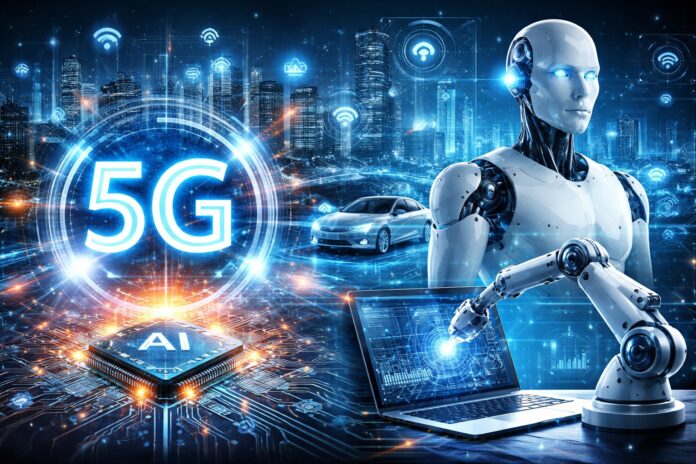
The Next Generation of Technology: How 5G, Artificial Intelligence, and Automation Are Changing Our Lives
The next generation of technology is no longer a concept of the distant future — it’s already starting to shape the world we live in. 5G, Artificial Intelligence (AI), and Automation are three technologies that are transforming every aspect of society, from the way we communicate and work to how we interact with the world around us.
While these technologies have been discussed for years, the reality is that they are now fully operational or are about to be deployed on a global scale. In this article, we explore how each of these technologies is going to change our lives, the opportunities they will create, and the challenges that society will face in adapting to these changes.
Part A — 5G: The Next Generation of Mobile Networks and Infrastructure
5G is more than just the next mobile network. It represents a massive leap in telecommunications technology. The rollout of 5G networks promises to deliver internet speeds up to 100 times faster than current 4G networks, enabling new kinds of digital services and applications that were previously unimaginable.
What is 5G, and Why is It So Important?
5G is not just a faster version of 4G; it’s a revolutionary change in how we connect to the internet and interact with the digital world. Some of the key features of 5G include:
-
Increased speed and capacity: With 5G, data transfer speeds will be significantly faster, allowing for instantaneous downloading, ultra-high-definition video streaming (such as 4K/8K), and much faster communication across all devices.
-
Low latency: The most exciting feature of 5G is its low latency — the delay in communication. This can be reduced to nearly zero latency, which means near-instantaneous communication. For example, autonomous vehicles will rely on 5G networks to make real-time decisions as they navigate roads.
-
Massive connectivity: 5G will support more devices per square kilometer, enabling the widespread adoption of smart cities, Internet of Things (IoT) devices, and wearable technologies.
-
Network slicing: This is a new feature of 5G that allows telecom companies to create customized network paths for different types of services. For example, critical services like healthcare or emergency response can be given higher priority for connectivity, while less essential services can be placed on a different network slice.
The Impact of 5G on Everyday Life
The introduction of 5G will have a profound impact on a variety of industries. Here’s a closer look at its potential uses:
-
Smart Cities: 5G will enable smarter infrastructure with real-time communication between devices. Traffic systems, energy grids, and even garbage collection can be optimized to reduce waste and improve efficiency. Cities will be able to collect data in real-time to adjust operations based on demand.
-
Healthcare: 5G could revolutionize healthcare by enabling telemedicine services, where doctors can interact with patients via high-definition video. Furthermore, it will enable remote surgery and provide real-time data transmission for health monitoring devices.
-
Autonomous Vehicles: 5G’s ultra-low latency is critical for the deployment of self-driving cars. Autonomous vehicles will rely on 5G to communicate with each other, traffic signals, and road sensors to make instant decisions.
-
Education and Remote Work: 5G will facilitate seamless remote learning and collaboration by providing the infrastructure to support large-scale video conferencing, online lectures, and real-time interaction with classmates and instructors.
Part B — Artificial Intelligence: The Revolution That Is Driving Our Society
Artificial Intelligence (AI) is a technology that is already shaping our daily lives in ways we never thought possible. It is transforming how we work, communicate, and make decisions. AI is capable of analyzing vast amounts of data, detecting patterns, and providing insights at a speed and scale that surpasses human abilities.
What is AI, and How Does It Work?
At its core, AI is the development of machine intelligence that can perform tasks typically requiring human intelligence. The key to AI is its ability to learn from data through algorithms, enabling machines to make predictions, decisions, or recommendations based on patterns in the data.
Some of the main technologies driving AI include:
-
Machine Learning (ML): A subset of AI, ML uses data to allow computers to “learn” and make decisions without explicit programming.
-
Deep Learning: A subset of ML, deep learning uses neural networks to mimic human cognition, helping AI to make even more accurate predictions.
-
Natural Language Processing (NLP): This allows AI to understand and generate human language. It is the technology behind chatbots like ChatGPT, language translators, and voice assistants like Alexa and Siri.
How AI Will Change Our Lives and Workplaces
The adoption of AI is already underway, and it is impacting both personal lives and business operations:
-
Business Automation: Many businesses already rely on AI to automate tasks that once required human labor, such as customer service (via chatbots), inventory management, and marketing (through predictive analytics and personalized recommendations).
-
Personalized Services: AI enables companies to analyze consumer behavior and provide highly personalized services. For instance, platforms like Netflix and Spotify use AI to recommend shows, movies, and music based on your viewing/listening habits.
-
Healthcare: AI is being used to analyze medical data, helping doctors make faster, more accurate diagnoses. Additionally, AI-powered devices can help monitor patients’ health conditions in real-time, providing life-saving insights before problems arise.
-
Job Creation and Reshaping Roles: AI is often seen as a job killer, but in reality, it’s creating new roles and industries. For example, AI specialists, data scientists, and robotics engineers are in high demand as companies embrace automation.
The Ethical Implications of AI
Despite its benefits, AI raises significant ethical questions. AI systems can perpetuate bias because they are often trained on historical data that reflects existing prejudices. Furthermore, as AI systems make more decisions autonomously, it becomes essential to address concerns about accountability and transparency in AI decision-making.
Part C — Automation: The Future of Productivity
Automation is another technology that is changing the way we live and work. It involves using machines, software, or robots to perform tasks that would traditionally be done by humans. The rise of automation has been a major driver of increased productivity, but it also brings with it both opportunities and challenges for workers and industries.
What is Automation, and How Does It Work?
At its core, automation replaces repetitive tasks with machines. It can be applied to manufacturing, logistics, customer service, and many other areas. For example:
-
Robotic Process Automation (RPA): Automates routine tasks like data entry and report generation.
-
Industrial Automation: Robots and machines perform tasks such as assembly, welding, and packaging in manufacturing processes.
The Impact of Automation on Jobs and the Economy
The implementation of automation has a significant impact on both the labor market and economic productivity:
-
Increased Efficiency: Automation can improve the speed and accuracy of processes, while also reducing operational costs.
-
Job Transformation: While automation may eliminate certain manual jobs, it also creates new roles in the management, maintenance, and programming of automated systems.
-
Economic Growth: By automating processes, businesses can scale more quickly and reach a global market, which drives economic growth.
Challenges of Automation
Despite the benefits, automation raises concerns about job displacement. As more industries adopt automation technologies, workers in traditional roles may find it difficult to transition into new roles. Governments and businesses will need to ensure that workers are reskilled and upskilled to keep up with these changes.
Part D — The Future of Technology: Convergence of 5G, AI, and Automation
The convergence of 5G, AI, and Automation is not just a theoretical concept; it’s the reality of the future. These technologies are working together to create an integrated digital ecosystem that will shape everything from urban development to consumer experiences and workplace dynamics.
How These Technologies Will Work Together
-
5G will provide the high-speed, low-latency network that is needed to support real-time applications for AI and Automation. For example, autonomous vehicles will rely on 5G to communicate with other vehicles and infrastructure in real-time, while smart cities will use 5G to optimize traffic, energy usage, and more.
-
AI will help analyze data and provide insights for decision-making, while automation will execute tasks based on those insights. For example, AI can predict when a machine will fail, and automation can replace it before it disrupts operations.
-
These technologies combined will lead to smarter, more efficient, and more personalized services and experiences across all sectors.
The Future We’re Heading Toward
The future will be defined by a connected, intelligent world, where everything from your car to your home will be smarter and more efficient thanks to the convergence of these technologies. However, this future will also bring new challenges that will need to be addressed with ethical frameworks, regulations, and policies to ensure fairness, accessibility, and security for all.
Sources & Tools
-
3GPP (the standards body behind 5G specs)
https://www.3gpp.org/ -
ITU (International Telecommunication Union) — IMT-2020 / 5G framework
https://www.itu.int/en/ITU-R/Pages/imt-2020.aspx -
GSMA — 5G resources, deployment and ecosystem analysis
https://www.gsma.com/futurenetworks/5g/ -
FCC (U.S.) — 5G / spectrum policy and official consumer-facing info
https://www.fcc.gov/5G -
NIST — Artificial Intelligence Risk Management Framework (AI RMF)
https://www.nist.gov/itl/ai-risk-management-framework -
OECD AI Policy Observatory — policy, datasets, and definitions
https://oecd.ai/ -
Stanford HAI — research on AI impacts, governance, and trends
https://hai.stanford.edu/ -
ENISA (EU cybersecurity agency) — telecom/5G security guidance
https://www.enisa.europa.eu/topics/5g-security -
International Labour Organization (ILO) — automation/AI and the future of work
https://www.ilo.org/global/topics/future-of-work/lang–en/index.htm -
World Economic Forum — reports on technology, jobs, and automation
https://www.weforum.org/reports/