
Table of Contents
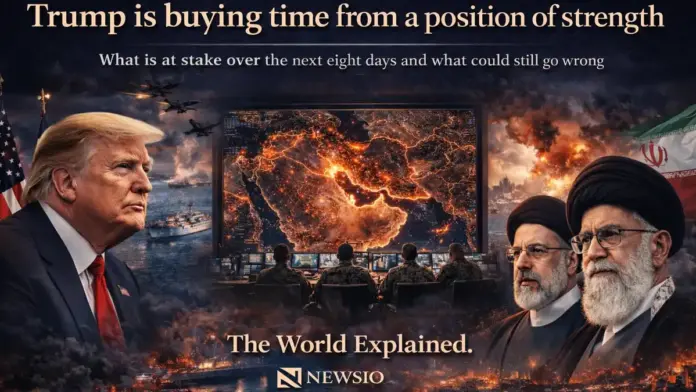
Trump is buying time from a position of strength: what is at stake over the next eight days and what could still go wrong
If this crisis is going to be explained honestly, the first thing to say is also the most important one: this does not look like peace. It looks like a temporary pause that the United States accepted from a position of strength, while Iran entered it from a position of strain, distrust, and political necessity.
President Donald Trump has said U.S. forces will remain around Iran until Tehran complies with the deal, and he has openly threatened renewed military action if that compliance does not come. That is not the language of a stable settlement. It is the language of a pause under pressure.
This is why the next eight days matter so much. They are not just calendar days inside a ceasefire. They are a test of whether Washington can turn military advantage into a more durable political result, or whether the crisis will swing back into open confrontation through Hormuz, Lebanon, and mutual distrust.
Reuters reports that the White House is pressing for full reopening of the Strait of Hormuz without tolls, while Iran continues to signal that it wants leverage, conditions, and room to protect its own narrative.
For readers who followed the earlier escalation, this article belongs in the same line as Newsio’s earlier English analysis, Trump–Iran: The 10–15 Day Window and Strike Claims Explained and Trump did not buy peace — he bought time from a position of strength. The story has not ended. It has simply moved into a harder phase, where fewer bombs do not necessarily mean less danger. They can mean the danger has become more political, more economic, and more deceptive.
What has actually happened so far
The public picture now has four core elements.
First, there is a real two-week pause, and the U.S. is treating it as conditional rather than final. Trump says American forces will stay in place around Iran and that shooting resumes if Tehran does not comply. Reuters also reports that Washington is still pressing hard on Hormuz and on Iran’s obligations under the deal.
Second, Tehran is not behaving like a side that trusts the process. Iranian officials have continued to push back on key U.S. interpretations, especially around nuclear restrictions and the terms of maritime access. The ceasefire exists, but the meaning of the ceasefire is still contested. That alone makes it fragile.
Third, the Strait of Hormuz remains the center of gravity. Reuters reported that Iran would allow no more than 15 vessels per day through the strait, far below normal commercial flow, even as the pause took effect. That is not normal maritime life. That is controlled passage under political and military stress.
Fourth, the wider region is still unstable. Israeli attacks in Lebanon have continued, and major international coverage has warned that this could undercut or politically poison the pause. In other words, the bilateral U.S.-Iran track is not the whole battlefield.
Why this looks more like strategic time than peace
The strongest reading of the moment is not that Trump found common ground with Tehran. It is that Washington judged a two-week pause more useful than immediate deeper escalation.
That matters because a superpower does not usually pause at this stage to hand initiative to the other side. It pauses when time itself becomes strategically valuable. Publicly, the United States has paired the pause with continued military readiness, threats of renewed force, and demands over Hormuz. Reuters reports that this is happening while the U.S. still maintains major force posture in the region and pushes for compliance rather than mutual accommodation.
That does not prove every specific behind-the-scenes move. It does not prove every aircraft shift, weapons transfer, or undisclosed planning step. But it strongly supports a more limited and more accurate conclusion: this pause is being used by Washington as a strategic window, not as a surrender of leverage. That is the disciplined inference from the public posture.
For broader English-only internal context on how this kind of pressure works in real terms, readers can also look at The U.S. strategy toward Iran: the pressure points that could shape the next phase. That piece matters because it explains the deeper logic behind pressure on maritime leverage, infrastructure, and regime resilience rather than treating the conflict as a simple exchange of strikes.
Why Hormuz is still the real test
If someone wants to know whether the crisis is calming or merely changing shape, the best place to watch is not a press conference. It is Hormuz.
The White House wants the strait reopened without tolls. Iran appears to want controlled access, leverage, and continued influence over passage. Reuters reported that Tehran has emerged from the opening phase of the war bruised, but still with real leverage over Hormuz. That is why this passage matters more than the headline language of diplomacy.
This is exactly why Newsio has already emphasized the issue in Strikes on energy infrastructure and a ship hit in the Strait of Hormuz and Fuel Prices Surge: How wars move oil markets and what the public should actually watch. The public does not need mythology here. It needs a simple truth: Hormuz does not have to be fully closed to shock the world. It only needs to become uncertain, restricted, expensive, or politically weaponized.
That same point is reinforced externally by the International Energy Agency’s Middle East and global energy markets analysis, which shows why disruption in this corridor hits energy security and the global economy far beyond the Gulf.
What could go wrong over the next eight days
There are at least four major ways this can break badly.
The first is conflicting interpretations of the deal. If Washington and Tehran think they agreed to different things, then the ceasefire contains its own collapse mechanism. Reuters and other major reporting already show this problem around uranium enrichment, maritime access, and enforcement.
The second is a maritime incident in Hormuz. A mine threat, a limited blockade, an attack on a vessel, or even a tighter passage cap could quickly turn this pause back into confrontation. The AP has already highlighted possible mine fears and the strait’s fragility.
The third is Lebanon. Israeli operations there are not a side note. They are one of the main reasons this pause may fail before it has real time to mature. If Tehran concludes that the pause is being used to pressure its allies elsewhere while Washington still calls it diplomacy, the political room for de-escalation shrinks even further.
The fourth is narrative warfare. Misinformation tends to run ahead of verification during exactly this kind of phase. A ceasefire can be sold internally as victory. Tactical survival can be packaged as strategic triumph. That does not make it true. It makes the information environment part of the conflict itself.
The regime’s internal narrative and the problem of truth inside Iran
This is one of the hardest parts of the story, and one of the most important.
The Iranian people are not the Iranian regime. A serious publication has to hold that line with total clarity. But it also has to say something else plainly: information inside Iran does not move under normal free conditions. The regime has strong incentive to present survival as victory, pressure as resistance, and tactical breathing room as proof of strength. That does not mean all Iranians believe the same thing. It means the internal information environment is structured by fear, control, and propaganda far more than by open contest of facts.
That is why public celebrations by regime-adjacent voices should be read with discipline. They may reflect real support in some circles. But they also reflect the information conditions under which such narratives are produced and amplified. The point is not to mock them. The point is to understand them. This is not proof that Iran “won.” It is proof that the regime is trying to sell a version of events that protects its internal legitimacy at the exact moment it is under severe external pressure.
For readers who want the people-versus-regime distinction kept morally clear, Newsio has already covered that angle in The Regime in Tehran, the Billions It Reached, and the People It Never Chose to Build and Pezeshkian’s Letter to Americans and the Regime’s Double Language.
This is not a final victory story for anyone
There is another mistake that serious analysis has to avoid: assuming that strong U.S. leverage automatically means the story is over.
Washington clearly looks stronger right now. Trump is speaking from advantage. U.S. military posture remains forceful. The global economy reacted as though the immediate worst case had been pushed back. But that is not the same thing as a stable end-state. Reuters’ broader analysis notes ambiguity, domestic skepticism, and unresolved strategic goals even after tactical gains.
And Tehran, for all the damage it has taken, still has cards. Hormuz is one. Internal narrative control is another. Regional spillover remains a third. So the cleanest description is not “the crisis is over.” It is “the crisis has entered a more dangerous phase to misread.” That phase is quieter than all-out escalation, but potentially more treacherous because it invites false certainty.
What readers should actually watch next
If readers want to understand the next eight days without drowning in noise, they should watch four things.
Watch Hormuz. If vessel flow stays restricted, the crisis is still alive in its core form.
Watch Lebanon. If Israeli strikes keep widening there, the pause becomes harder to sustain politically.
Watch the U.S. tone. If the White House shifts from “pause” language back toward hard enforcement language, that is a major signal. Reuters has already shown that Trump is keeping that option open.
Watch the gap between internal claims and external reality. The more the regime sells victory at home while shipping, energy, and diplomacy remain unstable, the more obvious it becomes that propaganda is trying to outrun facts.
The clear conclusion
Newsio does not exist to decorate confusion. It exists to explain the world.
And the world, right now, looks like this:
There is no stable peace.
There is no real trust.
There is no full return to normality.
There is a pause.
There is pressure.
There is leverage.
And there is a superpower using time as a strategic asset while a wounded regime tries to hold on to what it still can.
That is the real shape of this moment.