
Table of Contents
Trump is buying time from a position of strength: why the two-week pause is not peace and what is really at stake now
This is not peace. It is a pause under pressure.
The clearest way to explain this moment is also the simplest: the two-week U.S.-Iran pause does not read like peace. It reads like a temporary suspension inside an active crisis, with Washington speaking from a position of leverage and Tehran speaking from a position of strain, distrust, and internal political need.
President Donald Trump has said U.S. forces will remain around Iran until Tehran complies, and he has publicly warned that military pressure can return if the deal breaks down. That is not the language of a settled peace. It is the language of a power that believes it still holds the initiative.
That is why the phrase that fits best here is not “Trump found peace.” It is: Trump bought time from a position of strength. A superpower does not usually accept a narrow pause at a moment like this because it has suddenly relaxed. It accepts one because time itself can become a strategic asset: time to hold military advantage, time to press for compliance, time to force the other side into harder choices, and time to test whether battlefield gains can be turned into political results. That is the underlying logic of the current phase.
Readers who followed the earlier escalation can see the continuity in Newsio’s prior coverage, including Trump–Iran: The 10–15 Day Window and Strike Claims Explained, Trump did not buy peace — he bought time from a position of strength, and The U.S. strategy toward Iran: the pressure points that could shape the next phase. The story did not end. It moved into a more deceptive phase, where fewer explosions can still mean more danger if the structure of the crisis remains unresolved.
The regime is selling “victory” while the facts point to something else
One of the most important pillars of this story is narrative control. Inside Iran, regime media and pro-regime voices have strong incentive to portray the two-week pause as proof of resilience, even as the broader public facts point to a far murkier reality.
A pause can be sold internally as victory when information is constrained, fear is managed, and the state needs to preserve legitimacy after severe pressure. That does not make the claim true. It makes it politically useful to the regime. This is exactly why misinformation thrives in moments like this: because narrative needs move faster than truth.
The more disciplined reading is this: Iran does not look like a clean winner. Reuters’ broader reporting describes a country that emerged bruised but still dangerous because of its leverage over the Strait of Hormuz.
That is a very different thing from strategic victory. It means the regime still has cards. It does not mean the regime reversed the balance of power. In fact, the very need to stage endurance and defiance as triumph suggests the opposite problem: survival has to be packaged as success because the internal political story must not collapse.
This is where Newsio’s people-versus-regime distinction matters. The Iranian people are not the regime ruling them. That moral line remains essential. For internal context, the same distinction runs through The Regime in Tehran, the Billions It Reached, and the People It Never Chose to Build and Pezeshkian’s Letter to Americans and the Regime’s Double Language. A serious publication does not confuse a controlled internal narrative with the free judgment of an entire society.
The United States is not stepping back. It is holding the field.
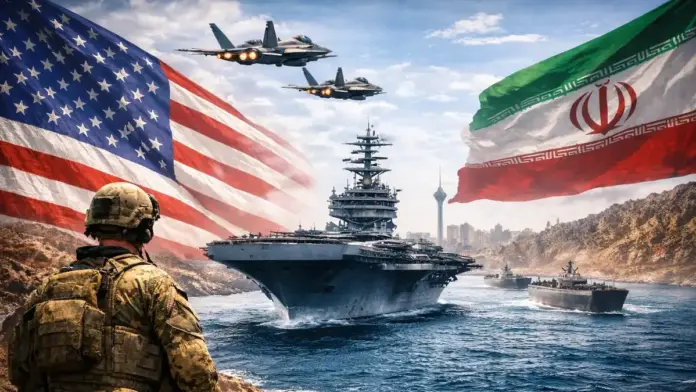
The second major pillar is military posture. This is where the article has to stay forceful but precise. It would be sloppy to suggest that U.S. forces are simply “on vacation” during the pause. The public record points to something more serious: the United States is remaining deployed, keeping pressure in place, and preserving the option of renewed action if the diplomatic window fails.
Reuters’ reporting makes that plain. Washington is not talking like a side that has disengaged. It is talking like a side that believes it can afford to wait because it still controls the larger strategic geometry.
That is the deeper meaning of “buying time from a position of strength.” It does not require hidden fantasies or unverified claims about every undeclared move behind the scenes. It only requires reading the open posture correctly. A government that keeps its forces in place, threatens a return to action, presses for maritime compliance, and frames the pause as success is not acting as though the crisis is over. It is acting as though the pause serves its interests better than immediate further escalation.
This also aligns with Newsio’s existing internal analysis network. Strikes on energy infrastructure and a ship hit in the Strait of Hormuz and Fuel Prices Surge: How wars move oil markets and what the public should actually watch already show how force, shipping, and market psychology interact. The current pause fits that same architecture. It is not military silence. It is strategic management.
Hormuz is the real battlefield now
If there is one place where the truth of this crisis becomes visible, it is the Strait of Hormuz. Not in slogans. Not in victory speeches. In shipping flow. In legal arguments over passage. In tanker traffic. In insurance stress. In energy prices.
Reuters reported that Iran would permit no more than 15 vessels a day through the strait, far below normal conditions, while the UN’s maritime agency warned that talk of tolls would set a dangerous precedent under international law. That means the strait is not back to normal. It remains political, militarized, and contested.
This matters globally. Hormuz is not a regional detail. It is one of the world’s most critical energy chokepoints. That is why the external authority link in this article belongs naturally here: as the International Energy Agency’s Middle East and global energy markets analysis makes clear, disruption in this corridor affects energy security, shipping stability, and the wider global economy. This is also why the topic belongs inside Newsio’s wider internal web of coverage, including Strait of Hormuz: closure claims, data, and real-world implications, Strikes on energy infrastructure and a ship hit in the Strait of Hormuz, and Fuel Prices Surge. The site’s strength is exactly that: one crisis, many linked angles, one coherent truth structure.
And this is the practical point readers need most: as long as Hormuz remains restricted, politically weaponized, or legally uncertain, the crisis is still alive. A pause in bombing does not cancel a choke point. It only changes the form of the pressure.
What is actually at stake now
The first thing at stake is whether Washington can convert military leverage into political compliance. That is the core test of the next phase. The pause only helps the White House if it yields something tangible: freer passage, clearer Iranian concessions, or stronger proof that U.S. pressure worked. If none of that arrives, the pause becomes strategically less useful and the argument for renewed coercion grows stronger.
The second thing at stake is the credibility of U.S. power. This crisis is not just about one bilateral confrontation. It is about whether a superpower that claims to protect maritime order can actually restore reliable passage through one of the world’s most important energy corridors.
If the answer remains uncertain, then the issue ceases to be merely Middle Eastern. It becomes a test of deterrence, reputation, and systemic authority. That is one reason NATO diplomacy is already being pulled toward Hormuz commitments.
The third thing at stake is the global economy. Market relief after the pause was real, but relief is not the same thing as repair. Oil, freight, insurance, and investor confidence remain tied to whether Hormuz actually normalizes.
Reuters and other coverage show that this has not happened yet. So the public should not read the recent market bounce as proof that the danger has passed. It is better understood as a temporary repricing away from the immediate worst case.
What could still go wrong
The first risk is a fresh incident in Hormuz. It does not take total closure to destabilize the pause. A mine alert, a vessel seizure, a new passage restriction, or a toll enforcement move could quickly shake markets and diplomacy all over again. The AP and Reuters both indicate that the strait remains fragile enough for exactly that kind of danger.
The second risk is regional spillover through Lebanon. The Guardian’s reporting makes clear that continued Israeli military action there is already straining the political meaning of the U.S.-Iran pause. If Tehran concludes that the pause is being used while allied pressure continues elsewhere, the room for de-escalation shrinks.
The third risk is conflicting interpretations of the deal itself. If Washington and Tehran believe they agreed to different things on compliance, enrichment, or shipping rules, then the seeds of breakdown already exist inside the arrangement. That is what makes this period more dangerous than it looks: it is not only about what each side does, but about what each side thinks the other promised.
The fourth risk is propaganda outrunning reality. If the regime continues to sell internal victory while the outside world sees restricted shipping, unresolved disputes, and continued force posture, then the information war becomes a conflict multiplier. False certainty inside a closed narrative system is one of the fastest ways to harden a dangerous misreading of the moment.
The clear conclusion
Newsio does not exist to inflate confusion. It exists to explain the world.
And the world, right now, looks like this:
There is a two-week pause.
The regime is trying to sell it as victory.
The United States is not stepping back.
Hormuz remains the real center of danger.
The economy has taken a breath, not found safety.
And the next days will show whether Washington can turn leverage into a more stable result, or whether this pause becomes the prelude to a harsher phase.
That is the real shape of this moment.