

Table of Contents
Trump Escalates in Hormuz: What the U.S. Blockade of Iranian Ports Really Means for Oil, Shipping, and the West
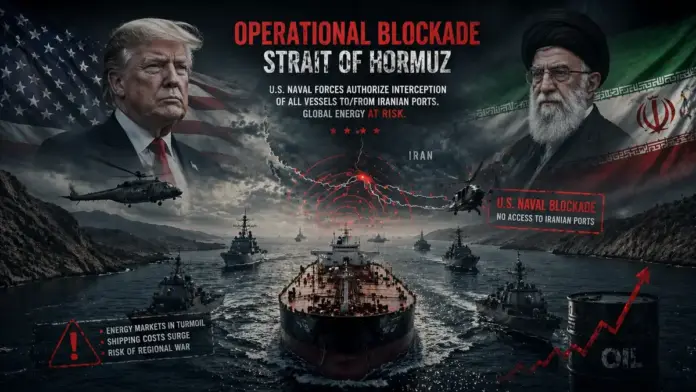
The first correction has to come at the very top. Washington has not announced a total closure of the Strait of Hormuz for all ships and all countries. What the United States has announced — through President Donald Trump’s order and U.S. Central Command’s operational notice — is a naval blockade targeting maritime traffic going to and from Iranian ports in the Gulf and the Gulf of Oman.
Transit through Hormuz to non-Iranian destinations is still, at least formally, allowed. But that distinction does not make the move small. It makes it more precise, while keeping it deeply escalatory.
Reuters reported that vessels entering or leaving the blockaded area without authorization could face interception, diversion, and capture, while AP reported that oil prices jumped sharply after the announcement.
That means the most accurate framing is not “Trump closes Hormuz for the world,” but “Trump imposes a U.S. naval blockade on Iran’s maritime access inside the strategic environment of Hormuz.” The difference matters.
A full shutdown of Hormuz would amount to an immediate chokehold on the wider Gulf. What has been announced instead is narrower in legal wording but still enormous in strategic effect: ships heading to Iranian ports, or departing from them, may now be stopped by U.S. forces regardless of flag.
Reuters said the blockade applies to vessels from any country accessing Iranian ports on the Arabian Gulf and Gulf of Oman.
The broader reality, however, is the same one markets immediately understood. Once the strongest navy in the world says it will enforce a blockade in the waters surrounding the world’s most sensitive energy chokepoint, the situation stops being a rhetorical standoff and becomes an operational crisis.
AP said oil prices surged after the announcement, with U.S. crude and Brent both rising sharply, while Reuters reported Brent moving back above $100 as markets priced in disruption risk rather than mere political theater.
What the United States actually announced
The clearest factual line comes from the U.S. military notices reported by Reuters. CENTCOM said the blockade would begin on April 13 and would apply to all maritime traffic entering and exiting Iranian ports.
Reuters later reported that the enforcement zone would extend through the Gulf of Oman and the Arabian Sea east of Hormuz, and that humanitarian shipments would be allowed but inspected.
This is crucial because it means the measure is not only symbolic and not only confined to the narrowest geographic reading of the Strait itself. It is a functional maritime enforcement action against Iran’s seaborne commercial access.
The key technical nuance is that Washington is not declaring that every ship passing through Hormuz will be stopped. It is declaring that ships tied to Iranian ports can be stopped. Militarily, that is narrower than a total closure.
Politically, it is still a major escalation, because it is a unilateral blockade imposed by force against a state already in acute confrontation with Washington after the collapse of talks. Reuters reported that the move followed failed negotiations aimed at ending the recent U.S.-Iran conflict cycle.
In practical terms, the message to global shipping is brutal in its simplicity: you may still pass through Hormuz, but not in order to enter or leave the Iranian port system. That directly threatens Iran’s oil exports and maritime trade, while simultaneously creating enormous uncertainty for insurers, ship managers, charterers, commodity buyers, and flags of convenience that fear being drawn into a U.S. military enforcement environment through an otherwise commercial transaction.
Reuters explicitly noted that vessels could be intercepted, diverted, or seized.
Why Trump moved now
The immediate trigger appears to be the collapse of recent diplomacy. Reuters and AP both tied the announcement to failed talks and to the broader six-week conflict environment in which Washington and Tehran have been colliding over maritime access, regional power, and the nuclear issue.
In plain terms, the White House appears to have concluded that if it could not extract the outcome it wanted at the negotiating table, it would try to impose a far harsher cost through the sea.
Politically, Trump is trying to shift from the message “I will not tolerate more Iranian pressure in Hormuz” to the message “I will cut Iran off from its maritime lifeline if it refuses to yield.”
That helps explain why Moscow immediately warned that the blockade would be bad for markets, and why Reuters reported that around 2 million barrels per day of Iranian oil exports were directly exposed to the move.
For Newsio readers, this also connects naturally to the wider internal frame already built in English. Strait of Hormuz: What a “closure” claim really means is the clearest internal explainer on why even the word “closure” can move oil, fuel, and household costs within hours. And Trump, Netanyahu, Europe, and Iran: Why the West Is Splitting matters here because today’s blockade is not just an Iran story. It is also a Western cohesion story.
What changes inside Hormuz itself
The most dangerous part of this moment is not only what is formally prohibited. It is that the sea space has now become a zone of competing military interpretation. The United States says it is not closing neutral transit to non-Iranian destinations.
Iran, meanwhile, has already treated the blockade as an act of war and threatened retaliation against Gulf ports. Reuters reported those threats explicitly, while AP described a wider fear of spillover into port infrastructure and regional shipping.
That means even ships not bound for Iran may now operate inside a climate of delay, fear, insurance escalation, and possible miscalculation. Marine insurance does not price only the formal legal status of a corridor.
It prices the risk of accidents, interceptions, drones, missile strikes, mines, and panic reactions by commercial operators. Hormuz therefore does not need to be fully closed to trigger shock. It only needs to become dangerous enough that part of the market behaves as though effective disruption has already begun.
Reuters reported that traffic remained active but low before enforcement, and AP described shipping slowdowns as tensions worsened.
That is why the internal Newsio chain matters here. Strait of Hormuz: energy infrastructure strikes and ship hit already showed how quickly military escalation spills into the economic bloodstream of the region. Fuel Prices Surge: How wars move oil markets and what the data says about what comes next is also a natural internal bridge, because the market is already pricing fear, not just physical disruption.
Why the West does not look united
One of the most important political facts of the day is that key European allies are not lining up behind Washington. Reuters reported that NATO allies including the UK and France refused to join Trump’s Hormuz blockade effort. That is not a technical footnote. It is a strategic fracture.
The European logic appears to be that Hormuz must remain open and that, even if Iran is to be pressured, a unilateral U.S. maritime enforcement scheme against shipping to and from Iranian ports pushes the region too close to broader war.
In other words, Europe is not only arguing about how hard the West should push Tehran. It is arguing about whether this form of military pressure can still be separated from a much wider Gulf conflict. Reuters reported that London and Paris were unwilling to be drawn into the operation under current conditions.
That makes today’s development the practical expression of a split Newsio already identified in Trump, Netanyahu, Europe, and Iran: Why the West Is Splitting. The disagreement is not cosmetic. It is about strategy, legality, escalation control, and who bears the price if deterrence fails.
What it means for oil, shipping, and the economy
Hormuz remains the most important energy chokepoint in the world. Once a U.S. blockade aimed at Iranian ports is layered on top of that geography, the effect is not limited to Iranian exports alone. The larger effect is a repricing of maritime risk across the region. Markets do not only ask how many barrels are cut today. They ask what happens tomorrow if Iran retaliates, if Gulf ports are hit, if war-risk premiums surge, or if shipowners simply refuse exposure.
AP already reported a jump of roughly 7% to 8% in benchmark prices after the U.S. announcement, while Reuters said Brent moved above $100 again. That is the market saying clearly that it does not see this as mere messaging. It sees a real possibility of disruption to supply, shipping, and regional stability.
This is the point readers need to keep firmly in mind: even if the measure is directed at Iran, the consequences will not stay inside Iran. They will spread through insurance, freight, inflation expectations, fuel costs, industrial inputs, and political pressure in Europe and Asia.
That is why the strongest external authority baseline here is Reuters’ reporting on the U.S. enforcement notice in the Gulf of Oman and Arabian Sea and AP’s reporting on oil prices rising after the U.S. said it would block Iranian ports. These are not peripheral business effects. They are the core of why Hormuz matters globally.
What Iran can do now
Tehran has multiple ways to respond, and none of them are low-risk. One option is calibrated military intimidation without immediate full-scale war: more threats to shipping, more pressure on regional infrastructure, more harassment at sea.
Another is diplomatic framing: to present the U.S. blockade as unlawful war-making and try to mobilize international opposition, especially among states unwilling to let Washington act as the sole enforcer of access through the world’s most sensitive oil route.
A third is to lean into market fear itself — to make the global economic cost of the blockade so visible that pressure shifts back onto Washington. Reuters and AP both described Iranian threats and the fear of regional retaliation.
That means Trump’s move does not only pressure Iran. It pressures the entire system’s tolerance for risk. If the crisis drags on, the next battles will not be fought only at sea or in the air. They will be fought in insurance markets, port security calculations, Western alliance politics, and global energy pricing.
Newsio readers looking for the broader Tehran-side logic can also connect this piece to When the Regime in Tehran Fears Collapse and Is Iran Threatening the World? What Is Real and What Is Propaganda?, because this crisis is also about how the regime uses external pressure and regional escalation to reframe its own struggle.
The key conclusion
The “Hormuz blockade” associated with Trump is real as escalation, but it requires precise wording. Based on what has been confirmed so far, this is not a full closure of the Strait for all shipping and all countries. It is a U.S. naval blockade targeting maritime access to and from Iranian ports within the operational geography of Hormuz and the Gulf of Oman. That alone is enough to push global risk sharply higher.
The second key point is that this move does not have unified Western backing. European allies are keeping their distance, which means Trump may have U.S. naval power but not full strategic legitimacy across the alliance.
And the third, most important point for readers, is that markets are already speaking. Oil is up, fear is being priced in, and anyone who thinks a Hormuz crisis stays “over there” has not understood what this passage really is: the place where geopolitics turns into cost for the entire world with brutal speed.