

Table of Contents
Trump, Netanyahu, Europe, and Iran: Why the West Is Splitting Over War, Regime Change, and the Future of the Middle East
The real rupture is not just rhetorical. It is strategic.
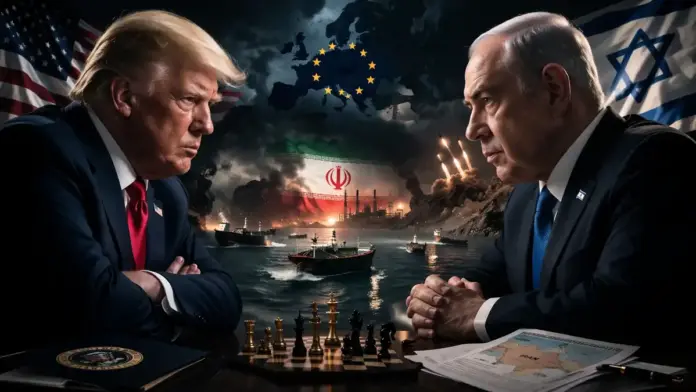
Donald Trump and Benjamin Netanyahu are not simply frustrated with Europe. They are colliding with a different European reading of the Iran crisis itself. Washington and Tel Aviv increasingly frame the war through pressure, coercion, and what they see as a historic opening against the Iranian regime.
Much of Europe, by contrast, sees a widening conflict with unclear political aims, large legal and strategic risks, and potentially devastating consequences for energy, shipping, and regional stability. That difference is no longer subtle. It is now visible in airspace decisions, base access, diplomacy, and public language.
That is why the current dispute should not be reduced to a headline like “Trump attacks Europe.” The deeper story is that the Western bloc is no longer operating from one common theory of the Iran problem. The U.S. and Israel increasingly act as if force can break the strategic deadlock and possibly reshape the regime question itself. Europe, or at least key parts of it, acts as if that same strategy could produce a much wider regional fire without a coherent political end state.
This divide matters far beyond diplomacy. It affects NATO cohesion, the legality and logistics of military operations, the future of the Strait of Hormuz, energy markets, and the larger question of whether “regime pressure” is the same thing as a workable postwar strategy. For readers who want the wider Newsio frame on how Hormuz turns war into global economic pressure, the internal explainer Strait of Hormuz: What a “closure” claim really means fits naturally here.
What Trump is really attacking when he attacks Europe
Trump’s criticism of Europe is not only about morality or alliance discipline. It is about burden, obedience, and operational usefulness. Reuters reported that France refused to allow certain U.S. military flights related to the Iran war to cross its airspace, prompting Trump to publicly accuse Paris of being “very unhelpful” and to suggest Washington would remember it. Reuters also reported that Italy denied use of the Sigonella base in Sicily for some U.S. operations, while Spain closed its airspace to U.S. planes involved in attacks on Iran.
Those are not cosmetic disagreements. They are operational refusals. They tell Washington that key allies are not prepared to translate alliance language into direct military support for this war. In Trump’s worldview, that looks like weakness, freeloading, or strategic ingratitude. In the European worldview, it looks more like refusing to be drawn into a conflict whose legal basis, escalation path, and political endpoint remain highly contested.
This is where Trump’s anger becomes structurally important. He is not simply saying Europe is timid. He is saying Europe is failing a loyalty test at precisely the moment Washington believes the Iran file requires hard alignment. That is also why the issue bled into broader alliance questions. Reuters reported that Defense Secretary Pete Hegseth even declined to reaffirm NATO’s collective-defense commitment in straightforward terms, saying it was ultimately up to Trump. That is an extraordinary signal in the middle of an alliance dispute.
Netanyahu’s argument is different from Trump’s, but it pushes Europe in the same direction
Netanyahu’s language is not identical to Trump’s, but it leads toward the same strategic pressure point. Reuters reported that Netanyahu said the war against Iran could open a path toward the fall of the regime, while also saying such a process cannot simply be guaranteed by Israel alone. In other words, the Israeli position increasingly implies that the conflict is not only about immediate military degradation. It is also about reshaping the political future of Iran.
That matters because Europe is far less willing than Israel to think in regime-change-adjacent language, especially in a live war. For European capitals, the memory of Iraq, Libya, and other destabilizing interventions remains close enough to make them deeply suspicious of military campaigns whose political horizon is undefined or overpromised.
Germany’s Chancellor Friedrich Merz said openly that he had doubts about the aims of the war and stressed that any future European role in stabilization would require an international mandate and parliamentary approval.
So while Trump pressures Europe as an ally that should “do more,” Netanyahu pressures Europe more indirectly by advancing a theory of victory that many European governments do not trust. Europe hears not just battlefield resolve, but strategic ambiguity: what exactly comes after intensified pressure on Tehran, and who pays if the answer is fragmentation, prolonged conflict, or regional spillover?
For the internal Newsio angle on how wartime claims and compressed timelines should be read carefully rather than emotionally, Trump–Iran: The 10–15 Day Window and What We Actually Know belongs naturally in this discussion.
Europe is not “doing nothing.” It is choosing a different theory of action.
This point matters because a lot of polemical language flattens Europe’s position into passivity. That is not accurate. Reuters reported that EU foreign-policy chief Kaja Kallas said Europe saw its role primarily in diplomacy and, later if needed, in helping restore safe passage through Hormuz, not in joining a war it did not start. France has also approached around 35 countries over a possible future post-conflict Hormuz mission, emphasizing that such an operation would be defensive and focused on maritime security rather than participation in the war itself.
That is a very different theory of power from the U.S.-Israeli one. Europe is effectively saying: we may contribute to de-escalation, maritime stabilization, and possibly post-conflict security architecture, but we will not simply convert ourselves into a support platform for an open-ended campaign against Iran. Spain has gone even further rhetorically, framing the war as reckless and illegal and rejecting participation outright.
This does not mean Europe is strategically superior. It means Europe is strategically different. It is trying to preserve room for diplomatic relevance and postwar legitimacy rather than joining a campaign whose stated and unstated objectives still appear unstable. That difference is exactly what infuriates Washington and frustrates Israel. Europe is not validating the theory that more pressure automatically brings better outcomes.
The phrase “liberating Iran” is politically powerful—and strategically dangerous
One of the most seductive narratives in wartime is that pressure on a regime can be morally recoded as liberation of a people. The problem is that this language often outruns the policy beneath it. There is no doubt that the Iranian regime is repressive, violent, and destabilizing. Reuters has reported intensifying crackdowns inside Iran, widespread fear of unrest, and deep regime anxiety about internal fracture under war conditions. But none of that automatically proves that outside military escalation produces orderly liberation.
This is where Europe’s caution becomes easier to understand. European governments are not blind to the nature of the regime in Tehran. They are unconvinced that joining a U.S.-Israeli war is the same thing as helping the Iranian people. That distinction is not moral softness. It is historical memory plus strategic caution. They know that the collapse or weakening of an authoritarian system under external attack can generate outcomes far messier than the rhetoric of freedom suggests.
So when American and Israeli rhetoric implies that Europe is failing to support Iran’s liberation, the European answer is essentially this: war is not automatically a liberation mechanism, and no serious state should pretend otherwise without a clear political theory for the day after. That is the real disagreement. It is not just about courage. It is about whether force can deliver the political outcome its advocates imply.
For readers who want the energy-and-economy side of why Europe is so cautious, Newsio’s internal explainer Fuel Prices Surge: How wars move oil markets and what the data says about what comes next is part of the same story.
Why Hormuz sits at the center of the European calculation
Europe’s position cannot be understood without Hormuz. Reuters reported that the Strait’s disruption has sent energy markets into severe stress, with Brent recording huge monthly gains and Europe confronting inflation and gas-price consequences from a war not of its own making. European ministers have already had to discuss coordinated responses to energy-market fallout.
That changes everything. To Washington and Israel, Hormuz pressure may be part of the strategic contest with Tehran. To Europe, Hormuz is also an economic threat vector. It is a shipping, fuel, inflation, and industrial-risk problem. This helps explain why France and others are thinking in terms of a future defensive maritime mission, not wartime co-belligerence. Europe wants to protect the corridor without owning the war.
This is one reason the split looks deeper than a temporary diplomatic spat. Each side is prioritizing a different fear. Washington and Tel Aviv fear that restraint allows Tehran to survive and regroup. Europe fears that participation locks it into escalation, legal ambiguity, and severe economic blowback without any reliable political payoff. Both fears are real. But they point toward opposite strategies.
The West is now divided not only over means, but over ends
This may be the most important point in the entire article.
Disagreements over military means are common in alliances. What is happening now looks deeper because it includes a disagreement over political ends. Is the objective to punish Iran, deter Iran, degrade Iran, negotiate with Iran from strength, or open the way to a transformed Iranian political order? The U.S. and Israel increasingly sound as if several of those goals can coexist. Much of Europe sounds unconvinced that they can be fused so easily.
That matters because alliances can often survive arguments over tempo or tactics. They struggle much more when the underlying theory of victory begins to diverge. If one camp thinks escalation creates opportunity and another thinks escalation creates uncontrollable risk, they are no longer fighting over details. They are inhabiting different strategic universes.
This is also why Europe’s refusals feel so provocative to Trump. From his point of view, they do not merely slow operations. They imply doubt about the entire strategy. And from the European side, that doubt is the strategy: keep distance from military ownership, preserve diplomatic space, and avoid inheriting the consequences of a war whose political destination remains blurry.
What this fracture means for the future of the Middle East
The split matters because the future regional order cannot be built by force alone. Even if Washington and Israel succeed in inflicting major damage on Tehran’s military and strategic infrastructure, the political aftermath will still require legitimacy, maritime stabilization, economic management, and some wider international architecture. Europe is already positioning itself around that later phase, even while refusing to validate the current war phase fully.
That positioning may yet prove pragmatic. Or it may later look evasive if the conflict produces a genuine opening and Europe appears absent when strategic decisions are being made. But for now, Europe has made a calculation: it would rather risk being accused of timidity than risk becoming co-owner of a war it does not trust.
The deeper implication is severe. The West is not only arguing about Iran. It is arguing about how power should be used in a fractured century: when coercion is justified, when regime pressure becomes regime fantasy, when alliance loyalty ends, and when economic interdependence becomes a veto on military enthusiasm. That is why this story is so much larger than one Trump outburst or one Netanyahu statement. It is a test of whether “the West” still exists as a coherent strategic subject when the stakes become truly high.
What readers should keep
First, Trump’s criticism of Europe reflects a real strategic clash, not just irritation. France, Italy, and Spain have all limited or refused operational support for parts of the Iran war.
Second, Netanyahu’s posture pushes the same divide from another angle: the war is increasingly discussed not only as deterrence, but as pressure on the future of the Iranian regime itself. Europe is far less willing to think in those terms.
Third, Europe is not absent. It is choosing diplomacy, legal caution, and potential postwar maritime stabilization over wartime participation.
Fourth, the core fracture is this: Washington and Tel Aviv increasingly see opportunity in force, while much of Europe sees escalation without a trustworthy political landing. That is why the split matters—and why it may shape not only Iran, but the future strategic coherence of the West itself.