

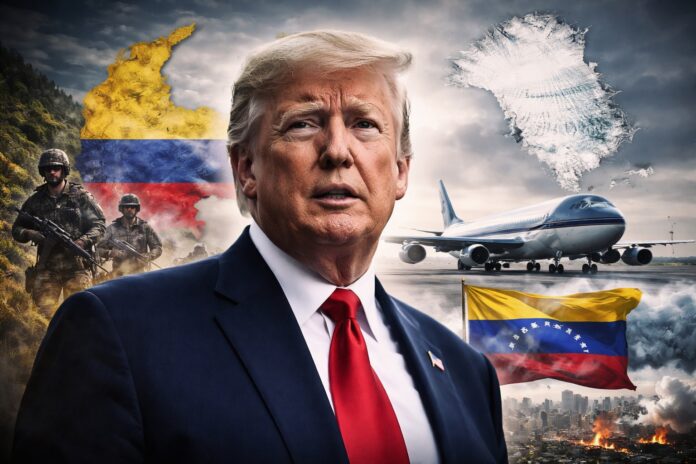
Introduction: A New Phase in American Power Projection
In the aftermath of the bold U.S. strike that resulted in the capture of Venezuelan President Nicolás Maduro, President Donald Trump has not only defended the operation but has escalated U.S. rhetoric into new and controversial territory.
While aboard Air Force One answering reporters’ questions, Trump went beyond commenting on the Venezuela intervention — he issued pointed warnings to neighboring governments and reaffirmed ambitious strategic targets far beyond the Caribbean. Fox News+1
His remarks — including a blunt declaration that “we’re in charge” of Venezuela and calls for expanding U.S. influence over regions such as Greenland — have sparked intense debate globally about American foreign policy, hemispheric sovereignty, and the limits of power in the 21st century. Βικιπαίδεια+1
1. “We’re in Charge”: Trump’s Assertion of Control Over Venezuela
Following the dramatic U.S. military operation in Venezuela — dubbed Operation Absolute Resolve — American forces captured Nicolás Maduro and transported him to New York to face charges related to narcoterrorism and drug trafficking. Βικιπαίδεια
In a press interaction aboard Air Force One, Trump went further than simply defending the strike:
“It means we’re in charge,” he told reporters when asked who would govern Venezuela following the successful extraction of Maduro from Caracas. The Times
The assertion cemented a controversial narrative: that the United States, having forcibly removed a foreign head of state, would temporarily oversee Venezuelan governance until a transition could be implemented — even as Venezuela’s Supreme Court installed Vice President Delcy Rodríguez as acting president and denounced the operation as illegitimate. The Guardian
2. Trump’s Expanded Threats: Colombia in the Crosshairs
Trump’s remarks didn’t stop with Venezuela. While addressing questions about drug trafficking and regional instability, he turned his gaze toward Colombia, a longtime U.S. partner and major Latin American state.
According to Trump:
“Colombia’s very sick too, run by a sick man who likes making cocaine and selling it to the United States. He’s not going to be doing it very long.”
This was directed at Colombian President Gustavo Petro, whom Trump accused of harboring drug production and trafficking networks. Fox News+1
Pressed on whether military action could extend to Colombia in a manner similar to Venezuela, Trump replied:
“It sounds good to me.”
This statement raised alarm bells in Bogota and throughout the hemisphere, as it implied possible U.S. operations on the territory of a sovereign democracy — an escalation beyond typical diplomatic pressure. Fox News
The aggressive tone follows a spiral of criticism and sanctions the Trump administration has already leveled at Colombia for its perceived lack of cooperation in the drug war, including sanctions on Petro’s family and government figures. AP News
3. Greenland: Strategic Ambition or Provocation?
In a dramatic pivot that has drawn ridicule and concern from allies, Trump also renewed his contention that the United States “needs Greenland from the standpoint of national security.” AP News
Greenland, an autonomous territory of the Kingdom of Denmark and a NATO ally, is rich in strategic value due to its location near Arctic shipping routes and natural resources. Trump’s language suggested that U.S. security interests outweigh existing diplomatic norms—an implication received coldly by Denmark, which has emphasized the inviolability of its territory’s sovereignty. The Times
Although purely rhetorical at this point, the statement echoes Trump’s earlier political interests in the island during his previous presidency, and it signals continued U.S. prioritization of Arctic influence amid Russian and Chinese activity in the region. euronews
4. Broader Geopolitical Context: Cuba, Mexico, and Beyond
Trump’s heightened rhetoric isn’t limited to Colombia and Greenland. According to AP News, the administration’s focus also includes pressure on Cuba due to its historical alliance with Maduro and potential economic fallout from its Cuban oil support system. AP News
The Trump administration has framed its Venezuela policy within an expanded interpretation of the Monroe Doctrine and even hinted at a modernized “Donroe Doctrine,” signaling U.S. intent to reassert American dominance in the Western Hemisphere. AP News
In remarks delivered concurrently, Trump has also suggested Mexico and Cuba could face consequences for failing to align with U.S. drug and security priorities — further complicating diplomatic relations across the region. ca.news.yahoo.com
5. International Reaction: Allies, Critics, and the Law
These statements have not gone unchecked. International reaction has been sharply critical:
-
Denmark has rebuffed Greenland ambitions, with its prime minister calling U.S. threats “absurd” and emphasizing sovereign integrity. The Times
-
European Union representatives reiterated borders are “inviolable,” rejecting any suggestion of territorial acquisition. The Times
-
Colombia’s President Petro denounced Trump’s comments as slander and imperial intervention, asserting that threats against sovereign leaders undermine diplomatic norms. The Times
-
The United Nations and other global actors have questioned the legality of the Venezuela operation itself, setting the backdrop against which Trump’s broader threats are evaluated. Βικιπαίδεια
These reactions highlight a broader concern: that the post‑Maduro strategy, if unchecked, could erode international law norms around sovereignty and non‑intervention.
6. What This All Signals About U.S. Policy
Taken together, Trump’s comments while boarding Air Force One reveal a comprehensive and assertive foreign policy approach:
-
Operational readiness to conduct military interventions — even in sovereign nations — based on U.S. security claims. Βικιπαίδεια
-
A willingness to publicly threaten governments that fail to align with U.S. priorities, especially on drug trafficking and security. Fox News
-
Continued ambition to shape global power balances beyond Latin America, including strategic Arctic regions. euronews
This blend of rhetoric and military action reflects a presidency unafraid to leverage forceful language and implied coercion as tools of geopolitical influence — a trend likely to further strain alliances and reshape diplomatic norms in the coming years.
Conclusion: Power, Provocation, and the Future of Hemispheric Relations
President Trump’s statements following the Venezuela operation are far more than headlines; they delineate a foreign policy direction that prioritizes American authority through assertive language and action. By declaring that the U.S. is “in charge,” warning Colombia’s leadership, and reigniting ambitions over Greenland, Trump is signaling an expansive — and controversial — vision for American power.
Whether this approach will yield security and cooperation or provoke resistance and global backlash remains an open question. What is certain, however, is that these comments mark a defining moment in U.S. foreign policy — one that will resonate across capitals from Bogota to Copenhagen for years to come.