
Table of Contents
Trump’s answer: the military stays there, the pause is not peace, and the people of Iran are not the target
The pause is real. Peace is not.
The first thing a serious reader should understand is this: the two-week U.S.-Iran pause is not the same thing as peace. It is a temporary halt inside an active crisis, with Washington speaking from a position of leverage and Tehran speaking from a position of strain, distrust, and internal political necessity. Reuters reported that Trump said U.S. forces would remain around Iran until Tehran complies, making clear that Washington does not view this moment as a final settlement.
That is why the most accurate formula is still the strongest one: Trump bought time from a position of strength. He did not speak like a leader who believes the crisis is over. He spoke like a leader who froze the fire temporarily while keeping the military instrument in place and the option of renewed pressure open. Reuters’ reporting on U.S. posture, compliance demands, and pressure around Hormuz all points in that direction.
For Newsio readers, this article belongs in the same chain as Trump–Iran: The 10–15 Day Window and Strike Claims Explained, Trump did not buy peace — he bought time from a position of strength, and The U.S. strategy toward Iran: the pressure points that could shape the next phase. Those pieces matter because they show the same underlying logic from different angles: time here is not empty time. It is strategic time.
The military is still there because the pressure is still there
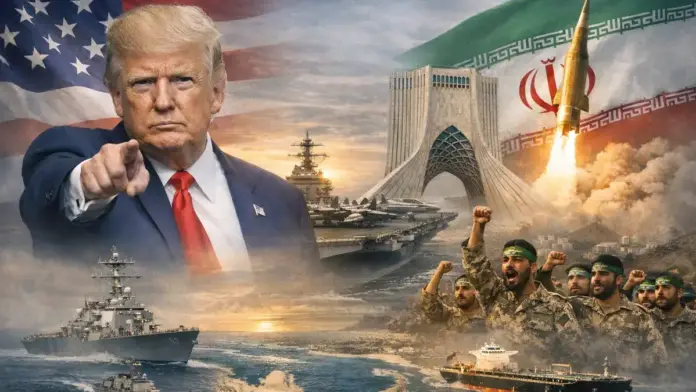
The public message from Washington is not “we are going home.” It is “we are staying in place and watching what Tehran does next.” That distinction matters. Reuters reported that Trump said U.S. military assets would remain around Iran until compliance is achieved. That posture does not look like a relaxed postwar drawdown. It looks like an active holding position, with the military tool still ready if diplomacy fails.
This is where careless language can hurt an otherwise strong article. It is not necessary to claim hidden facts that have not been publicly confirmed. The public posture is already strong enough. A government that keeps forces in place, publicly ties the pause to compliance, and leaves the door open to renewed action is using the pause as strategic leverage, not as a gesture of surrender or exhaustion. Reuters’ reporting supports that reading directly.
That is also why the line “the military stays there” is not rhetorical decoration. It is the operational core of the story. The United States is trying to see whether battlefield and coercive leverage can be translated into a more durable political result. Until that answer is clear, the force remains part of the equation.
The regime is selling “victory” because it needs to
One of the most important parts of this story is internal narrative management inside Iran. The regime has a strong incentive to present the two-week pause as proof of resilience and even as a kind of victory. That is politically understandable from the regime’s point of view. It does not make the claim credible. Reuters’ broader crisis reporting describes Iran as pressured, fragile, and still dangerous because of leverage over Hormuz, not as a clean strategic winner.
That is why victory messaging from regime-aligned voices should be read carefully. It may reflect real support in parts of the system. But it also reflects the needs of a power structure that cannot afford to look broken in front of its own base. A regime under pressure often has to package survival as triumph. That is not evidence of dominance. It is evidence of internal political necessity.
For readers who want this distinction kept morally clear, Newsio’s Iran Regime: Pezeshkian’s Letter and the Reality Behind It and The Regime in Tehran, the Billions It Reached, and the People It Never Chose to Build are essential companion reads. Both help separate diplomatic theater and regime messaging from the lived reality of people under coercive rule.
The people of Iran are not the regime
This is the moral center of the article and it has to stay sharp.
The people of Iran are not the regime ruling them. They are not the same thing politically, morally, or analytically. Reuters’ reporting on domestic fear, instability, and the regime’s concern about unrest points in exactly that direction, and Newsio’s own prior work has repeatedly made the same distinction.
That distinction matters even more in a crisis like this because authoritarian systems often hide behind the people they control. They speak in the name of the nation while restricting the nation’s ability to speak freely. That is why this story cannot be written as if “Iran” means one unified human will. It does not. It means a population living under a regime that fears truth, fears open communication, and fears what free circulation of information would do to its internal legitimacy.
For that reason, one of the strongest analytical corrections in the entire debate is very simple: the current U.S. posture, as publicly described, is aimed at regime behavior, strategic leverage, maritime access, and security calculations. It is not publicly framed as a war against the Iranian people as such. Keeping that distinction intact is not softness. It is accuracy.
Why free communication changes everything
This is where the human difference becomes impossible to ignore.
In the freer parts of the world, communication is close to ordinary life. A phone in a pocket. A signal. A message. A photograph. A post. A disagreement. A correction. The ability to receive information and to send it back into the world. That seems basic until you compare it with a system where the flow of truth is politically filtered and where the state has a permanent interest in shaping what reality is allowed to look like.
That is why this article is not only about ships, pressure, or Trump’s language. It is also about communication itself. A society that cannot move information freely cannot breathe freely. A people that cannot openly describe the moment they are living in do not fully possess the civic space that freer societies take for granted. That is not a side issue. It is one of the deepest parts of the crisis. Newsio’s Iran: no new mass uprising confirmed this week is useful here because it shows how public mood, pressure, and visible street reality can diverge under restrictive conditions.
Hormuz remains the real test
If there is one place where the truth of this pause becomes visible, it is the Strait of Hormuz. Reuters reported that Iran would allow no more than 15 vessels a day to pass, far below normal conditions. That alone is enough to show that the crisis has not normalized. It has only changed form. As long as passage remains politically restricted, militarily sensitive, or economically uncertain, the crisis is still alive at its core.
This matters far beyond the Gulf. Hormuz is one of the most important energy chokepoints in the world. The International Energy Agency’s analysis of the Middle East and global energy markets makes clear why disruption there carries consequences for shipping, energy security, and the broader world economy. That is why this article also belongs in the same internal Newsio web as Strikes on energy infrastructure and a ship hit in the Strait of Hormuz and Fuel Prices Surge: How wars move oil markets and what the public should actually watch. One crisis. Multiple connected explanations.
What is really at stake now
Three things are at stake at once.
First, Washington wants to know whether military and coercive leverage can produce a cleaner political result. The pause only benefits the White House if it yields something tangible: freer maritime conditions, clearer Iranian concessions, or evidence that U.S. pressure worked. Reuters’ reporting on compliance language and military posture makes that much clear.
Second, the credibility of U.S. power is on the line. This is not only about one bilateral file. It is about whether a superpower that claims to defend maritime order can actually restore confidence in one of the world’s most important sea corridors. If Hormuz remains politically weaponized, then the issue becomes larger than the immediate U.S.-Iran relationship.
Third, the global economy remains exposed. The pause may have reduced immediate panic, but it did not restore normality. Shipping uncertainty, restricted passage, and market sensitivity all show that the system has taken a breath, not found safety. Newsio’s own fuel and Hormuz coverage makes this chain visible for readers who want the practical consequences rather than only the geopolitical theater.
The clean conclusion
The most honest line is still the clearest one:
The military stays there. The pause is not peace. The people of Iran are not the target.
Washington is using time from a position of strength. Tehran is trying to control the internal narrative while preserving what leverage it still has. Hormuz remains the real pressure point. And the people of Iran remain trapped between the outside pressure of geopolitics and the inside control of a regime that does not speak for all of them.
That is the real shape of the moment.