

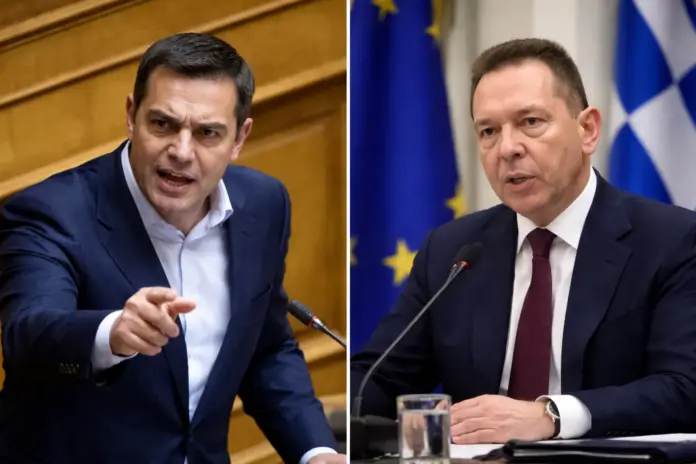
Tsipras–Stournaras Dispute Reopens the 2015 Debate
A renewed public clash between Bank of Greece Governor Yannis Stournaras and former Prime Minister Alexis Tsipras has brought Greece’s 2015 economic crisis back into the political spotlight.
At the center of the confrontation are contrasting interpretations of that turbulent year: whether certain decisions were unavoidable under extreme pressure, whether risks were miscalculated, and how institutional warnings were handled at the time.
The debate does not concern historical memory alone. It also touches on how institutional accountability and political responsibility are framed in times of economic crisis.
For background on the structure and institutional role of the central bank, the official profile of the Governor of the Bank of Greece outlines the scope of authority and responsibilities.
Political Narrative vs. Institutional Mandate
Two parallel discussions shape this confrontation.
The Political Dimension
From a political standpoint, the dispute revolves around competing narratives: who safeguarded economic stability, who assumed excessive risk, and what long-term costs resulted from strategic decisions in 2015.
Such disputes inevitably influence public perception of credibility and leadership. Political memory remains a powerful factor in shaping today’s discourse.
Coverage across the Politics section reflects how historical economic episodes continue to inform current political positioning.
The Institutional Dimension
At a different level, the debate concerns the independence of the central bank. The Bank of Greece operates within the Eurosystem framework and is not a political actor. Its role centers on financial stability, liquidity monitoring, and macroeconomic assessment.
Understanding this distinction is essential when evaluating public exchanges between elected officials and institutional officeholders.
Economic Context and Regulatory Evolution
Revisiting 2015 also reopens discussion about capital controls, liquidity pressures, and broader financial oversight mechanisms.
Since that period, regulatory and monitoring structures have evolved significantly. The framework for banking supervision, compliance, and financial transparency continues to adapt—an evolution explored in the analysis of bank transaction monitoring and regulatory oversight in Greece.
Although today’s institutional setting differs from 2015, the episode remains a reference point in debates about crisis management and systemic resilience.
For broader economic reporting and context, readers can explore the Economy section.
What Comes Next
The current dispute is likely to remain within the realm of political statements rather than formal institutional proceedings. However, it highlights an enduring issue: how to balance democratic political accountability with the operational independence of central banking institutions.
For readers, three elements deserve attention:
-
Clear distinction between documented facts and political interpretation.
-
Concrete evidence supporting claims about economic management.
-
Respect for institutional mandates while maintaining democratic scrutiny.
The 2015 crisis continues to function as a symbolic reference point in Greek political life. Whether this renewed confrontation leads to substantive clarification or remains rhetorical will depend on the depth of evidence presented in the coming weeks.
Summary
The Tsipras–Stournaras clash revives debate over Greece’s 2015 economic crisis, highlighting tensions between political interpretation and institutional responsibility. While the confrontation intensifies public discourse, the core issue remains the balance between political accountability and central bank independence.