

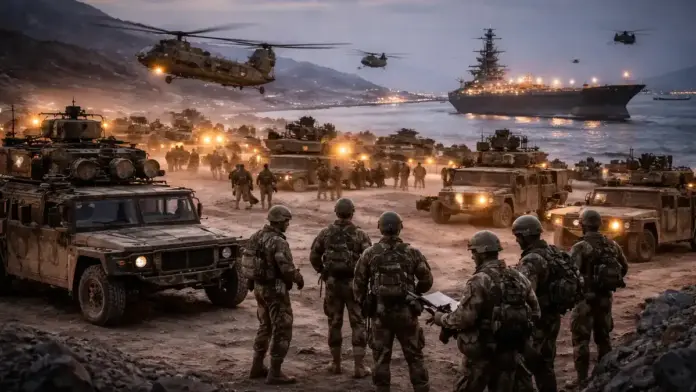
US ground troops in Iran: why “we’re not ruling it out” raises risk before the battlefield changes
When people hear that “Trump is seriously considering sending ground troops into Iran,” the instinct is to treat it as a finished decision. In reality, the most important line sits between two very different realities: an option that’s kept on the table versus an order that’s been given.
That gap matters because language moves markets, alliances, and public expectations before a single unit moves. “We’re not ruling it out” is not a deployment plan. But it is a signal that raises the risk premium—and forces everyone to price in more outcomes.
So here’s the point of this explainer: separate what’s confirmed from what’s not confirmed, map the scenarios that fit the facts, and show what indicators would suggest a real shift from “options” to “decisions.”
If you want a clean mental model for breaking news like this—especially when social media turns “maybe” into “it’s happening”—keep this evergreen close: How to read the news without being manipulated.
What we know so far
What’s confirmed: the door is publicly left open
Credible reporting shows that the possibility of “boots on the ground” has not been categorically ruled out in public-facing messaging. That alone is enough to change the conversation. It shifts the frame from air-and-sea pressure to a heavier kind of commitment—one that carries a different political and operational cost.
But it still doesn’t equal a decision.
What’s also confirmed: officials say the US is not currently postured for ground forces
A key, fact-checked line in reputable reporting is that the US is not currently “postured” for ground forces in Iran. That wording matters. It implies that, at least at the time of that reporting, a ground deployment was not being described as the present operational posture—even if options exist.
This is the one external authority source embedded naturally in the article: Reuters.
What “ground troops” can mean (and why most people picture only the extreme)
In public debate, “ground troops” usually conjures one image: a large-scale invasion. In practice, the term covers a spectrum:
-
Small, specialized teams for narrow missions
-
Temporary ground presence to secure specific assets or corridors
-
Broader ground operations with major political and human costs
This is where misinformation thrives: one phrase gets interpreted as the most extreme version of itself.
What we do not know (and should say plainly)
-
There is no confirmed, public timetable for a ground deployment.
-
There is no verified statement that a ground move has been approved.
-
We cannot confirm whether the public language is meant as deterrence, negotiation pressure, or preparation for escalation.
That “we don’t know yet” is not weakness. It’s the difference between reporting and rumor.
Why this talk moves reality even if no troops are sent
Geopolitics doesn’t wait for final decisions. When the possibility of ground involvement rises—even rhetorically—three changes kick in fast.
1) The timeline changes
Air-and-sea operations are often sold as time-limited. Ground involvement changes expectations about duration, political stamina, casualties, and the “day after.” Even discussion of it forces leaders, allies, and markets to think in longer horizons.
2) The risk of escalation rises through miscalculation
More options on the table can mean more uncertainty in how each side reads the other’s intentions. That increases the chance of:
-
misinterpretation of signals
-
rapid escalation after an incident
-
actions by proxies that drag main actors into wider conflict
3) The information war gets louder—and harder to verify
This is the part most readers underestimate. The moment “boots on the ground” enters the conversation, the volume of viral claims spikes: alleged leaks, maps, “inside sources,” anonymous accounts.
A useful internal context piece (same language, no cross-linking) that fits this exact verification challenge is Newsio’s “what’s confirmed” approach on sensitive claims: Iran internet blackout and Starlink interference: what’s confirmed.
It’s not the same topic, but it is the same problem: separating evidence from noise when stakes are high.
The core distinction that readers should hold onto
If you remember one line, make it this:
Options are not decisions. Signals are not deployments.
The public can be prepared for possibility without being misled into certainty.
What this means for you
If you live in the US, or follow US policy closely
Watch how language evolves. The shift you’re looking for is not a dramatic headline. It’s a change in verbs:
-
from “we don’t rule it out” → to “we are preparing”
-
from “options” → to “planning”
-
from “planning” → to “deployment posture”
Those shifts usually arrive with more structured briefings, more legal framing, and clearer mission definitions.
If you’re Greek, or watching from Europe
Even when events are far away, risk travels through energy, shipping, and macro uncertainty. The biggest immediate impact is rarely “instant collapse.” It’s the slow drip of uncertainty turning into cost—insurance premiums, freight routes, market volatility, political pressure.
For the broader scenario frame that Newsio has already built (and which helps readers understand why these crises don’t stay local), this related internal report fits naturally: Trump–Iran: the “10-day window” and what comes next.
A practical rule for the next 48–72 hours
Treat any claim about “confirmed ground deployment” as untrusted until you see:
-
named officials on record, or
-
consistent confirmation across top-tier outlets, and
-
language that shifts from hypothetical to operational
When you see those three align, the story changes category—from speculation to action.
The indicators that would signal a real shift (not just rhetoric)
If the debate is moving from “kept on the table” to “being executed,” you’ll usually see at least some of the following:
A) The mission starts to sound defined
Leaders stop speaking in open-ended hypotheticals and begin describing purpose, scope, and endpoints—even in careful language.
B) Public messaging becomes more structured, less improvisational
You get recurring briefings, consistent phrasing, and fewer “off the cuff” lines. That often indicates internal alignment.
C) Legal and political groundwork appears
In democracies, heavier commitments usually require more explicit political cover: formal authorizations, consultations, coalition framing, or legal arguments that go beyond generic language.
D) The “day after” conversation becomes unavoidable
When officials begin speaking about stabilization, governance, or long-term containment, it often signals that planners are thinking beyond short cycles.
• Summary: Reporting supports that ground involvement is being discussed as a possibility, but there is no confirmed decision or timetable. The most important difference is between leaving an option open and moving into operational posture.