

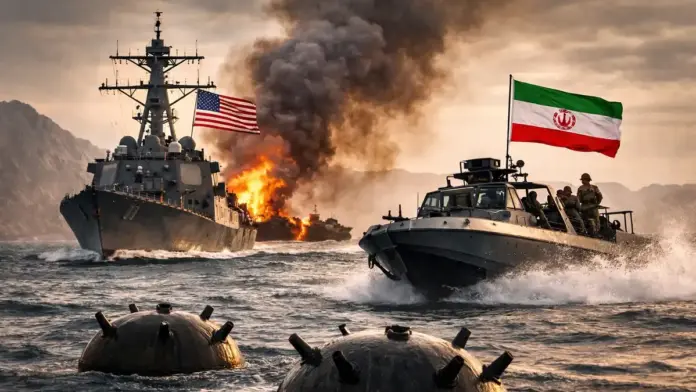
The Strait of Hormuz crisis has entered a more dangerous phase
The latest reports on the U.S.-Iran confrontation around the Strait of Hormuz point to something more serious than routine war rhetoric. U.S. officials say American forces struck Iranian mine-laying vessels near the strait after intelligence and military concerns mounted over possible attempts to threaten or disrupt one of the world’s most critical shipping corridors. That alone is enough to treat the situation as a major geopolitical escalation, not a passing headline.
But this is also exactly the kind of story that gets distorted fast. The most important discipline here is to separate what is publicly confirmed from what is being asserted by one side in the middle of an active military crisis. The strongest verified layer at this stage is that the United States has publicly claimed it destroyed 16 Iranian mine-laying vessels near the Strait of Hormuz, while broader reporting shows the crisis has already disrupted shipping calculations and intensified market anxiety. What is not yet fully established through independent public verification is the complete underwater operational picture: how many mines, if any, were deployed, where exactly, and on what scale.
That distinction matters because misinformation grows in the gap between fear and proof. A claim such as “Iran has fully sealed Hormuz” goes beyond the confirmed record. A claim such as “nothing is happening because there is no perfect public proof yet” is equally misleading. The evidence available supports a more serious and more disciplined conclusion: the crisis is real, the maritime risk is real, the U.S. has acknowledged direct military action against alleged Iranian mine-laying vessels, and the consequences for shipping, energy, and strategic stability are already significant.
What is confirmed so far — and what remains less clear
The core confirmed element is the U.S. position itself. Reuters reported that Washington said American forces destroyed 16 Iranian mine-laying vessels near the Strait of Hormuz, and a senior U.S. military official separately confirmed that the United States was striking Iranian mine-laying boats as part of the response to the threat environment in the area. That takes this well beyond abstract deterrence language. It places the confrontation in an active operational phase.
A second confirmed layer is the broader commercial effect. Reporting carried by NPR, citing Pentagon statements and wider conflict coverage, described the strait as effectively shut to normal tanker traffic under war conditions, while Reuters and other outlets showed that market and security concerns were already severe enough to force reassessments across energy and shipping networks. Even before every tactical detail is independently documented, real-world maritime behavior is already telling us that the threat is being treated as credible.
What remains less clear is the full technical scope of the mine threat. Public reporting has not independently established the exact number of mines laid, whether all suspected mine-laying efforts reached deployment stage, or the precise maritime geometry of the risk corridor. That does not make the U.S. claim false. It means the responsible way to write about it is to distinguish between an official wartime claim and a fully mapped, independently confirmed final picture. In conflicts like this, that difference is not cosmetic. It is central to accuracy.
Why the Strait of Hormuz matters far beyond the Gulf
The Strait of Hormuz is not just another regional maritime passage. According to the U.S. Energy Information Administration’s analysis of global oil transit chokepoints, Hormuz remains one of the most important energy chokepoints in the world, with few practical alternatives if flows are disrupted. Separate EIA analysis also shows that about one-fifth of global LNG trade moves through the strait, underlining how a shock there can hit both oil and gas markets at once.
That is why this is not a narrow military story. It is a shipping story, an insurance story, an inflation story, and a global confidence story. If a corridor this central is seen as unsafe, markets react long before any government formally declares a closure. Charterers hesitate. insurers reprice risk. shipowners pause movements. energy traders widen their threat assumptions. The economic damage begins with uncertainty, not only with total physical shutdown.
Readers who want the wider strategic frame behind Hormuz can also connect this piece with Newsio’s earlier English-language analysis, Strait of Hormuz: would a seizure or blockade help the global economy or the United States?, which explained why disruption in this waterway is inherently destabilizing rather than economically beneficial. The present crisis now pushes that argument out of the theoretical zone and into a live escalation phase.
Where the misinformation actually sits
The first distortion is overstatement. Social media narratives often jump from “there are reports of mine-laying activity” to “Hormuz is fully mined and the world economy has already been shut down.” That leap is not supported by the publicly confirmed record. The second distortion moves in the opposite direction: because not every operational detail is independently visible, some claim the threat is invented or exaggerated from scratch. That is also unsound. The U.S. military action, the official statements, and the wider disruption signal a threat environment that is already serious even before every detail becomes transparent.
The most useful way to frame the story is stricter and more credible. There are strong official U.S. claims of Iranian mine-laying activity or preparation. There is confirmed U.S. military action against vessels described as mine-laying boats. There is visible commercial anxiety around Hormuz. But there is not yet a fully independent public map of the entire alleged mine deployment picture. That is the line between disciplined reporting and panic amplification.
This fact-check logic matters for Newsio’s editorial identity because wartime narratives almost always try to force readers into one of two bad choices: believe everything instantly or dismiss everything entirely. Serious reporting does neither. It identifies what is documented, what is claimed, what is still uncertain, and where the manipulation enters the story.
Why maritime behavior matters as much as battlefield claims
In a crisis like this, the commercial system itself becomes a form of evidence. Shipping companies do not wait for perfect theoretical clarity if they believe a corridor has crossed into unacceptable risk. They act on probability, insurance exposure, and crew safety. That is why the practical effect of a mine threat can resemble partial closure even before a legal or military authority calls it that.
This is also why the escalation in Hormuz must be read together with Newsio’s earlier reporting on wider regional instability, including Dubai & Qatar: what’s confirmed about the Gulf incidents (fact-checked) and Trump–Iran: 10–15 Day Window and Strike Claims Explained. The current moment is not isolated. It sits inside a broader pattern in which military claims, threat signaling, and regional maritime vulnerability keep feeding one another.
Once that wider context is understood, the logic becomes clearer. The real issue is not only whether a route is technically open. The real issue is whether commercial actors believe it is safe enough to use at scale. If they do not, disruption becomes economically real even in the absence of a formal blockade declaration.
What could happen next
The most likely near-term paths all remain dangerous. One possibility is prolonged but limited maritime confrontation: repeated threats, strikes on suspected mine-laying assets, intense surveillance, and irregular commercial movement under heavy caution.
Another is an expanded multinational security effort to protect transit and reassure shipping. The most dangerous scenario is a chain reaction of miscalculation — a ship hit, a false identification, a rushed retaliation, or a broader military response that transforms a shipping crisis into a deeper regional war.
None of those paths is benign. Even the least dramatic one keeps pressure on energy costs, freight decisions, and political risk pricing. That is why the Strait of Hormuz remains one of the clearest places where military tension, global trade, and information warfare converge in real time.
What readers should take away
The responsible conclusion is not that every viral claim about Hormuz has already been proven in full detail. The responsible conclusion is that the crisis has clearly escalated, that the United States says it struck Iranian mine-laying vessels near the strait, and that the shipping and energy implications are serious enough to matter globally right now.
The second conclusion is equally important. The absence of complete independent public verification for every tactical detail does not erase the danger. It simply means the story must be written with precision rather than slogans. That is the difference between journalism and amplification.
And the third conclusion is the one that matters most for an international audience: what happens in Hormuz does not stay in Hormuz. A crisis there threatens shipping confidence, energy flows, LNG markets, inflation, and broader geopolitical stability.
That is why this English-language companion should stand directly beside the already published Greek article in hreflang logic: same event, same editorial core, same fact-based discipline, adapted naturally for a U.S. and international English-speaking readership.