

Table of Contents
The U.S.-Iran talks collapsed because the gap was never just diplomatic – it was strategic, ideological, and existential
This did not fail over one detail at the end
The talks between the United States and Tehran’s regime ended without a deal after roughly 21 hours of direct negotiations in Islamabad, and that outcome was not a last-minute accident. It was the visible result of a process in which both sides arrived not only with different demands, but with different definitions of security, power, acceptable compromise, and strategic survival.
AP and Reuters both reported that the talks ended without agreement after a marathon round of direct engagement, with uranium enrichment, the Strait of Hormuz, frozen assets, sanctions, and regional conditions all remaining unresolved.
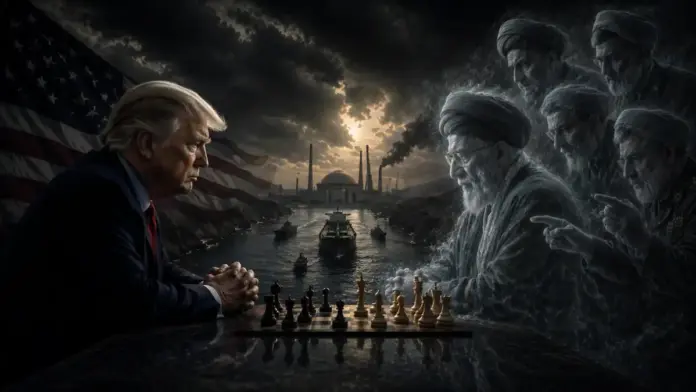
That is the first point the public should keep. The talks did not collapse because one side misread one paragraph. They collapsed because each side was negotiating from a different worldview. Washington entered the room trying to contain or roll back what it sees as an expanding strategic threat: nuclear capability, missile leverage, Hormuz pressure, and Tehran’s wider regional network.
Tehran entered the room trying to survive pressure without appearing to yield, trying to extract relief without strategic disarmament, and trying to preserve the core instruments that keep the regime feared at home and taken seriously abroad. That is more than a diplomatic disagreement. It is an existential mismatch.
The nuclear issue was not a side dispute
At the center of the breakdown sat the nuclear question. AP reported that Vice President JD Vance framed the core obstacle as Iran’s refusal to commit to abandoning nuclear weapons ambitions, while the Iranian side accused Washington of making excessive or unreasonable demands.
That alone shows the shape of the collision: the American position treated the nuclear issue as a non-negotiable security test, while Tehran treated it as a sovereignty and survival issue it could not simply surrender under pressure.
This is where the deeper divide becomes impossible to hide. For Washington and much of the wider Western and regional camp, the issue is not a routine civilian energy file. It is the possibility that a regime with a long record of repression, proxy warfare, coercion, and destabilization may maintain or approach a capability that radically changes the strategic balance.
For Tehran, the nuclear file is tied to deterrence, regime endurance, and national leverage. When one side sees a matter as a red-line security threat and the other sees it as part of sovereign survival, compromise becomes exceptionally difficult. The IAEA’s latest safeguards report remains the most important external technical reference here, because it shows why concern about Iran’s enrichment is not abstract politics but a concrete international proliferation issue.
Hormuz was never “just shipping”
Hormuz was not a parallel issue. It was one of the pillars of the failure. AP and Reuters both described the Strait of Hormuz as one of the most contentious points in the negotiations, with the U.S. demanding unrestricted maritime access and Iran linking the wider settlement to Hormuz-related control and broader political conditions.
That matters because it reveals the real structure of the confrontation. For the United States, Hormuz is an international artery, a test of credibility, and a line that cannot be left under permanent coercive pressure. For Tehran, Hormuz is leverage — one of the last major tools that can turn geography into negotiation power.
One side approaches the strait as a rules-and-access problem. The other approaches it as a pressure instrument. Even while sitting at the same table, they were not operating from the same logic.
This is exactly why the argument in The United States has entered Hormuz to reopen it matters to this article. That piece explained the operational dimension. This one explains why the diplomatic dimension could not be separated from it.
The $6 billion claim showed that propaganda entered the room too
Another major point of friction was the frozen-assets issue. Reuters reported that Iranian sources claimed the United States had agreed to unfreeze Iranian funds held abroad, with one source placing the figure at $6 billion, while a U.S. official directly denied that any such agreement had been reached.
That contradiction was not just a communications glitch. It showed that the negotiation was being fought on two levels at once: at the table, and inside the narrative. Tehran was not waiting for a signed outcome before trying to build a victory frame.
It was already trying to present the process itself as proof that pressure had worked and concessions were being extracted. Washington, on the other side, could not politically allow the image of billions being released without hard conditions or visible strategic return. That made the environment even more toxic.
When one side tries to monetize ambiguity before agreement exists, trust collapses even faster.
That is also why Tehran says “victory” and talks about $6 billion — but Washington denies it and the talks have only just begun fits naturally inside this companion article. The propaganda clash was not a side-show. It was part of the failure.
Both sides were also negotiating with their own domestic audiences
Any serious analysis has to account for the political depth underneath the diplomacy. Washington entered the talks needing to show that it would not legitimize Iran’s pressure architecture, would not leave Hormuz under coercive logic, and would not accept a nuclear gray zone as a normal condition.
Tehran entered needing to avoid the image of humiliation, avoid strategic stripping, and avoid telling its own internal audience that the regime had bent under force.
That means each side had a third audience sitting invisibly in the room: its own political base. For Washington, that narrowed the room for concession. For Tehran, it narrowed the room for visible compromise. When a negotiation is crowded by those constraints, long talks often end exactly the way these did: hours of engagement, no bridge across the core gap.
This was not only a clash of states. It was a clash of order
Here is the deeper layer.
The problem was never just that the leaders said different things. The problem is that the two sides represent different ideas of how order is built and preserved. The American and broader Western position, however inconsistent in practice at times, is still built around open sea lanes, limits on weapons proliferation, and the reduction of regional coercive networks.
Tehran’s regime operates through a different logic: nuclear advancement as deterrent leverage, Hormuz as pressure architecture, proxy power as strategic reach, and crisis itself as a means of preserving internal cohesion.
That is why the collapse was not just diplomatic. It was the result of two incompatible systems meeting in one room. Washington was trying to force rollback, constraint, and compliance. Tehran was trying to preserve leverage, narrative, and survival. Those are not two versions of the same peace formula. They are two rival formulas for power.
Washington’s view: contain the threat, do not normalize it
If you look closely at the U.S. side, the logic is relatively consistent. The United States wanted three things at once: freer shipping through Hormuz, a clearer commitment on the nuclear issue, and a weakening of the strategic tools through which Tehran can hold the region and the market under pressure.
That does not make Washington neutral or morally perfect. It does show, however, that its negotiating logic was centered on reducing a threat structure, not recognizing that structure as an acceptable long-term reality.
That is why the U.S. approach looked more like a compliance test than a process of mutual recognition on equal strategic terms. For Tehran, that is unacceptable, because accepting it too fully would mean admitting that some of the regime’s most important instruments of power are fundamentally illegitimate. That is where the bridge breaks.
Tehran’s view: survive through pressure, ambiguity, and narrative
Tehran’s logic is equally clear and far more dangerous for regional stability. The regime did not go into the talks to begin a linear reconciliation with the free world. It went in trying to gain space, time, recognition, and possibly economic relief without surrendering the core tools that keep it feared and relevant. That is also why the regime speaks so often in the language of “victory,” even when the facts remain uncertain or heavily contested. It needs to sell victory because it cannot afford to sell weakness.
This is where the broader argument in The Iranian people are not the enemy — the enemy is Tehran’s regime and the system of fear keeping the crisis alive becomes essential. A regime like this does not merely negotiate for peace. It negotiates for regime endurance. That is why every true de-escalation is difficult for it: real de-escalation would strip away part of the machinery that keeps it feared, coherent, and alive.
What the collapse means now
The failure of the talks does not automatically mean instant return to the most extreme form of open conflict. It does mean the fragile pause becomes more fragile, the regional fronts stay hot, and any future diplomacy would begin from an even harder starting point. AP reported that no immediate new round was scheduled even as mediators tried to keep channels from collapsing entirely.
That alone says a great deal: the need for contact remains, but the ability to turn contact into settlement has moved farther away.
The most important conclusion is this: the collapse was predictable not because adversaries can never talk, but because these particular adversaries met while carrying incompatible strategic identities.
Washington did not want to normalize Tehran’s coercive model. Tehran did not want to surrender the coercive tools that make the regime matter. Under those conditions, the likeliest result was never historic reconciliation. It was the continuation of crisis in another form.
The conclusion the public should keep
What failed here was not one press conference or one line in one draft.
What failed was a bridge between two incompatible logics.
Washington wanted threat reduction.
Tehran wanted survival without strategic disarmament.
The United States wanted freer Hormuz and a harder nuclear line.
The regime wanted relief, recognition, and the preservation of leverage.
One side was speaking the language of rollback and restraint.
The other was speaking the language of endurance through pressure, ambiguity, and narrative.
That is why the talks collapsed.
Not because the mediators were weak.
Not because the room was too small.
But because the gap between Washington and Tehran ran far deeper than diplomacy alone could hide.