

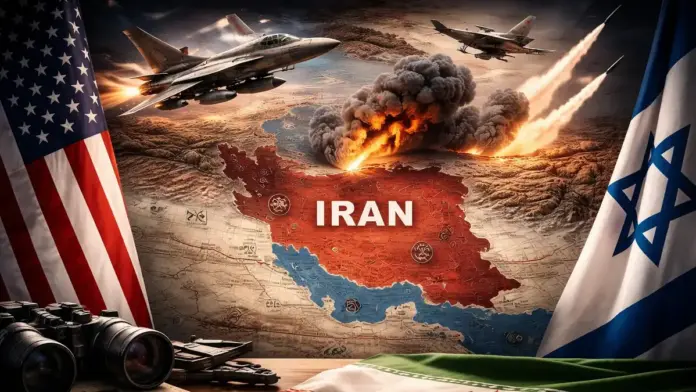
The U.S.–Israel–Iran picture in the first hours — and the critical questions that remain open
The first rule in a fast-moving crisis is simple: separate what’s confirmed from what’s asserted. When major powers exchange strikes, the information battlefield becomes as important as the physical one. In the first hours, official statements arrive alongside leaks, unverifiable footage, and politically loaded claims. If you don’t filter, you don’t understand.
Here’s what the most credible reporting indicates at this stage:
-
Israel publicly stated it launched a “pre-emptive” strike against Iran, framing it as a security-driven operation aimed at reducing an imminent threat.
-
Multiple outlets reported explosions in Tehran and heightened alert measures in Israel, including warnings and restrictions consistent with preparation for retaliation.
-
Separate reporting indicates the operation was coordinated with the United States, though “coordination” can mean several different things (intelligence sharing, air defense posture, logistics, timing, and political alignment) and not necessarily identical levels of direct operational participation.
Verified outline, here is one external source:
Reuters report
What remains unclear or genuinely unsettled
Even if the broad outline is confirmed, several crucial details do not “lock” immediately:
-
The exact target set: air-defense nodes, command-and-control, missile infrastructure, or other sites. Early lists can be incomplete or wrong.
-
The scale of damage and casualties: numbers fluctuate, and some claims are designed to shape perception, not document reality.
-
The scope of U.S. involvement: there’s a big difference between political/strategic coordination and direct, on-the-ground operational participation.
-
The true trigger: “pre-emptive” language is a legal-political framing; whether it’s accepted internationally depends on facts that are rarely public in real time.
The honest way to cover this is not to pretend uncertainty doesn’t exist. It’s to make uncertainty explicit—and then explain what it means.
What “coordinated strikes” can mean in practice
Coordination isn’t one thing. It can include:
-
aligning the timing window and deconflicting airspace,
-
intelligence sharing and targeting support,
-
electronic warfare posture and cyber readiness,
-
air and missile defense preparedness (including regional bases),
-
diplomatic messaging and escalation management.
That’s why headlines can be misleading. Two allies can run one synchronized strategy with different operational roles. You can’t infer the second from the first without evidence.
Why the timing matters
In this region, timing is never random. A strike may aim to:
-
degrade capabilities before they harden or disperse,
-
send a deterrent signal,
-
reshape negotiation leverage,
-
force the other side into either restraint or a predictable response pattern.
But the most important point for readers is this: the moment the first strike lands, the main story becomes the next 24–72 hours, because that’s where crises either cap—or spiral.
Related article (big-picture explainer):
Place this link at the end of this paragraph as context on Iran’s internal pressures and the broader outlook:
…because the internal and regional pressures around Iran shape how escalation plays out: Iran 360: what’s happening now, what people are demanding, and the realistic outlook for 2026
The retaliation question: what everyone watches first
When a strike happens at this level, analysts don’t start with rhetoric—they start with capability and signaling. The key questions are:
-
Scale: Is retaliation symbolic, limited, or sustained?
-
Targets: Military only—or infrastructure with broader disruption?
-
Geography: Does it expand beyond the primary battlefield into a wider regional arc?
-
Method: Missiles, drones, cyber operations, proxies—or a mix?
The difference between a controlled crisis and a cascading one is often where the response lands and how the next side chooses to interpret it.
The second battlefield: narratives and legitimacy
Every side fights for the same strategic asset: legitimacy.
-
“Pre-emptive” is intended to frame the strike as defensive and necessary.
-
“Violation of sovereignty” frames it as illegal aggression.
-
Claims about specific facilities or leadership targets can be used to shape domestic morale and international support.
In the early hours, the public gets a flood of “certainty.” The newsroom should deliver the opposite: a hierarchy of confidence—what is confirmed, what is probable, and what is unknown.
Why airspace, shipping, and energy markets matter immediately
Even before the full facts settle, consequences appear fast:
-
Airspace disruptions can re-route flights and raise costs.
-
Shipping risk premiums can increase insurance and logistics costs.
-
Oil and gas price sensitivity rises because the region is structurally tied to global energy flow and market psychology.
This doesn’t mean automatic “shock” everywhere. It means markets price risk, and risk spikes in war scenarios.
The diplomacy track is not separate—it’s the exit ramp
There are always two tracks running at once:
-
Operational track: what happens in the field.
-
Diplomatic track: what messages are sent behind closed doors to prevent uncontrollable escalation.
The moment you stop seeing diplomacy as “after the war” and start seeing it as the mechanism that prevents the next strike, the story becomes clearer.
(related recent report / window framing):
Place this link right after the phrase “time-window framing” in the paragraph below:
…because time-window framing often becomes a political tool during escalation cycles: Trump–Iran: the “10-day window” — what it means and what changes the game
The information hazard: why viral “proof” is often useless
In conflict coverage, viral clips are frequently:
-
out of context,
-
from a different location,
-
from a different year,
-
or deliberately edited.
Professional handling is not optional. If a claim cannot be verified, it must be labeled as such—or left out.
(practical guide / verification environment):
Place this link at the end of the paragraph below to explain why verification gets harder:
…especially when access and connectivity are unstable and independent confirmation becomes difficult: Iran internet blackout and Starlink interference: what’s confirmed
What this means for you
If you’re following this as a citizen
-
Don’t treat early “details” as final. The first version of a crisis is usually incomplete.
-
Trust reporting that distinguishes confirmed vs unconfirmed and corrects itself visibly.
-
Watch for scam waves and misinformation spikes that exploit fear and uncertainty.
If you have exposure through travel or business
-
Expect route changes and delays if regional airspace restrictions widen.
-
Be cautious with communications security (phishing often rises during geopolitical shocks).
-
Don’t make decisions based on a single viral claim—wait for consistent confirmation across major outlets.
If you care about the big picture
The next phase will be defined by three variables:
-
Whether retaliation stays contained or expands geographically.
-
Whether either side sets a ceiling (explicitly or through backchannel messaging).
-
Whether diplomacy becomes an exit ramp or a talking point with no effect.
If escalation continues, the biggest risk isn’t only one more strike. It’s miscalculation—one side reading the other’s signal wrong, and acting on an assumption that later proves false.
What to watch next
-
Formal statements clarifying scope and objectives.
-
Independent confirmation on damage/casualties.
-
Signals of de-escalation: emergency diplomacy, mediation attempts, or bounded language.
-
Any spillover affecting regional bases, shipping lanes, or civil aviation.
• Summary: Israel says it launched a pre-emptive strike on Iran; credible reporting indicates coordination with the U.S., while key details (targets, damage, and exact operational roles) remain fluid and require careful confirmation.