

Table of Contents
The crash is confirmed. The cause is not.
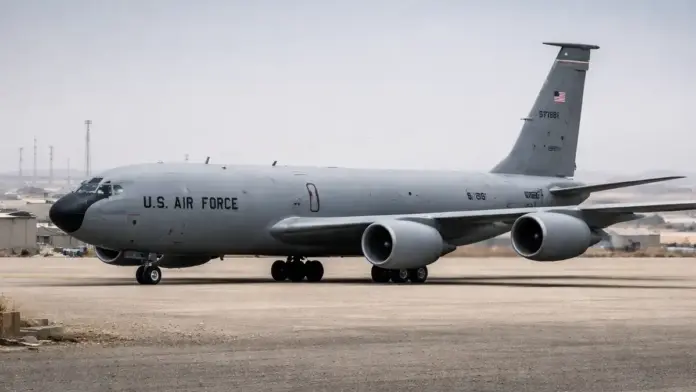
A U.S. military aircraft crash in Iraq is no longer a rumor-level report. The United States has confirmed that a KC-135 refueling aircraft crashed in western Iraq and that all six service members on board were killed. Reuters and AP both report that U.S. officials said the incident involved a second KC-135 that landed safely, and that the crash did not result from hostile fire or friendly fire, with the cause still under investigation.
That distinction matters immediately, because this is exactly the kind of story that gets distorted within minutes. One level of the story is confirmed: the aircraft was lost, six U.S. personnel were killed, and the incident happened in western Iraq.
Another level remains unresolved: what precisely caused the crash. A third level has already entered the information war space, because an Iran-backed Iraqi armed group claimed responsibility for downing the aircraft, even as U.S. officials said publicly that hostile action was not the cause.
The right way to report this is not to flatten everything into a single dramatic conclusion. The right way is to separate the tragedy, the official military findings so far, and the unverified claims now circulating around the incident. That is the difference between reporting and amplification.
What is confirmed so far
The core confirmed picture is straightforward. A U.S. KC-135 refueling aircraft crashed in western Iraq on March 12, 2026. All six crew members aboard were killed. Another KC-135 involved in the broader incident landed safely. U.S. officials said the event occurred in friendly airspace and was not caused by hostile or friendly fire, while the full cause remains under investigation.
That alone gives the incident real weight. The KC-135 is not a marginal platform. It is a refueling aircraft central to long-range U.S. air operations, which means the loss is not just a human tragedy but also an operational blow inside a region already under intense strain. Reuters notes that the crash comes amid a wider U.S.-Iran war environment in which American casualties have already been mounting.
Readers looking for a stronger verification framework behind fast-moving conflict coverage can also see Newsio’s guide on how to read the news without being manipulated.
What should not be treated as settled fact
The first thing that should not be locked in prematurely is the claim that the aircraft was shot down. That claim exists. Reuters reports that the Islamic Resistance in Iraq, an Iran-backed umbrella of armed factions, said it had downed the U.S. aircraft. But that statement is not the same thing as independent confirmation, and at this stage it directly conflicts with the U.S. military’s public account.
The second thing that should not be overstated is the idea that this incident, by itself, proves a wider collapse of U.S. military positioning in Iraq. The crash is serious. The deaths are serious. The operational context is serious.
But one crash, even one with major loss of life, does not automatically answer larger questions about battlefield balance, force sustainability, or the future of the U.S. role in Iraq. Those are broader analytical questions, not conclusions that can be safely extracted from the crash alone.
That same discipline matters in any conflict zone where armed groups have clear incentives to claim high-impact actions quickly, especially when those claims carry propaganda value even before evidence catches up.
Why the incident matters beyond the immediate tragedy
Even if the crash ultimately proves to be non-hostile in technical cause, it still lands inside an active regional war environment. That changes its meaning. In a stable theater, a military aviation accident is primarily an operational and safety story. In a live conflict zone involving U.S. forces, Iran, and multiple aligned militias, the same kind of event also becomes political, strategic, and psychological.
The aircraft involved was a refueling tanker, which is part of the infrastructure that allows sustained American air operations across distance. Losing such a platform matters because it can affect tempo, flexibility, and support capacity at the very moment Washington is already under pressure across multiple fronts. Reuters reports that this happened as U.S. casualties and injuries in the broader conflict were already climbing.
For broader English-language context across Newsio’s international explainers, readers can also browse the EN Analysis section.
Where misinformation begins
The first distortion is certainty without proof. In crisis coverage, the sentence “the aircraft was shot down” will always travel faster than “the cause remains under investigation.” But those two formulations are not equivalent. One is an armed-group claim. The other is the current official U.S. position. Treating them as equal would mislead readers.
The second distortion runs in the opposite direction: if the U.S. says the crash was not caused by hostile fire, some will assume the event is therefore politically unimportant. That is also wrong. A KC-135 crash with six dead in western Iraq, during an active regional war, is strategically meaningful even before the technical cause is known. It speaks to the stress level of the theater, the risks of ongoing operations, and the fragility of a regional security environment that keeps widening.
The third distortion is isolation. This should not be read as a self-contained aviation story. It belongs inside a larger chain of developments stretching across Iraq, Iran, the Gulf, and broader U.S. military operations in the region. That wider setting is what gives the incident much of its real significance.
For ongoing English-language coverage of fast-moving international developments, Newsio’s EN US & Global Politics section is the most natural companion hub.
Why Iraq remains a critical pressure point
Iraq is not a side theater in the current crisis. It remains a space where U.S. military presence, Iran-linked armed actors, regional escalation, and fragile political balances overlap in dangerous ways. That alone makes any U.S. military loss there immediately larger than the incident itself. The fact that an Iran-backed group moved so quickly to claim responsibility also shows how the information environment is now part of the battlefield.
That is also why the safest reading is the most disciplined one. Yes, the crash happened. Yes, six U.S. service members were killed. No, the public evidence available so far does not establish that the aircraft was downed by enemy action. Holding those three points together is what accuracy looks like here.
What readers should take away
The first safe conclusion is that the United States lost a military refueling aircraft in western Iraq and that all six aboard were killed. That part is confirmed.
The second is that, based on the public record so far, a hostile shootdown has not been established, even though an Iran-backed Iraqi group claims responsibility. The cause is still under investigation.
The third is that the incident matters even before the final cause is known. It adds weight to an already dangerous regional conflict and underscores how Iraq remains an active and volatile node in the wider U.S.-Iran confrontation.