

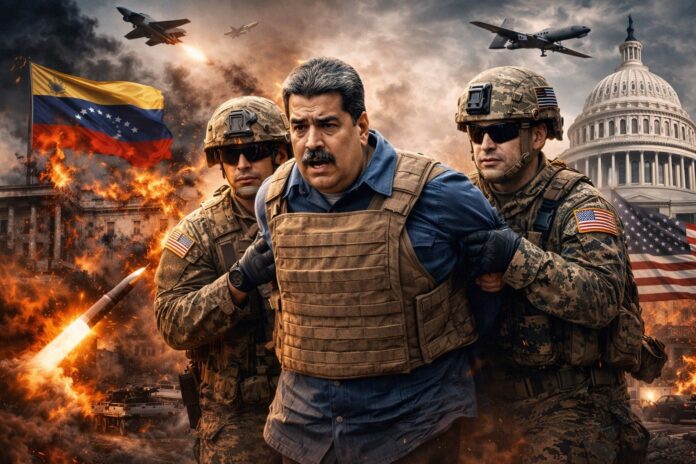
Introduction: The U.S. Military Operation and Global Consequences
Recent reports have emerged regarding the U.S. military operation in Venezuela, which allegedly included bombing strategic locations within the country and the capture of President Nicolás Maduro. This military action has sparked international concern and uncertainty, bringing to the forefront a range of geopolitical challenges and diplomatic tensions, particularly concerning the strategies of the United States and the ongoing crisis in Venezuela.
This article will explore the facts, legal consequences, diplomatic reactions, and strategic implications of this military operation.
The U.S. Attack and Maduro’s Capture: Contradictions and Uncertainties
Reasons Behind the U.S. Strategy
The decision of the United States to carry out a military operation in Venezuela is not sudden. The country has been in a prolonged crisis, facing a declining economy, social unrest, and political instability. The Nicolás Maduro government has been accused of human rights violations, oppression of the opposition, and abuse of power. On the other hand, the United States sees Maduro as a threat to democracy in Latin America and has supported the opposition in an effort to destabilize his regime.
The U.S. strategy on this matter includes increased sanctions against Venezuela, military intervention, and support for opposition forces aiming to overthrow Maduro.
Strategic Implications for Global Security
The U.S. military operation in Venezuela has significant geopolitical consequences both in the region and beyond. Relations with Russia and China, both of whom support Venezuela and oppose U.S. actions, may deteriorate, leading to diplomatic isolation for the U.S. and escalating tensions with Eurasian powers.
Russia, for example, has established a military presence in Venezuela, and China has heavily invested in the country through economic agreements and loans. The U.S. military action risks escalating these tensions and provoking strong reactions from these two powers.
The Legal Perspective: International Law and Ethics
Violation of Sovereignty
From a legal standpoint, the U.S. military operation in Venezuela raises serious issues of international law. Violation of national sovereignty and the use of military force without the approval of the UN Security Council calls into question the legality of these actions under international law. This move could be viewed as intervention in the sovereign rights of another country, violating the core principles of the United Nations.
The capture of Nicolás Maduro, although a move with significant political and legal consequences, also raises concerns about the legal process and the rights of the accused.
Diplomatic Reactions: Global Acceptance or Opposition?
Reactions from Major Powers: Russia and China
Russia and China, as major supporters of Maduro, have strongly condemned the military operation and stressed the need for diplomatic resolution of the differences. Their opposition to U.S. actions highlights the intense diplomatic contradictions that currently exist in the world.
Moreover, Latin America is divided on the issue. Countries such as Cuba and Bolivia have offered political support to Maduro’s regime, while others, such as Colombia and Ecuador, favor international pressure for regime change.
Impact on Venezuela: Strategic and Social Consequences
The People’s Resistance and Internal Conflicts
Venezuela remains in a state of political and social turmoil. The U.S. military operation could intensify internal conflicts, with the Maduro government trying to blame the U.S. for escalating the crisis. The people of Venezuela are divided between supporting and resisting the regime’s policies.
Conclusion: Future Directions and International Strategies
The U.S. military operation in Venezuela is likely to have long-term consequences for international relations, diplomacy, and the legal situation within the country. International reactions will determine the future of the political and strategic actions taken, shaping global political security in the near future.