

Venezuela’s Stock Market Surge: What Actually Drove the Rally, What It Does (and Doesn’t) Signal, and What to Watch Next
A sudden stock-market surge can feel like a headline that explains everything: “The market is soaring—so the future must be bright.”
But in countries with severe currency instability, thin trading, and high political risk, markets can move dramatically for reasons that have little to do with everyday living conditions—or even with a durable economic turnaround.
That’s exactly why Venezuela’s recent rally deserves calm interpretation, not celebration-by-default.
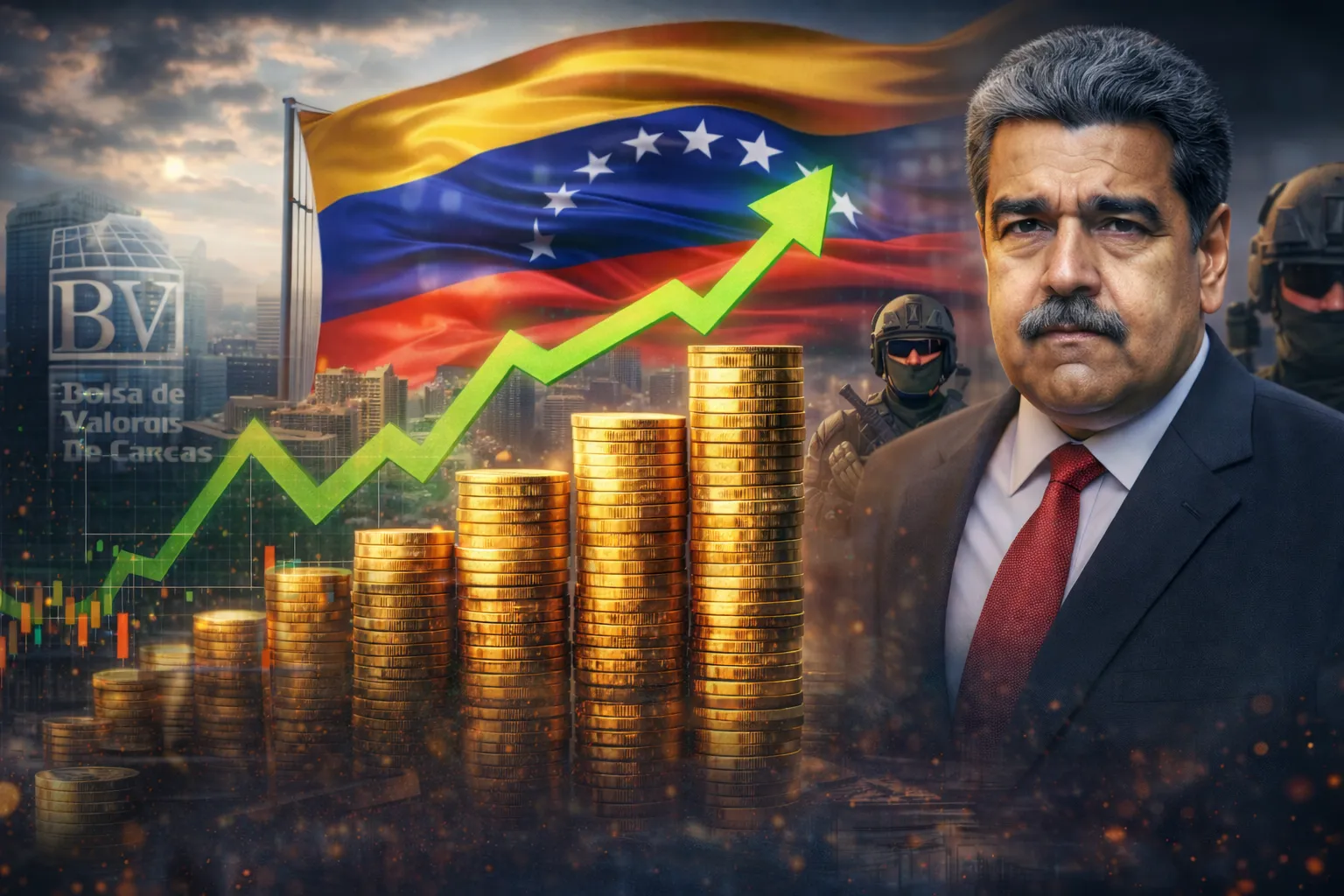
Multiple reports describe an extraordinary jump in Caracas-listed equities—one widely cited figure is roughly +124% in U.S. dollar terms over a short window, framed as a post–political-shock repricing. At the same time, the broader context remains volatile, including energy and sanctions dynamics that can change quickly.
This article answers three practical questions:
-
What likely drove the surge?
-
What does it actually signal—and what does it not prove?
-
What should a reader watch next to judge whether this is a real shift or a short-lived spike?
1) What we know about the surge (and what we should treat carefully)
The surge is widely reported
Several outlets have reported outsized gains in Venezuela’s main equity benchmark and described the move as unusually sharp for a market that has been battered for years.
But headline returns can overstate “real” meaning in thin markets
A critical detail in Bloomberg’s reporting is that—even during the rally—trading volumes were extremely low, which can amplify price moves.
The political narrative is contested and fast-moving
Some reporting frames the rally around dramatic political developments (including claims of leadership removal/capture).
Because these are high-stakes claims and narratives can diverge across outlets, the responsible approach is to treat them as reported developments and focus on the measurable mechanisms that move prices: expectations, liquidity, currency conditions, and sanctions risk.
2) Why a stock market can “explode upward” even when an economy is still fragile
Here’s the simplest truth: a stock index is not the economy.
It’s a pricing machine for a limited set of assets, reacting to expectations—sometimes rationally, sometimes emotionally.
A) “Re-rating” on regime-change expectations
Markets often reprice on the possibility—real or perceived—of:
-
sanctions easing,
-
policy reform,
-
reopening to foreign capital,
-
a more predictable legal environment for contracts and property.
Even the possibility can trigger a fast repricing when starting valuations are depressed. This is one of the most common drivers of sharp rallies in high-risk markets.
B) Thin liquidity magnifies everything
In small or constrained markets, a relatively small amount of buying can move prices a lot. Bloomberg noted exceptionally low volumes even amid the surge.
That does not invalidate the move—but it means the move may be less “broad-based” than the headlines suggest.
C) Currency dynamics can distort perception
In countries with currency instability, market performance can be difficult to interpret:
-
local-currency gains may not translate into stable purchasing power,
-
“dollar terms” depend on how exchange rates are measured and how accessible conversion actually is,
-
inflation and parallel-market dynamics can complicate comparisons.
The result: a chart can look spectacular while real economic stability remains uncertain.
D) The psychology of “the turning point”
After long stagnation, markets can overreact to a new story—especially when global investors fear missing the “first move.” The risk is that the same psychology can reverse quickly if the underlying conditions don’t improve.
3) Does a soaring market mean Venezuela is entering a “strong economic future”?
Not automatically.
A market surge can reflect hope. But durable recovery requires institutions and implementation. To turn a rally into a real economic trajectory, Venezuela would need progress in areas such as:
-
Rule of law and contract credibility (predictability matters more than optimism)
-
A functional financial system (payments, credit, capital mobility)
-
Inflation and currency stabilization
-
Transparent governance and policy continuity
-
A workable external framework (sanctions, trade channels, energy exports)
Energy developments matter here, because oil exports and external constraints have outsized influence on Venezuela’s macro outlook. Reuters has reported shifting dynamics around output and exports in the current environment.
4) What to watch next: a practical checklist for readers
If you want to judge whether this is a real turning point or a temporary spike, watch these signals—because they tend to separate “headline rallies” from sustainable change:
1) Liquidity and breadth
-
Are daily volumes rising meaningfully, or are prices moving on tiny trades?
-
Are multiple sectors participating, or only a few names?
(Thin liquidity can create dramatic charts that don’t represent broad confidence.)
2) Currency stability and inflation expectations
-
Is the currency environment stabilizing or becoming more chaotic?
-
Are price levels and exchange-rate conditions becoming more predictable?
3) Sanctions and international channels
-
Are there credible signs of policy normalization or new constraints?
-
Do energy/export pathways become more predictable? Reuters reporting suggests this channel remains pivotal.
4) Legal and institutional signals
-
Are property rights and contract enforcement improving?
-
Is there clarity on how businesses can operate and repatriate profits?
5) Real-economy indicators
Even if markets rally, recovery needs:
-
better supply conditions,
-
more stable prices,
-
improving employment and household purchasing power,
-
reliable public services.
A stock chart cannot substitute for those outcomes.
5) One authority link (official market reference)
If you want a clean reference point for the market itself, use the official Caracas exchange site:
Bolsa de Valores de Caracas (official): https://www.bolsadecaracas.com/
(That’s the best “authority anchor” for market context, announcements, and official market-facing information.)
A sober conclusion
Venezuela’s rally is real as a market move—and it may reflect a sharp shift in expectations after major political headlines.
But a surge—especially in a thin, high-risk environment—does not automatically prove that the economy has “turned the corner.”
The responsible takeaway is this:
-
Markets can move faster than fundamentals.
-
Hope can be priced in before institutions change.
-
The next weeks and months matter more than the first spike.
If liquidity broadens, currency conditions stabilize, and the legal and external environment becomes more predictable, then a rally can mature into something more durable. If not, the same forces that pushed prices up can pull them back down.