

Table of Contents
When the Sky Fills With Missiles, Self-Defense Is Not Optional: Why Israel Is Right to Defend Itself Against Tehran’s Regime
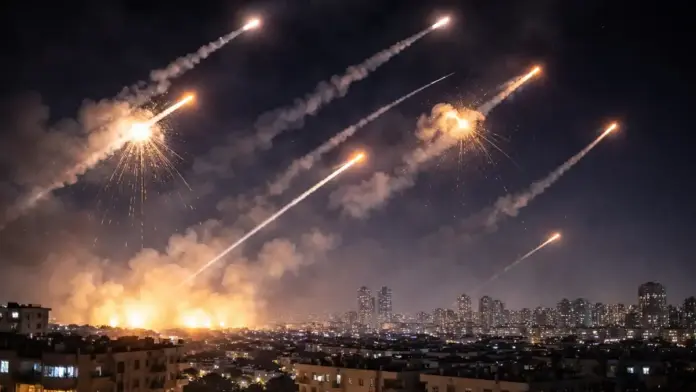
There are moments when neutrality is not moral clarity but moral evasion. When a country’s sky fills with missile trails over civilian areas, when families rush into shelters, and when children grow used to sirens instead of silence, the central question is no longer whether “both sides have their arguments.” The central question is whether a state has the right to defend its people. In Israel’s case, the answer is yes. Not as a slogan, but as a basic principle of survival under repeated attack.
Reuters has reported Iranian missile strikes on Israeli cities including Arad and Dimona, with injuries, building damage, and pressure on Israel’s air-defense systems.
That is the starting point of any serious analysis. Israel is not responding to an abstract theory, a vague atmosphere, or a rhetorical insult. It is responding to ballistic fire, to repeated threats against civilians, and to a regime that has made coercion, fear, and escalation into instruments of statecraft.
Reuters also reported that Gulf Arab states told the U.N. Human Rights Council that Iranian missile and drone strikes pose an “existential threat” to the region, targeting civilians and infrastructure. That matters because the warning is not coming only from Israel. It is also coming from Arab states that see Tehran as a destabilizing force well beyond one bilateral conflict.
To understand that broader picture, readers should also look at Newsio’s analysis of how Iran’s escalation reaches beyond Israe, because the missile war cannot be separated from the larger pressure Tehran is exerting on energy routes, infrastructure, and regional stability. And for the infrastructure dimension specifically, From Missiles to Water: A New Phase in the Iran-Israel War shows how the conflict is already expanding beyond classic battlefield logic.
Embedded video for the article
Recent verified footage has made the reality impossible to soften. A YouTube clip indexed in search results as “Missiles seen in Tel Aviv sky, as Iran launches strikes at Israel” is described as showing missile trails lighting up Tel Aviv’s night sky on March 13, 2026, as sirens blared during the ongoing war. That is exactly why this article cannot be reduced to rhetoric: the visual evidence matches the strategic reality.
Israel is not fighting an idea. It is fighting a real threat
One of the laziest habits in international commentary is to flatten everything into “cycles of violence.” That language often hides more than it reveals. Israel is not facing a symbolic rival. It is facing a regime that has repeatedly used missiles, drones, and infrastructure threats as part of a wider destabilization strategy.
Reuters reported Iranian attacks and threats extending beyond Israel to Gulf infrastructure and civilian targets, while AP documented continued Iranian strikes across the region as the war widened. That means Israel’s case for self-defense does not rest on emotional language. It rests on repeated hostile action.
This is also why the distinction between a people and a regime matters so much. A serious article should never collapse an entire nation into the identity of its rulers. Newsio has already made that distinction clearly in They Are Not Hitting Iran as a People. They Are Hitting the Regime. The core issue here is not hostility toward ordinary Iranians. It is opposition to a regime that has normalized ideological aggression, missile escalation, and strategic intimidation.
When the sky fills with missiles, “restraint” cannot mean passivity
The footage of Israel’s sky filled with missile trails is not just dramatic imagery. It is the visual form of a simple fact: no serious state can be expected to absorb repeated barrages over civilian territory and still behave as though time is unlimited and the threat is theoretical.
Reuters reported dozens injured in Iranian strikes on Arad and Dimona, including children, while AP described the conflict as escalating around locations near sensitive sites. Whether every projectile reaches its intended target is not the point. The point is that people are being attacked and forced to live under active missile threat.
That is why the pro-Israel case does not require exaggeration. It requires one clear premise: when a state is under repeated missile attack, it has not only the right but the obligation to degrade the source of that threat as far as it lawfully can. To deny that principle to Israel while granting it to almost any other country would not be moral balance. It would be selective judgment.
Tehran’s danger is bigger than a single barrage
The deeper issue is that Iran’s threat is not confined to one launch window or one battlefield exchange. Reuters reported Tehran’s threats of retaliation against Gulf energy and water infrastructure if Iranian power plants were hit. Reuters also reported the Gulf states’ accusation that Iranian strikes amount to existential destabilization.
This is not the behavior of a status-quo power acting with regional restraint. It is the behavior of a regime that uses shock, fear, and uncertainty to pressure entire systems at once.
That wider logic is why this article belongs in a larger strategic frame. Readers who want the broader context should also move through Newsio’s analysis of whether Iran can threaten Europe with missiles and Newsio’s global politics coverage. The point is not to inflate the fear. It is to show that Israel’s security argument sits inside a much wider pattern of Iranian escalation.
The nuclear backdrop makes the question even heavier
This is where discipline matters most. It would be irresponsible to write that Iran has already fielded operational multiple nuclear warheads as an established fact. That is not what the strongest public evidence shows. But it would be equally irresponsible to pretend there is no serious international concern about Iran’s nuclear trajectory.
The IAEA Director General said in March 2026 that diplomacy was the only way to achieve long-term assurance that Iran would not acquire nuclear weapons, and official IAEA material stressed the need for Iran’s full cooperation and access. In other words, the world’s main nuclear watchdog is not treating this as a casual issue.
That matters because missiles are never judged only by their engineering range. They are judged by the strategic context around them. A regime already willing to fire ballistic missiles toward Israeli population centers is not judged in a vacuum when questions about nuclear capability and transparency remain open. That is why Israel’s security doctrine does not read these developments as academic concerns. It reads them as warnings that cannot be ignored.
The truth here is not in false symmetry
There is a kind of commentary that treats fairness as the equal flattening of all moral distinctions. That approach fails here. On one side is a state trying to intercept missiles over its cities and protect civilians. On the other is a regime that fires those missiles, threatens critical infrastructure, and projects coercive risk across the region. To describe that as a morally interchangeable situation is not sophistication. It is confusion.
A serious pro-Israel article does not need fantasy. It does not need to lie, and it does not need to overclaim. It only needs to say plainly what the evidence already supports: Israel is facing a real missile threat from a regime whose conduct has alarmed not only Israeli officials but Gulf states, nuclear watchdogs, and global markets as well. In that environment, self-defense is not a luxury. It is the minimum duty of a functioning state.
What should remain
The image of missile trails over Israel should not be consumed as spectacle. It should be understood as proof of the condition under which this argument exists at all.
When the sky fills with incoming fire, the right to defend a population is not a marginal legal footnote. It becomes the center of the moral question. And once that is admitted, the rest follows clearly: a country under repeated attack has the right to intercept, to strike back against the systems that threaten it, and to refuse the fantasy that passive endurance is a higher virtue than survival.
That is why the strongest honest conclusion is also the simplest one. Israel is right to defend itself.