

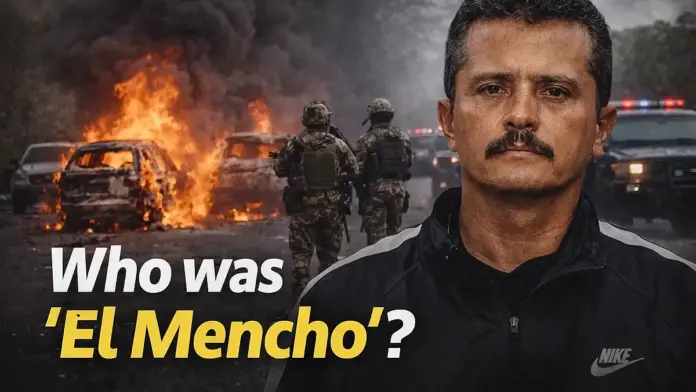
Who Was “El Mencho” and Why His Story Matters Beyond Mexico
Nemesio Rubén Oseguera Cervantes—better known as “El Mencho”—became one of the most referenced names in Mexico’s modern security crisis. Major law-enforcement profiles and international reporting widely described him as the top figure behind the rise of the Jalisco New Generation Cartel (CJNG).
His story matters because it helps explain how a local criminal network can evolve into a transnational security problem—and why leadership shocks inside cartels can trigger sudden, highly visible disruption.
This explainer focuses on what reliable public sources consistently support. Where details conflict or remain unproven, the text says so plainly and avoids filling gaps with speculation.
Early life and origins: what we can say with confidence
Publicly available profiles typically place Oseguera’s roots in western Mexico, and reporting often ties his background to poor, rural communities. Those accounts share a consistent theme: he did not start with wealth or status, and he built power through networks, leverage, and violence.
At the same time, early-life specifics often vary across public write-ups—birthplace, early schooling, and the timeline of his first moves. That is common in organized-crime cases, where aliases, falsified documents, and conflicting local records complicate biographies.
A responsible summary is simple: he emerged from a region long shaped by migration, informal economies, and criminal competition, and he entered adult life in an environment where illicit work offered money and status that legal work rarely matched.
The U.S. chapter: migration, arrests, and a pattern that repeats
Several mainstream profiles and law-enforcement summaries describe a period in which he lived in the United States and came to the attention of authorities through drug-related activity. This matters because it illustrates a broader reality: cartel careers often form across borders, not inside a single country.
The pattern that appears in many such biographies is familiar to investigators:
-
a move north for work and opportunity,
-
entry into drug distribution networks,
-
early arrests or law-enforcement contact,
-
a return to Mexico with new connections and experience.
Even when the public record does not offer complete documentation for every step, the broader arc remains consistent across reliable reporting: the U.S. system encountered him early, and that cross-border dimension never disappeared from his story.
Returning to Mexico: building influence inside a shifting cartel landscape
Mexico’s cartel environment has not been static. Alliances splinter, new groups form, and regional “operators” rise fast when they can deliver logistics, discipline, and intimidation.
In accounts that track Oseguera’s rise, his early value was not celebrity. He allegedly contributed execution and organization—skills that cartels reward quickly when they help secure territory, routes, and money.
This is the phase where a biography becomes less about “a man” and more about “a system.” People rise because a structure needs them, and the structure grows because people like them can enforce it.
The CJNG rise: from regional force to national footprint
Public reporting often frames CJNG as one of the most powerful and operationally capable criminal organizations in Mexico. Analysts and journalists commonly describe it as fast-moving, aggressive, and highly adaptable.
Three characteristics repeatedly appear in credible descriptions of CJNG’s growth:
1) Speed and coordination
CJNG has been widely portrayed as capable of mobilizing quickly—moving people, vehicles, and weapons, and shifting tactics from stealth to public disruption when it suits the organization.
That operational speed matters because it turns criminal competition into public security events. When a group can block roads, intimidate communities, and disrupt transport on short notice, it forces state resources into visible crisis management.
2) Blending coercion with local influence
Many cartels do not rely solely on violence. They also use recruitment, social control, and economic capture—pressuring businesses, controlling local markets, and creating fear-based compliance.
When a group mixes coercion with local influence, it becomes harder to dismantle. The organization does not “live” only in armed cells. It also embeds through facilitators, money movement, and local leverage.
3) A transnational dimension
Law enforcement and policy communities frequently link CJNG to international drug markets, which increases diplomatic and operational pressure on Mexico–U.S. cooperation.
That context helps explain why “El Mencho” became such a priority target. Authorities and governments viewed him not only as a domestic crime leader, but as a node in a cross-border security problem.
The “invisible leader” model: why he stayed hard to capture
Profiles of Oseguera commonly emphasize a leader who avoided publicity and operated through layers. That model offers three advantages:
-
It reduces direct exposure to surveillance.
-
It forces rivals and authorities to guess his movements.
-
It turns the organization into the brand, not the person.
This is also why stories about him can attract exaggeration. When a figure rarely appears publicly, the information vacuum invites myths, recycled images, and low-quality “confirmations.”
A serious explainer treats that vacuum carefully. It focuses on institutional records and consistently reported facts rather than on dramatic claims.
Sanctions, indictments, and the institutional pursuit
One of the firmest parts of any “El Mencho” biography is not narrative. It is paperwork: sanctions, indictments, public reward notices, and fugitive listings.
This matters for readers because it anchors the story in verifiable institutional action. It also shows how modern anti-cartel strategy works:
-
target leadership,
-
disrupt finances and facilitators,
-
pressure networks that move money, chemicals, weapons, and protection.
This approach does not always produce immediate stability, but it shows how governments structure the pursuit when direct arrest proves difficult.
Family and inner-circle pressure: how authorities widen the net
High-level cases often expand beyond the leader. Authorities attempt to pressure a network by examining relatives and close associates, especially where financial support, front businesses, and money movement appear.
This is not a moral claim about guilt by association. It is an enforcement strategy. Investigators follow money, logistics, communications, and corporate shells.
In many transnational organized-crime cases, that strategy becomes the main lever when direct access to the leadership tier remains limited.
The “kingpin shock” problem: removing a leader can raise short-term risk
Even when authorities manage a major strike, cartels do not automatically collapse. A leadership shock can produce two conflicting outcomes:
-
It can weaken the group by disrupting coordination and trust.
-
It can intensify violence as factions compete for control.
That second outcome is why analysts watch the days and weeks after a leadership shock closely. The headlines focus on a single person. The security reality depends on what happens inside the organization afterward.
What this means for you
This story is not only about Mexico. It also shows how fast-moving security news can distort public understanding if readers rely on viral content.
Three practical lessons apply anywhere:
1) Confirm the basics before absorbing the drama
In high-risk stories, misinformation spreads because it feels “plausible.” The safest habit is to treat dramatic claims as unconfirmed until an institutional record or top-tier reporting supports them.
2) Distinguish “what happened” from “what it means”
A confirmed event can still produce uncertain outcomes. A leadership shock can weaken a network, or it can trigger competition and retaliation.
Clear reporting separates the facts from the analysis and avoids presenting assumptions as outcomes.
3) Watch operational signals, not slogans
Stability shows up in operational indicators:
-
fewer road disruptions,
-
restored transport patterns,
-
reduced violent spillovers,
-
consistent official messaging that matches observable conditions.
That is how the “next chapter” becomes visible without speculation.
Summary
“El Mencho” became a central figure in modern reporting on cartel power because his trajectory reflects how criminal leadership forms: early cross-border exposure, gradual consolidation of influence, and a later phase defined by institutional pursuit and international pressure.
The deeper story is structural. Leadership matters, but networks matter more, and the aftermath of any leadership shock depends on succession dynamics, internal cohesion, and the state’s ability to contain retaliation and disruption.
Related articles and source links
For broader context on how institutions communicate and how fast-moving events can distort public understanding: Electronic voting in Greece: what’s changing, what’s not, and what citizens should watch for.
For a structured explainer on how global systems evolve and why cross-border mechanisms matter: The rise of digital currencies and their impact on traditional banking.
For a practical reference on how “ownership” and systems shift in the digital era: Assets in Greece 2026: digital ownership.
Official U.S. reference page on Nemesio Rubén Oseguera Cervantes (“El Mencho”): Nemesio Rubén Oseguera Cervantes (“El Mencho”)