

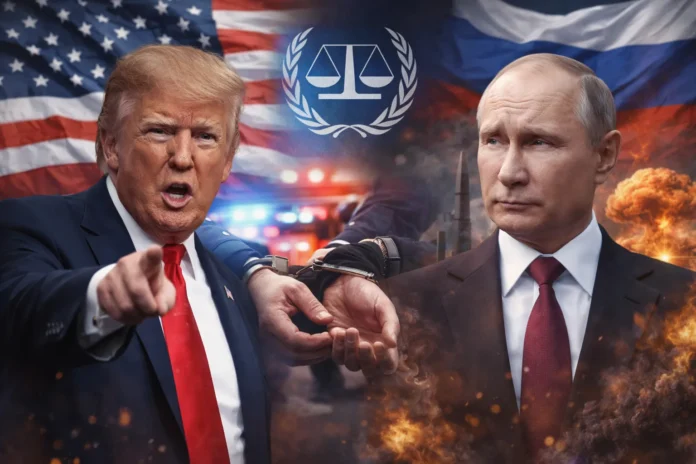
“Would you arrest Putin?” What Trump said, what Moscow is signaling, and why the ‘arrest’ debate is changing the rules of the game
The public discussion about the prospect of “arresting” Vladimir Putin—whether as a legal process or as an operational fantasy—has returned with force, because it is not only about one person. It touches the core of the international order: who enforces rules, with what legitimacy, and where the line sits between diplomacy, deterrence, and escalation.
The issue flared again in the wake of a U.S. operation in Venezuela, where Washington announced it had seized Nicolás Maduro in a lightning operation. That development “plugged into” a politically explosive question: if the United States can seize a leader in Latin America, could a similar debate ever be raised—however hypothetically—about Putin?
What Trump said about the prospect of “arresting” Putin
In a public exchange with reporters, Donald Trump appeared—at least at the level of rhetoric—not to fully rule out such an idea, responding in a way that kept deliberate ambiguity. The phrasing and tone were widely portrayed as a “not completely off the table” answer, without any specific plan or legal framework being described.
That ambiguity matters. In international politics, ambiguity is not always weakness—it can be a tool of pressure. But when the subject is the leader of a nuclear power, ambiguity can become fuel for escalation.
What Moscow “answered,” and how it frames the issue
In this cycle, Moscow did not necessarily respond through a single, personal “Putin-to-Trump” one-liner. But it did respond through a political message and a strategic warning delivered via senior officials and institutional positioning.
-
Deterrence messaging through Russian statements
Russian officials described the U.S. operation in Venezuela as unlawful and destabilizing—and crucially underscored that if something similar were directed at a “stronger country,” it could be treated as an act of war. In practical terms, this is a red line: do not move the “arrest” concept into a domain where the cost becomes unthinkable. -
Institutional “shielding” against international judicial moves
On the legal front, Russia has moved to ensure it can disregard decisions by foreign or international criminal courts, through legislative changes signed by Putin in late December 2025. This is widely read as a preemptive defense against international accountability initiatives tied to Ukraine—and it aligns with Moscow’s broader narrative that any attempt to impose justice without Russia’s consent is treated as hostile action.
The critical background: the International Criminal Court’s arrest warrant
The “arrest” discussion does not start from zero. There has been an International Criminal Court (ICC) warrant since 2023, tied to allegations involving the unlawful transfer or deportation of children from Ukraine.
Here is the decisive distinction:
-
The ICC has no police force. It relies on state cooperation.
-
An arrest, where it can happen, comes through the obligations of ICC member states if the person enters their territory. This is why ICC member states have, at times, indicated that—at least in theory—they would be obliged to execute an arrest warrant if Putin were to enter their jurisdiction.
So, one thing is “an ICC-based arrest if travel places a person within a cooperating jurisdiction,” and a completely different thing is “an arrest via a special operation.” The second is not a legal mechanism; it is pure geopolitics—and a pathway to confrontation.
Why this debate “changes the game”
The very public framing—“Would you arrest Putin?”—shifts the terrain from classic diplomacy into a zone where:
-
Deterrence becomes personal
When the personal security of a nuclear-power leader is threatened, even rhetorically, deterrence can take more dangerous forms. Moscow’s warning—that such a move could be treated as an act of war—is designed precisely to keep this notion out of operational reality. -
Legal language gets confused with military language
The ICC warrant belongs to a legal logic: procedure, jurisdiction, state cooperation.
An “arrest operation” belongs to a different logic: power, coercion, surprise—and it will be read as hostile action. -
Diplomacy becomes harder—even when channels remain open
In the same broader timeline, Trump publicly rejected a Russian claim that Ukraine attempted to strike Putin’s residence, signaling reluctance to build on narratives that could explode negotiations or create pretexts for escalation. This illustrates a pattern: harsh rhetoric on one track, and on another track a desire to control temperature and preserve room for maneuver.
Three realistic scenarios (and what they imply)
Scenario 1: The debate remains rhetorical pressure
Most likely: the phrase functions as a political signal to multiple audiences—Russia, Ukraine, domestic voters, allies. Practical policy stays on familiar rails: sanctions, negotiations, agreements, exchanges. It is not “spectacular,” but it is the only sustainable track.
Scenario 2: A harder “accountability” line through third-country constraints
Here the weight stays on the ICC framework: travel constraints, venue and airspace issues, pressure on ICC member states, and higher diplomatic costs. This is not “an American arrest,” but a constriction of mobility and an increase in political cost.
Scenario 3: A dangerous shift toward an “operation” logic
The most extreme and most destabilizing: treating coercive seizure of a nuclear-power leader as a conceivable option. Moscow’s deterrence line—“it would be an act of war”—is intended to close exactly that corridor. In practice, this scenario would inject a level of instability that no security architecture can absorb cleanly.
FAQ
Can the United States arrest Putin because of the ICC warrant?
The ICC warrant functions through state cooperation and is not an “automatic button.” The Court depends on member states to execute warrants if a wanted person enters their territory.
So what do people mean when they say “arrest”?
Public debate often blends two different things:
(a) a legal arrest and surrender through ICC member-state cooperation, and
(b) an “operational seizure.”
The first is institutional and jurisdiction-based. The second is escalation-by-force and would be treated as hostile action.
What is the essence of Moscow’s response?
That such operations, if directed against a major power, could be treated as a warlike act—meaning Moscow pushes the issue from “political dispute” into “deterrence.”
Why did this topic resurface now?
Because the United States announced a high-profile operation involving Nicolás Maduro in Venezuela, reopening the public argument about how far a superpower can go—and what happens if that logic is projected onto far higher-stakes targets.