

Table of Contents
Iran is not formally a monarchy. That does not mean it failed to develop a dynastic logic of power.
The most dangerous misunderstanding about Iran’s ruling system is that it can be explained simply as a strict theocracy driven by ideology alone. The structure that emerged over time was more layered and more coercive than that. Public reporting on the transition after Ali Khamenei’s death shows a state in which formal institutions continued to exist, but real power remained concentrated around the Supreme Leader’s office, the Revolutionary Guards, loyal clerical networks, and the inner circle built around the Khamenei household.
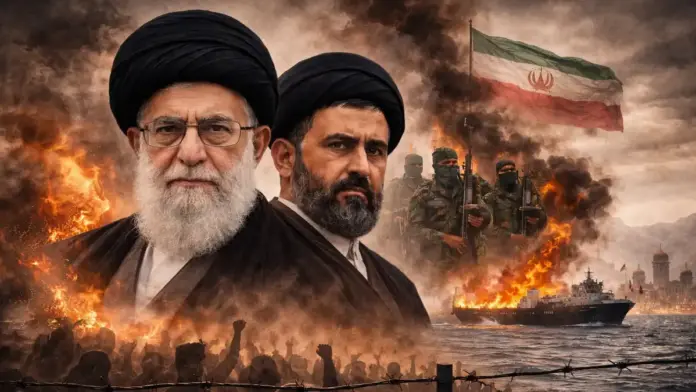
Reuters reported that Mojtaba Khamenei was elevated with strong backing from the Islamic Revolutionary Guard Corps, reinforcing the sense that the succession was not merely institutional but dynastic in political effect.
That matters far beyond Iran’s borders. When power stops being meaningfully constrained by accountable institutions and instead hardens inside a closed network of family influence, coercive security actors, and ideological gatekeepers, repression at home and aggression abroad stop being separate stories.
For readers who want the immediate transition context, Newsio has also covered Iran: Khamenei’s death confirmed — what we know, what changes now, and what to watch next
They become two expressions of the same survival mechanism. Reuters’ recent reporting also indicates that U.S. intelligence does not currently see the Iranian state as close to collapse, which underlines the real point: this is not a brittle façade held together by one man alone, but a deeper authoritarian system with enough embedded structure to absorb shocks and continue operating.
That is why the phrase “a family tyrannizing its own people” needs to be handled with precision rather than slogan. Iran is not the private legal property of the Khameneis. But the political architecture that formed around them came to resemble a closed hereditary order of access, trust, and influence.
In practice, that created a form of theocratic nepotism with consequences not only for Iranian society, but for regional stability, maritime security, and the global energy system.
The “shadow state” is not a metaphor. It is how real power has operated.
Iran has formal institutions: a president, a parliament, elections, and the Assembly of Experts. But Reuters’ explanation of Iran’s power structure makes the hierarchy clear: the Supreme Leader sits above the elected branches and holds decisive authority over security, foreign policy, and the ideological direction of the state. That creates a dual structure in which institutions function, but do not truly rule. The constitutional shell exists, while the command center sits above it.
Inside that system, the beyt — the Supreme Leader’s office and surrounding network — has functioned as far more than an administrative center. Reuters describes it as a parallel structure of influence across the bureaucracy. That matters because shadow power is most effective when it does not need to be fully visible.
Mojtaba Khamenei’s role for years fit that pattern: influential, protected, and deeply embedded, but not publicly central in the way a normal transparent successor might be. In systems like this, invisibility is not weakness. It is operational design.
The Revolutionary Guards are central to this picture. They are not just a military body. They are a pillar of regime continuity. Reuters reported that the Guards pushed wavering clerics to support Mojtaba Khamenei’s rise, showing how security power can override or steer religious and political processes when succession becomes existential. That is not routine institutional order. It is the deep state asserting itself over the visible state.
The dynasty of fear was not built on ideology alone
Ali Khamenei ruled for decades through a combination of ideological legitimacy, anti-Western positioning, and hard internal repression. Reuters’ obituary profile described an “iron rule” that repeatedly crushed internal unrest and kept the regime intact through periods of deep pressure. That is the first layer of fear: fear imposed on society. It is how authoritarian systems turn dissent into risk, politics into surveillance, and public anger into a security problem.
The second layer is fear inside the regime itself. In authoritarian systems of this kind, loyalty is not just a virtue. It is a survival requirement. Access to the top depends on being regarded as safe, ideologically reliable, and controllable. That helps explain why succession in Iran does not resemble a normal political transition. It resembles the management of risk inside a sealed power chamber. Reuters’ reporting on Mojtaba Khamenei’s silence after his elevation adds to that reading. Silence in such a system can reflect control, insecurity, internal calculation, or all three at once.
The third layer is fear exported outward. When regimes built on coercion feel existential pressure, they often externalize that pressure through confrontation, deterrence theater, and regional escalation.
That does not mean every Iranian strategic move is reducible to domestic insecurity. But it does mean the internal architecture of repression cannot be separated from the external production of crisis. The system’s need to survive at home shapes how it behaves abroad.
That external dimension also appears in Newsio’s analysis, Iran after the U.S. strike: what China and Russia stand to gain strategically against America and Israel, which places the regime’s behavior inside a wider geopolitical contest.
Where public discussion gets distorted
One distortion romanticizes the regime through the language of “resistance.” In parts of international discourse, Iran’s rulers are still framed primarily as an anti-imperial pole standing against outside enemies. That framing erases the internal reality: a society that has lived through repeated crackdowns, shrinking political faith, and a concentration of power in institutions that are not genuinely accountable to citizens. Recognizing external pressure on Iran does not require sanitizing the character of its ruling system.
A second distortion goes too far in the opposite direction by reducing Iran to “just one family.” That also misses the structure. The system has endured because it is not merely familial. It is hybrid: clerical, military, bureaucratic, ideological, and patronage-driven at the same time. The Khamenei household has been central, but it has not been the whole machine. The dynastic logic is real precisely because it sits on top of a deeper architecture of coercive power.
A third distortion assumes that removing one person automatically dissolves the regime. Current U.S. intelligence reporting points in the opposite direction. The Iranian government is assessed as remaining in control and not at immediate risk of collapse. That does not make it healthy or stable in a long-term sense. It means regimes of fear often last longer than outsiders predict because they are built around layered enforcement networks, not only charismatic leadership.
For readers following how claims, escalation windows, and strategic signaling shape perception, Newsio has also examined the issue in Trump–Iran: The 10–15 Day Window, Strike Claims, and What We Actually Know
Why the phrase “global ignition” is not mere rhetoric
“Global ignition” should not be used carelessly. It does not mean every Iranian crisis becomes a world war. It means that when a system this closed, militarized, and security-centered enters an existential phase, the consequences do not stay inside national borders. They touch energy flows, maritime risk, regional alliances, insurance pricing, and the wider military balance across the Middle East.
The recent Hormuz-related escalation has shown exactly that dynamic: an internally repressive structure can generate external shocks far larger than its domestic legitimacy would suggest.
This is why analyzing the structure of power is not an academic detour. The more closed, dynastic, and securitized a regime becomes, the more likely it is to prioritize self-preservation over public welfare or regional stability. Tyranny at home and strategic recklessness abroad are not identical, but they often reinforce each other. That is the deeper warning embedded in Iran’s current trajectory.
For Newsio’s internal editorial ecosystem, this English-language piece naturally pairs with existing Iran-focused coverage already visible on the site, including analysis of whether democracy in Iran is real, reporting on Mojtaba Khamenei’s succession, and the broader Hormuz-linked instability cluster. That makes this article a true hreflang companion rather than a detached rewrite: same editorial spine, same subject architecture, same anti-misinformation discipline, but written for an international English-speaking audience.
What readers should take away
The first conclusion is that Iran has not operated as a normal accountable state in which visible institutions hold the decisive power. It has functioned through a layered shadow-state model in which formal institutions coexist with a deeper command structure centered on the Supreme Leader’s office, the Revolutionary Guards, and tightly controlled elite networks.
The second conclusion is that Mojtaba Khamenei’s rise has strengthened the perception of dynastic continuity rather than meaningful institutional renewal. Reuters’ reporting that his elevation was driven strongly by the Revolutionary Guards is central here because it shows the succession as a managed power transfer inside the regime’s hard core, not an open political recalibration.
The third conclusion is the most important one for global readers: the internal architecture of fear in Iran is not just an Iranian domestic issue. It produces consequences for the Gulf, for shipping lanes, for energy markets, and for broader geopolitical stability. Once power becomes closed, hereditary in effect, and shielded by coercive institutions, the cost never stops at the border.