


Table of Contents
Japan’s 7.7 Quake, the 80-Centimeter Tsunami, and the Fear of a Stronger Blow
Japan’s 7.7-magnitude earthquake was not just another spike on a seismograph. It was a violent reminder that even the world’s most earthquake-prepared country cannot cancel the force of nature. It can only meet that force with speed, discipline, engineering, and public readiness.
When a quake of that size strikes off northern Japan, the real story is never only the first jolt. It is the chain reaction that follows: tsunami alerts, evacuations, transport disruption, infrastructure checks, and the psychological pressure of not knowing whether the first shock was the main event or only the opening blow.
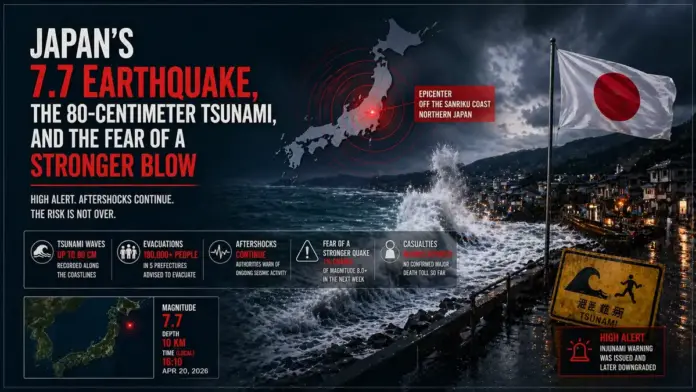
Reuters reported that the quake struck off northeastern Japan, triggered tsunami warnings later downgraded to advisories, and produced waves of up to 80 centimeters, while authorities said there were no immediate reports of major casualties or serious damage.
That is why this event matters beyond the raw headline. Japan did not simply absorb a 7.7 quake. It was pushed into a full-spectrum stress test of coastal readiness, transport resilience, emergency communication, and public discipline.
AP reported that more than 180,000 people across five prefectures were told to seek shelter, while bullet train services were suspended and officials urged residents to review evacuation plans and emergency supplies immediately.
The quake did not stay at the epicenter
A major earthquake in Japan is never only about the place where the rupture begins. It rapidly becomes a test of regional systems and national reflexes. Reuters reported that tsunami warnings initially projected waves of up to 3 meters before actual observed waves came in much lower, including about 80 centimeters in Iwate.
That does not mean the response was excessive. It means Japanese authorities followed the rule that has kept countless people alive: warn early, move fast, and downgrade later if the data justifies it.
This is one of the clearest lessons of Japanese civil protection. In a country built on the edge of the Pacific Ring of Fire, readiness is not theoretical. It is a daily operating principle. That is also why a quake like this carries global significance. If even Japan moves into high alert, suspends major transport, and activates coastal warnings within minutes, then no serious state can treat seismic risk as a marginal planning issue.
Reuters reported that highways were temporarily closed and Shinkansen services were disrupted, showing how fast a single offshore rupture can spill over into the everyday mechanics of national life.
For readers who want a practical preparedness baseline rather than just dramatic description, Newsio’s Emergency Survival Guide fits naturally here because the first minutes after a major disaster are always ruled by the same hard logic: move, protect, verify, and do not improvise.
The fear of a stronger hit is not panic. It is a state-level risk calculation.
The most serious layer of the story is not just that the quake happened. It is that Japanese authorities warned of a slightly increased risk of an even stronger quake in the coming days.
AP reported that officials raised the estimated probability of a magnitude 8.0 or stronger quake over the next week to about 1%, compared with a usual baseline near 0.1%. That is not a prediction that a “megaquake” will happen. It is a formal warning that the risk window has shifted enough to justify heightened readiness.
This distinction matters enormously. Serious reporting should not tell readers that a megaquake is “coming” as if it were confirmed. But it should also not downplay the significance of a tenfold jump in the estimated short-term probability.
The right line is the disciplined middle line: higher risk, no certainty, maximum preparedness. Reuters and AP both make clear that Japanese authorities were not treating the 7.7 event as closed history the moment the shaking stopped. They treated it as the start of a new period of watchfulness.
That logic also connects well with Newsio’s own earthquake coverage in https://newsio.org/37-magnitude-earthquake-near-drama-greece-no-damage-reported/, because both cases show the same core principle: one quake is often not the full story. What matters is the evolving sequence, the monitoring, and the discipline not to declare safety too early.
Why an 80-centimeter tsunami is not “small” in any serious sense
One of the easiest public misunderstandings in tsunami coverage is to hear “80 centimeters” and assume the danger was minor. That is the wrong instinct. A wave of that size can still pose serious risks in ports, river mouths, low-lying coastal zones, and already stressed shorelines.
The Japanese response reflects that reality. Authorities do not wait for perfectly catastrophic visuals before they act. They act because even lower tsunami heights can become deadly when people remain near the water, underestimate speed, or assume the first wave is the only one.
Reuters reported that the warning was later downgraded because the observed wave heights were below the first projections. But the sequence itself proves the seriousness of the system: authorities treated the coastline as threatened until the data clearly showed otherwise. That is not panic. That is competent statecraft under uncertainty.
For a broader public-service frame, this article also sits naturally beside Newsio’s Civil Protection category, because the central issue is not only “what happened in Japan,” but how a serious state reacts when a natural event can still evolve into a multi-layer emergency after the first impact.
What we actually know so far about casualties and damage
This is the point where careful reporting matters most. There were reports of injuries, but not a confirmed major death toll from the strongest early coverage. Reuters said there were no immediate reports of casualties or significant damage in the first official briefings, while AP reported minor injuries in Aomori and Iwate. That means the situation remained serious without justifying exaggerated casualty claims.
That distinction is important. Responsible journalism does not inflate casualties to make a disaster feel “big enough.” It also does not hide the fact that evacuations, transport shutdowns, and tsunami alerts represent real danger even when the worst-case outcome does not materialize.
The story here is not only the damage that did happen, but also the scale of the danger that Japanese systems were built to contain. AP noted that all nuclear facilities were reported safe and that the tsunami threat was later declared over by Japanese and U.S. authorities, which further underlines how much of the event became a test of prevention and response rather than a collapse into mass catastrophe.
Why Japan still gets tested even as the global model of readiness
A major quake in Japan always carries a wider lesson because Japan is the benchmark. It is the country many others point to when discussing earthquake engineering, warning systems, evacuation discipline, and public drills. That makes each major event there almost educational for the rest of the world.
If Japan still has to move into mass alert, suspend bullet trains, inspect infrastructure, and warn of the possibility of a stronger event, then other countries have no excuse for treating earthquake risk as a side issue.
Reuters emphasized that this quake revived memories of the 2011 disaster in the Sanriku region, even though the outcome this time appears much less severe. That contrast matters. It shows both the progress of preparedness and the permanent reality that preparedness does not eliminate danger. It only reduces the chance of catastrophe and improves the odds of survival.
This is what gives the story its depth. The quake is not just a disaster bulletin. It is a reminder that resilience is not the absence of vulnerability. Resilience is the ability to stay functional, informed, and coordinated while vulnerability is still active.
The real conclusion
Japan’s 7.7 earthquake was not only a major seismic event. It was a full test of public warning systems, emergency governance, transport resilience, coastal readiness, and citizen discipline.
The 80-centimeter tsunami waves, the evacuation orders, and the official warning of a slightly elevated risk of a stronger quake all showed the same thing: a disaster does not end when the first shaking stops. Often, that is when the heavier second phase begins — the phase of uncertainty.
Japan’s response offers a hard lesson for every other country. Preparedness does not mean you are beyond danger. It means that when danger comes, you have enough engineering, institutional reflex, and social memory to keep fear from turning into chaos. In an age of escalating natural risk, that may be one of the most serious forms of national strength left.