


Table of Contents
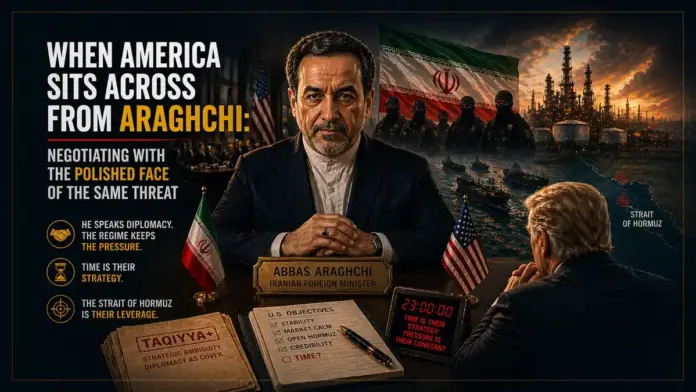
America at the Table with Araghchi: Negotiating with the Polished Face of the Same Threat
Washington is not sitting across from Abbas Araghchi because it has suddenly discovered a truly separate player inside the Iranian system. It is sitting across from the most polished, internationally legible, politically useful face of the same machine it says it wants to constrain.
That is the first line the reader has to understand. Reuters has described Araghchi as perhaps the most powerful foreign minister the Islamic Republic has had, with deep trust from Iran’s supreme leader, a central role in major negotiations, and roots inside the same state structure, including service during the Iran-Iraq war and long experience at the core of the regime’s diplomatic apparatus.
The American mistake begins when it assumes the suit changes the code. It assumes that because Araghchi sounds technical, measured, and internationally fluent, he represents a logic fundamentally different from the harder organs of the regime. He does not. He is not the opposite of the coercive system.
He is its most effective translation for Western ears, market psychology, and diplomatic theater. That is exactly why he is valuable. He does not erase pressure. He repackages it.
This is what gives the article its core line: the United States is not negotiating with an alternative Iran. It is negotiating with the polished interface of the same threat. And once that is understood, the whole scene changes. The issue is no longer whether Araghchi sounds more reasonable than a uniformed commander.
The issue is whether his reasonableness functions as a strategic instrument of timing, reassurance, and regained room for the regime. That same broader pattern is already visible in our Newsio analysis of why the war in Iran is fought in your wallet, where Hormuz pressure becomes economic pain far beyond the Gulf.
The face changes. The mechanism stays.
Araghchi does not sell negotiation alone. He sells time. Reuters reported in April 2026 that he said passage through the Strait of Hormuz was completely open during the ceasefire window. Markets reacted immediately. Oil fell. Financial nerves eased. For a short moment, the global reading of risk shifted.
This is not a minor detail. It is the essence of his usefulness to Tehran: he can create brief windows of market decompression and political ambiguity without forcing the regime to surrender the core leverage behind the crisis.
But the key is not the statement by itself. It is what followed. Reuters also reported that shipping firms sought clarifications before crossing Hormuz, while another Reuters report said vessels could pass only in coordination with the Islamic Revolutionary Guard Corps. In other words, the “calm” was never a clean restoration of normality. It was a short-lived reading of normality layered over a pressure architecture that remained intact.
This is why the argument locks so tightly into our earlier Newsio piece on The Hormuz Vise: Why the War in Iran Is Being Fought in Your Wallet. There, the focus was on how Hormuz becomes an economic vise. Here, the focus is on the man who helps that vise gain rhythm, disappear briefly, and then tighten again.
The illusion of power is Washington’s most expensive mistake
The United States enters negotiation believing it is preventing the worst. Tehran enters negotiation knowing that every minute of negotiation can be turned into time, position, rhythm, and psychological space. These are not two equivalent logics. Washington wants temporary stability, reduced market stress, and a counterpart who can sell a minimum level of calm. Tehran wants time without surrendering the machinery of pressure that makes time valuable in the first place.
That is where the geostrategic humiliation begins. Not in theatrical surrender, but in the quieter reality that the stronger power ends up needing the polished face of the very system it is trying to manage. Once that happens, negotiation becomes more than diplomacy. It becomes a test of whether Washington can still convert its words into stable reality.
That is also why the issue is larger than Araghchi as a person. Reuters’ reporting on his Hormuz remarks and the market response shows a clear pattern: statement, relief, hesitation, renewed ambiguity. A superpower does not have to lose a battle to lose credibility. It can lose credibility when its reassurances become easier to puncture than the regime’s tactical calming signals.
That same fault line is part of the logic we already developed in The Critical U.S.–NATO Turning Point, where the central issue was not just military posture, but whether the West can still project durable coherence under pressure.
Diplomacy does not cancel pressure here. It manages pressure.
Western readings often imagine diplomacy and pressure as opposites. In the Iranian case, they do not work that way. Araghchi’s diplomacy does not arrive to cancel IRGC pressure or strategic ambiguity. It arrives to make both more efficient. It gives them a form that can pass through embassies, shipping desks, editors, analysts, and governments. The regime does not present two disconnected realities, one soft and one hard. It presents a division of labor inside one state method.
That is where, in the Newsio editorial reading, diplomacy of this kind and taqiyya converge functionally. One face reassures. The other preserves the threat. One lowers the market pulse. The other keeps the next shock available. When beautiful language operates while pressure stays active, what appears as diplomacy stops being a clean bridge. It becomes strategic timing under a more civilized name.
This reading also reinforces our earlier Newsio analysis in Taqiyya+: The Spark of Sacred Deception and the Architect of Chaos, where we showed why Araghchi is not simply a smoother negotiator but the state operator who turns de-escalation language into a prelude to the next wave of uncertainty.
Negotiating with the polished face is already a credibility defeat
The hardest truth in this article is simple. America is not meeting a truly different force when it sits across from Abbas Araghchi. It is meeting the most polished translator of the same regime that keeps Hormuz available as a pressure lever.
Araghchi is not the denial of the machine. He is the machine’s best interface to the West. And that is precisely why U.S. reliance on him as a vector of stabilization becomes dangerous.
Tehran does not need to prove military supremacy to gain from this arrangement. It only needs to show that it can manage the rhythm of crisis better than Washington can manage the rhythm of reassurance.
If the United States speaks of control, progress, or open passage, and the field soon re-enters ambiguity, the damage is not merely public-relations damage. It is strategic damage. The problem is no longer only what Iran is doing. The problem is that Washington begins to look less capable of turning its own words into durable order.
This connects naturally to Trump Escalates in Hormuz: What the U.S. Blockade of Iranian Ports Really Means. The crisis is never just about naval movement or oil tonnage. It is also about whether U.S. deterrence still looks credible when Tehran can insert temporary calming signals into the bloodstream of the global system.
The broader pressure web behind Araghchi
The face across the table also cannot be separated from the wider anti-Western structure behind it. Reuters reported that China absorbed more than 80% of Iran’s seaborne oil exports in 2025, preserving the regime’s economic oxygen line. Reuters also reported that Iran was nearing a deal to buy Chinese supersonic anti-ship missiles.
In parallel, Reuters reported Ukrainian intelligence claims that Russia supplied Iran with cyber support and spy imagery to sharpen attacks, and later reported that Moscow was expanding cooperation with Tehran on satellite imagery and drone production, while noting it could not independently verify all elements.
The cumulative structure matters: Beijing helps keep the regime alive economically, Moscow deepens strategic and technical support, and Tehran preserves the field-level choke point.
Within that structure, Araghchi serves a specialized function. He is the civil, polished, internationally consumable operator who helps move the system from raw coercion to temporary reassurance and back again. He does not speak outside the machine. He speaks for the machine in the register most likely to lower immediate resistance.
The safe but ballistic conclusion
America is not negotiating with a new player when it sits across from Abbas Araghchi. It is negotiating with the polished face of the same threat. Araghchi is not the alternative to the regime’s pressure system. He is its most refined interface to Western diplomacy, Western markets, and Western hope for temporary stability.
That is why talks with him are never just talks. They are a credibility test. They ask whether Washington still has the power to transform its language into stable reality, or whether Tehran has become better at using polished ambiguity to buy time, soften reaction, and return later from a stronger psychological position. If the answer keeps drifting toward the second outcome, then the defeat is not only military or economic. It is reputational. And for a superpower, reputational erosion is already a form of strategic loss.