

Table of Contents
Tehran’s “Ghost Women”: Chador, Machine Guns, and the Propaganda of Regime Survival
This was not a display of popular strength. It was a display of political need.
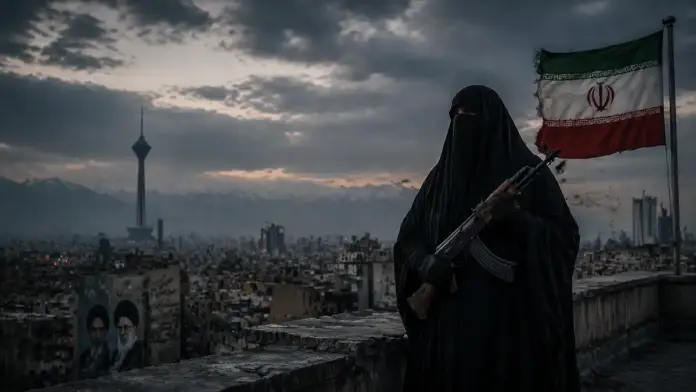
The armed female figures shown in Tehran should not be read as proof that Iranian women have rallied behind the regime or that the state has discovered a new social base of loyalty. They should be read as a staged image of endurance, discipline, and control at a moment when Tehran needs to project exactly those things.
Reporting on the event described a symbolic women’s military parade in Tehran, with young women and girls riding in jeeps fitted with mounted guns, while noting that women in Iran do not serve in combat roles. That alone tells readers they are not looking at ordinary operational reality. They are looking at a message.
That message matters because the regime’s real relationship with women in Iran is not one of empowerment, equality, or shared public sovereignty. U.N. investigators said in March 2025 that the Iranian government continues to intensify repression and surveillance against women and girls as part of a broader effort to crush dissent linked to the “Woman, Life, Freedom” movement. In other words, the same state that polices women’s bodies and public presence now wants to use female imagery as a decorative proof of loyalty. That is not consistency. That is political theater.
The clean line of truth is this: Tehran did not show the world a new female fighting force. It showed the world a regime trying to turn visual symbolism into social legitimacy. That is why the image deserves analysis not as military substance, but as propaganda built for domestic fear management, ideological signaling, and image control in a system that knows its legitimacy is under pressure.
What has actually been confirmed about the Tehran images
The first duty is to separate confirmed reality from social-media exaggeration. The available reporting supports that a symbolic women’s parade took place in Tehran and that the spectacle featured women and girls in jeeps with mounted weapons. The same reporting also stressed that Iranian women do not serve in combat roles. That means the visual was never strong evidence of battlefield readiness in the first place. It was symbolic from the start.
That distinction is crucial. A mounted machine gun on a vehicle is not a costume piece, but in a staged parade it can still function more as an image of force than as evidence of real deployable capability. The intended audience is not primarily a military analyst. It is the broader public, domestic and international, which is meant to absorb an impression: unity, obedience, permanence, and ideological discipline. The image is built to travel faster than the facts.
That is why the article must stay serious and disciplined. There is not enough verified evidence to claim that men were disguised beneath women’s clothing, and there is no need to make that leap. The stronger point is already visible without speculation: the regime used uniform veiling, distance, symbolism, and weapon imagery to create a mass-coded visual of loyalty that is difficult to verify but easy to circulate. That is exactly how propaganda often works.
The chador here functions less as devotion than as political staging
In this context, the chador is not important merely as clothing. It matters because it creates anonymity, uniformity, and symbolic obedience in a single frame. It suppresses individuality and helps the regime present the women shown not as free political actors with visible voices, but as disciplined figures inside a controlled visual grammar. That makes the image more useful to power.
This is where the hypocrisy begins to show in the open. Tehran wants to claim moral authority over women’s appearance in everyday life, while also using that same visual code as a state asset when it wants to project militancy and loyalty. The body is controlled in one setting and instrumentalized in another. The individual is suppressed in one setting and repurposed in another. What is presented as piety becomes, in practice, a stage prop for regime communication.
The contradiction becomes even sharper when placed next to the real social climate inside Iran. Reuters reported in late 2025 that veil restrictions had eased in some public spaces even as political repression deepened, with analysts describing the pattern as a deliberate release valve paired with a hard ceiling on genuine dissent. That makes the Tehran visual even more revealing: the regime is flexible on appearance only when flexibility helps preserve control.
This is not about attacking Iran. It is about refusing to confuse Iran with the regime
Any serious article has to make this distinction clearly. The target here is not Iran as a civilization, a nation, or a people. The target is the coercive political machinery ruling from Tehran. That distinction matters morally, politically, and journalistically. It also matches the larger English-language Newsio frame in When the Regime in Tehran Fears Collapse: Why It Exports Crisis, Rebrands War as National Survival, and Hides Behind the People of Iran, which centers the regime’s survival logic rather than collapsing an entire country into its rulers.
That is why this article stands with people, not with coercive spectacle. It stands with Iranian women whose real public history in recent years has been one of resistance, surveillance, punishment, and courage, not choreographed armed loyalty. U.N. investigators said the government continues to expand surveillance and restrictions on women and girls as part of a wider repression system. Reuters likewise reported this month that many Iranians fear an even harsher crackdown after war and unrest, despite the outward appearance of resumed daily life.
So the key correction is simple and essential: the regime’s image is not the people’s consent. A staged visual of disciplined female figures does not erase the lived reality of women facing repression, nor does it cancel the social memory of “Woman, Life, Freedom.” It only proves how badly the state needs a counter-image.
Why the regime needs spectacle now
Authoritarian systems do not overproduce visual loyalty when they feel secure. They do it when they need to compensate for political fragility, fear, or loss of trust. Reuters reported in April 2026 that Iran’s leaders joined crowds in Tehran to project control in wartime conditions. That language matters. “Project control” is not the same thing as naturally possessing it. The phrase points directly to the communicative work the state is trying to perform.
The same logic appears in the broader strategic environment around Tehran. In The Critical U.S.–NATO Turning Point: What Is Cracking Between Washington and Europe, What Tehran Gains, and Why the Anti-Western Bloc Is Watching With Strategic Satisfaction, the regime is shown not as a confident power but as a system that benefits from cracks, delay, pressure asymmetry, and narratives of endurance. This new visual of armed female figures fits naturally into that logic. It is part of the same effort to suggest the regime still has internal depth, disciplined symbolism, and emotional reserve.
And that is why the image should be read as political communication of the highest regime priority: survival. It is meant to tell domestic audiences that the state is still ideologically coherent. It is meant to tell hostile audiences that the system remains socially rooted. And it is meant to tell doubters inside Iran that resistance will be swallowed by a larger visual mass of obedience.
The strongest external authority baseline belongs exactly here
The cleanest external authority link for this article belongs in the section where the regime’s real treatment of women is established, because that is where the spectacle must be tested against reality. The strongest choice is the U.N. fact-finding mission warning that Iran continues systematic repression and escalates surveillance against women and girls. It fits naturally because it does not feel bolted on. It exposes the exact contradiction the article is built around: control in real life, symbolism in public imagery.
Put simply, the state wants to display armed female devotion while independent U.N. investigators describe a system intensifying surveillance and repression against actual women and girls. Once those two realities are placed side by side, the image stops looking impressive and starts looking revealing.
The deeper political fraud at the center of the spectacle
The deepest fraud here is not just that the regime controls women while displaying female-coded militancy. The deeper fraud is that it tries to pass off staged visual discipline as organic social legitimacy. That is the central lie. Real legitimacy produces visible trust, plural public life, and human agency. Propaganda produces choreographed forms, controlled distance, emotional compression, and repeatable imagery.
That is why the article belongs in the same family of analysis as Strait of Hormuz: would a seizure or blockade help the global economy or the United States? even though the subjects differ. In both cases, the core Newsio method is the same: strip away the noisy frame, isolate the real mechanism, and refuse the manipulative story the public is being asked to accept.
Here, the manipulative story is that the regime still commands an unquestioned social bloc so deep that even women appear ready to embody its armed continuity. What the image actually suggests is something colder: a system so conscious of its legitimacy problem that it increasingly relies on visual overstatement to cover the gap.
What readers should keep
First, the Tehran images do not prove a real female combat formation or a spontaneous groundswell of popular militancy. They show a symbolic parade designed to communicate power.
Second, the article should be read in defense of people, not against them. The line is pro-human, pro-Iranian society, and anti-coercive spectacle. The regime is not the nation. The image is not the people.
Third, the strongest factual contradiction sits at the center of the whole piece: independent U.N. investigators describe intensifying repression and surveillance against women and girls, while the regime simultaneously deploys female-coded imagery to simulate ideological strength and social legitimacy.
Fourth, this is why the article lands in the same category and with the same force as its Greek counterpart: not as a casual reaction, but as a serious political-communication analysis of how authoritarian power stages itself when it fears what real society looks like underneath the costume.