


Table of Contents
China’s Geostrategy of Hypocrisy: Repression at Home, Penetration Abroad
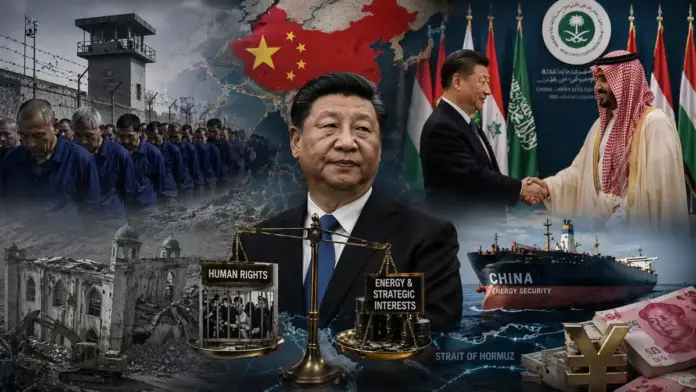
China’s posture toward the Muslim world is often described as contradictory. At home, Beijing has pushed the “Sinicization” of Islam in Xinjiang, while abroad it presents itself as a respectful partner to Muslim-majority states across the Middle East. But the contradiction is only superficial. These are not two separate policies moving in opposite directions. They are two functions of the same strategic doctrine: total control inside, maximum leverage outside.
That is why this story matters far beyond human-rights language alone. Xinjiang is not just a domestic security file. The Gulf is not just a trade file. Together, they reveal how Beijing thinks about power.
It crushes any identity at home that might compete with Party authority, then uses energy dependence, diplomatic access, and financial channels abroad to widen its room for maneuver against the West.
The clean line of truth is this: China is not embracing Muslim powers because it respects Islam. It is engaging them because it needs oil, shipping security, regional access, and more room for the yuan in global trade.
That is also where friction with the United States sharpens, because Beijing’s expansion in the Middle East touches sanctions enforcement, maritime chokepoints, and the larger contest over who shapes the rules of the international system.
Xinjiang is not a side issue. It is the internal command model.
If analysts treat Xinjiang only as a moral scandal, they miss the strategic core. Reuters reported in March 2024 that Xinjiang’s top Communist Party official said the “Sinicisation” of Islam was “inevitable,” while the same report noted that roughly two-thirds of the region’s mosques had been damaged or destroyed since 2017. That is not normal administrative pressure. It is state-directed civilizational compression.
This is not a claim resting on rhetoric alone. The U.N. human rights assessment on Xinjiang documented serious concerns involving arbitrary detention, discriminatory restrictions on religious practice, and broader patterns of abuse affecting Uyghurs and other predominantly Muslim communities. That matters here because the issue is not simply whether Beijing has been criticized. It is whether the Chinese state has built an internal system of control strong enough to erase autonomous identity at home while presenting itself as a pragmatic partner abroad.
In practical terms, Beijing is sending a simple message inside its own territory: no authority, loyalty, memory, or identity may stand above the Party. Once seen that way, the campaign in Xinjiang stops looking like a local anomaly and starts looking like a governing principle. The issue is not merely religion. The issue is whether any organized belief system can remain socially meaningful without first being politically domesticated.
This matters strategically because a state that wants to project durable power abroad first tries to eliminate internal uncertainty at home. Xinjiang is where Beijing has shown, in especially sharp form, how far it will go to turn diversity into obedience. That does not make the policy morally acceptable. It makes it structurally legible. The same regime that fears uncontrolled belief at home is entirely comfortable shaking hands with religious powers abroad if those relationships produce strategic gain.
The Middle East is not a friendship zone for Beijing. It is an energy and access zone.
China’s outreach to the Gulf and to regional powers is often framed as pragmatic diplomacy. That is true, but too vague. The sharper description is geostrategic acquisition through low-morality engagement.
Reuters reported in December 2022 that Xi Jinping told Gulf Arab leaders China would work to buy oil and gas in yuan, explicitly linking Gulf energy ties to Beijing’s ambition to internationalize its currency and weaken the dollar’s grip on world trade.
That moment mattered because it exposed the real offer Beijing makes to the region. China does not lead with lectures about governance, rights, or internal reform. It leads with transactions: stable purchases, infrastructure, financing, diplomatic respectability, and a promise not to moralize. For ruling systems that value regime continuity and strategic flexibility, that can be highly attractive.
This is why the Saudi-Iran thaw brokered in Beijing in 2023 had significance beyond diplomatic theater. It did not mean China had become the new global peace arbiter. It meant Beijing had found a way to appear useful in a region where access, energy, and perception all matter. The more it looks like a power that can talk to everyone without demanding internal change, the more strategic room it wins.
Iran is where the contradiction becomes measurable
The hardest edge of this story appears in China’s oil relationship with Iran. Reuters reported in March 2026 that China bought more than 80% of Iran’s shipped oil in 2025, averaging 1.38 million barrels per day according to Kpler data. That is not symbolic trade. It is structural dependence inside a sanctions-heavy environment.
So the contradiction is no longer rhetorical. The same Chinese state that has pushed coercive control over Islam in Xinjiang is also the principal buyer keeping sanctioned Iranian oil flowing at scale.
Beijing is not doing that because of cultural solidarity. It is doing it because Iranian oil helps feed China’s industrial system, deepens ties with a major anti-Western actor, and expands Beijing’s bargaining space against U.S. pressure.
This is also why the Hormuz question matters so much. If you want the wider English-language Newsio context on why maritime chokepoints are not side issues but transmission belts of global pressure, our analysis of a Strait of Hormuz seizure or blockade and its real economic meaning fits directly into this frame. Hormuz is not just a regional flashpoint. It is one of the places where China’s external vulnerability becomes visible.
Where the U.S. clash begins
It would be careless to say China “wants a world war” with the United States. The stronger and more defensible argument is different: Beijing is steadily expanding its strategic position in ways that cut across core U.S. interests.
That includes sanctions enforcement, energy leverage, maritime access, and the role of the dollar. Those lines do not automatically produce open war, but they do create a harder, more systemic rivalry.
Washington’s pressure campaign on Iranian oil makes that plain. Reuters reported this week that the United States intensified its effort to choke Iran’s oil trade, warning that buyers of Iranian oil could face secondary sanctions, with China sitting at the center of the issue because it has accounted for more than 80% of Iran’s shipped oil. That is not a theoretical collision. It is a live strategic fault line.
And the conflict is not only about barrels. It is also about who controls the legal and financial plumbing of the international system. If Beijing can buy sanctioned energy, route transactions through less vulnerable channels, and normalize more trade in yuan, then it is not just importing fuel. It is testing how much U.S. coercive power can be diluted at the edges.
For readers following Newsio’s broader English-language strategic coverage, this also connects naturally with our piece on the critical U.S.–NATO turning point and the anti-Western pressure system around Tehran. The larger point is the same in both analyses: authoritarian or anti-Western systems do not need a single dramatic rupture to weaken the Western position. Often they gain more through pressure chains, dependence channels, and cumulative friction.
This is geostrategy, not just geopolitics
The category here matters. This is not only a geopolitical story about hypocrisy, rhetoric, or diplomatic posturing. It is geostrategy because the heart of the matter is spatial and operational. Xinjiang is a zone of internal consolidation. The Gulf is a zone of external energy capture. Hormuz is a strategic chokepoint that can threaten China’s energy lifeline. Yuan settlement is a financial extension of the same broader effort to convert access into leverage.
Put differently, Beijing is building a model in which internal repression and external penetration reinforce each other. It disciplines space at home, purchases room abroad, and tries to reduce its exposure to U.S.-controlled pressure points one layer at a time. That is why “hypocrisy” is real but still insufficient as the final word. Hypocrisy is the visible surface. Strategy is the underlying machine.
What readers should take away
The first conclusion is that China’s repression of Islam at home and its deepening ties with Muslim powers abroad are not contradictory in any meaningful strategic sense. They serve different functions inside the same system of power. One neutralizes internal rivals to Party control. The other expands Beijing’s room for energy access, diplomatic reach, and monetary influence.
The second conclusion is that the Middle East matters to China not because Beijing has discovered civilizational respect, but because the region remains central to oil flows, maritime risk, and great-power competition. That is why Iranian oil, Gulf diplomacy, and yuan settlement all sit in the same strategic file.
The third conclusion is the most important one for an international audience: the danger is not that every contradiction becomes immediate war. The danger is that China is steadily learning how to turn contradiction itself into leverage. It represses where it fears autonomy. It partners where it needs access. And in the space between those two moves, it is building a harder, colder, and more durable architecture of power.