


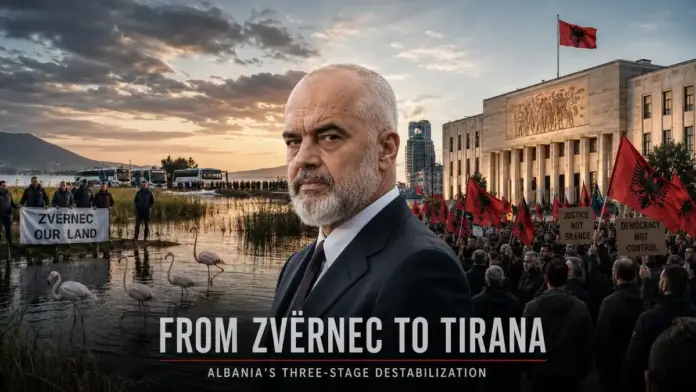
Albania’s crisis did not begin with flamingos — it began with land, violence, and a trigger
Albania’s destabilization crisis did not begin with flamingos.
The flamingos became the symbol. They became the second defensive line. They became the image that could travel internationally, simplify a complex Albanian land dispute, and turn a local confrontation into a global environmental cause.
But the first trigger was colder, older, and much more political: land, fencing, access, violence, property claims, and the unresolved wounds of Albania’s post-communist land order.
That distinction matters. If the story begins with flamingos, it looks like a civic environmental protest. If it begins with land, private security, injured protesters, diaspora mobilization, and claims rooted in old property rights, the picture changes completely. It becomes a three-stage escalation: first a land dispute, then an environmental shield, and finally a broader political crisis aimed at the government, the opposition, and the credibility of the constitutional order itself.
That is where Albania stands now.
Not inside a simple protest.
Inside a hybrid field.
The cold verdict: three stages, one destabilization chain
The crisis has passed through three visible stages.
The first stage was the land trigger: a local conflict around access, ownership, fencing, private security, and people claiming property rights in the Zvërnec and Vjosë-Nartë area.
The second stage was the flamingo stage: environmental organizations and activists placed the protected wetland, birds, habitat, and ecological damage at the center of the narrative. That gave the dispute an internationally understandable moral frame.
The third stage was political escalation: angry crowds moved beyond the original local dispute and began attacking the legitimacy of the government, the opposition, and the entire political order.
This sequence is the key.
A local incident became a symbol.
- The symbol became a movement.
- The movement became a political weapon.
That does not mean every protester is manipulated. It does not mean every environmental claim is false. It does not mean every citizen in the street is part of a foreign operation. That would be reckless and unfair.
But it does mean that a real grievance can be engineered, amplified, internationalized, and redirected. That is how modern destabilization works. It does not always invent anger. It finds anger, gives it a symbol, multiplies it through networks, and pushes it toward a larger strategic outcome.
Stage one: the land wound under the protest
To understand Zvërnec, one must understand that land in Albania is not just land.
- It is memory.
- It is family history.
- It is post-communist restitution.
- It is state confiscation.
- It is Law 7501.
- It is inheritance, resentment, lost documents, overlapping claims, court battles, administrative confusion, and decades of unfinished transition.
In many parts of Albania, especially coastal areas with high development value, land is not a clean technical issue. It is a historical wound. When people see fencing, private security, heavy machinery, and strategic investors moving around territory they believe is tied to their families or communities, they do not see only development. They see dispossession.
This is why the first trigger matters.
The public record around the project has already raised serious questions about ownership, offshore structures, protected areas, and opaque development channels. Reporter.al reported that the company developing the resort, Zvërnec South Adriatic Development, is registered offshore through a Dutch trust structure, while ultimate beneficial ownership remains anonymous. The same reporting linked the project to Jared Kushner and other high-profile investors, placing the case immediately inside a wider political and financial frame. Reporter.al’s investigation into the investors behind the Albanian resort is essential reading for understanding why the story could not remain local.
The first wound, then, was not ecological. It was property.
The first emotional trigger was not a bird.
It was the image of people facing fences, guards, and a state that many believed was moving faster than its own legitimacy.
The beating as a spark: when a technical dispute became public anger
Every large crisis needs a moment that compresses injustice into a visible scene.
In Zvërnec, that moment came through violence.
Reports from the area described residents and activists protesting against the development, with a Greek citizen among those injured and Greece’s Foreign Ministry expressing concern over the violence. Albanian Daily News reported that Greece raised the issue after a protest in the coastal area of Zvërnec, where residents and activists were demonstrating against the planned resort development. The report on the injured protester and Greek diplomatic concern gives the incident a diplomatic dimension that cannot be ignored.
This matters because violence transforms a dispute.
Before the incident, the conflict could still be described as a legal, environmental, or investment dispute. After the incident, it became a moral event. The question was no longer only who owns the land or whether the development is legal. The question became: who has the right to stand there, who protects whom, and whether private force was being used to close public space.
That is the type of trigger social engineering needs.
- A legal file is complicated.
- A beaten man is not.
- A property dispute takes time to explain.
- A video, an image, or a testimony of violence travels instantly.
From that point, the crisis entered a new phase.
Stage two: the flamingos as an environmental deterrent weapon
The flamingos came after the land trigger.
They were not irrelevant. They were not fake. The environmental concerns around Vjosë-Nartë, Zvërnec, Sazan Island, protected wetlands, dunes, birds, and coastal development are serious. Conservation organizations and civic groups have warned that sensitive habitats are at risk. BirdLife International framed the protests as a wider warning about what happens when governments sell off wetlands and treat environmental protections as obstacles to growth. BirdLife’s analysis of Albania’s flamingo protests shows why the ecological layer gained international traction.
But in the mechanics of escalation, the flamingos performed a second function.
They became a deterrent symbol.
A land dispute is difficult to export. Law 7501, post-communist property claims, coastal ownership disputes, local families, court documents, and unclear administrative decisions require context.
A flamingo requires no translation.
The flamingo is beautiful. It is vulnerable. It is innocent. It has no party, no corruption file, no political ambition, and no past. It can stand in front of bulldozers and instantly communicate one message: nature is being threatened by power.
That is why the flamingo became powerful.
It moved the crisis from local grievance to international language.
It made the issue legible to European activists, environmental groups, diaspora communities, foreign journalists, and social media audiences. It allowed the dispute to be framed not only as “who owns this land?” but as “who is destroying a protected natural space?”
That does not invalidate the ecological concern. It explains how the ecological concern became a strategic instrument.
In hybrid crises, a symbol does not need to be false in order to be used.
The second defensive line: activism, internationalization, and strategic pressure
Environmental activism can be sincere and still function as a strategic shield.
That is the difficult truth.
Activists may genuinely believe they are defending wetlands, birds, public space, and democratic accountability. In many cases, they may be right. But once a symbol becomes international, it can serve more than one purpose.
- It can protect nature.
- It can pressure the government.
- It can block an investment.
- It can attract foreign media.
- It can mobilize diaspora networks.
- It can embarrass institutions.
- It can shift the burden of proof onto the state.
- It can also be used by actors whose goals go beyond the environment.
This is why the second stage is so important. The flamingos did not simply decorate the protest. They upgraded it. They changed the political technology of the crisis.
BiEPAG described the “Flamingo Revolution” as a civic protest exposing lack of transparency and media capture, noting how the movement grew around the development dispute and the broader failure of public trust. BiEPAG’s analysis of the Flamingo Revolution is useful because it shows the bridge between environment, institutions, and information control.
That bridge is the heart of the story.
The flamingo was not the beginning.
It was the amplifier.
Stage three: from environmental protest to rage against the political order
The third stage is the most dangerous.
A protest over land and environment became a broader political wave. Crowds moved from the language of ecological protection to the language of political punishment. The government became a target. The opposition became a target. The old order became a target.
- The key slogan is not only “Albania is not for sale.”
- The key slogan is the one that places Prime Minister Edi Rama and opposition leader Sali Berisha in the same frame.
That changes everything.
If the protest were simply anti-Rama, the opposition could try to absorb it. If it were only environmental, it could be negotiated through permits, studies, protected status, and project revisions. If it were only anti-investment, the government could present it as fear of development.
But when the street turns against both government and opposition, the crisis is no longer about one project.
It becomes a crisis of political representation.
That is the moment when destabilization becomes visible. Not because the citizens have no right to be angry. They do. Not because the government is automatically innocent. It is not. Not because the opposition is irrelevant. It is part of the problem.
But because the target has expanded from a project to the legitimacy of the system.
The question becomes: if the government must fall and the opposition is also rejected, what comes next?
That is where constitutional order enters the story.
Anger has rights — but collapse has consequences
A democratic society has the right to protest.
- It has the right to demand transparency.
- It has the right to demand resignations.
- It has the right to demand investigations, early elections, accountability, environmental protection, and clean public processes.
But when public anger shifts toward the total rejection of the government, the opposition, and the constitutional order, the crisis crosses into a different zone.
A state cannot live on rage alone.
- If the government is rejected, who governs?
- If the opposition is rejected, who represents the alternative?
- If institutions are rejected, what mechanism prevents chaos?
- If the street becomes the only source of legitimacy, who protects the country from those who know how to manipulate streets?
This is the constitutional danger.
It is not an argument against protest. It is an argument against strategic blindness. The right to protest must be defended. But so must the state’s continuity, because every vacuum is an invitation.
In destabilization scenarios, the most dangerous moment is not the first protest. It is the moment when every institution loses legitimacy at the same time.
That is when external actors, domestic opportunists, criminal networks, intelligence services, and political predators begin to calculate.
Social engineering: how a real grievance becomes a larger operation
In hybrid warfare, the smartest actor does not need to invent anger from nothing.
That is too difficult.
The smarter method is to locate a real wound and turn it into a behavioral engine.
- Find a land dispute.
- Find an injured man.
- Find a protected habitat.
- Find a government with a trust deficit.
- Find an opposition that lacks credibility.
- Find diaspora networks.
- Find international cameras.
- Find a symbol that travels.
- Find a hashtag.
- Find uncertainty.
Then push.
Not always directly. Not always visibly. Not always through one central command. Hybrid pressure often works through convergence: different actors, different motives, one cumulative effect.
This is social engineering.
It does not require every protester to be controlled. It does not require every activist to be insincere. It does not require every post to be fake. It only requires the system to react predictably once a trigger is activated.
- The land trigger created emotion.
- The beating created outrage.
- The flamingos created moral clarity.
- The media created scale.
- The diaspora created mobility.
- The slogans created political escalation.
- The result is no longer just protest. It is a pressure architecture.
The Greece dimension: a field for investigation, not hysteria
The Greek dimension must be handled with discipline.
It cannot be ignored.
It should not be exaggerated without evidence.
There were mobilizations involving Albanians and solidarity activists in Greece. There were reports of people moving from Greece toward Albania. There was a Greek diplomatic reaction after an injured Greek citizen. There was media discussion around buses allegedly coming from Greece. There was also AI-generated imagery used to support claims about Greek-backed protest activity.
OBCT reported that an AI-generated image circulated showing buses arriving from Greece to protest in Albania, and that the image entered television discussions close to the government’s narrative. OBCT’s report on the Flamingo Revolution is important because it shows how the Greek dimension itself became part of the information war.
BiEPAG also noted that Albanian mainstream outlets aired AI-generated images claiming Greek sponsorship of the protests, using old nationalist rhetoric as part of the struggle over the movement’s legitimacy. BiEPAG’s account of AI-generated images and media capture should be read carefully because it shows how quickly a real or perceived external connection can be weaponized.
The correct position is not to say, without public evidence, that Greece organized the crisis.
The correct position is also not to pretend there is no Greek dimension.
The correct position is to investigate.
- Who moved?
- Who organized?
- Who paid?
- Who filmed?
- Who amplified?
- Who benefited?
Which narratives were authentic, and which were manufactured?
This is not anti-Greek hysteria. It is Albanian state seriousness.
The Iran precedent: why Albania cannot afford naivety
Iran may not be the starting point of this crisis.
But Iran is part of Albania’s security memory.
In 2022, Albania suffered major cyberattacks attributed by Western governments and security agencies to Iranian state-linked actors. The U.S. Cybersecurity and Infrastructure Security Agency, together with the FBI, issued a detailed advisory on Iranian cyber operations against the Albanian government. The CISA/FBI advisory on Iranian state actors and Albania remains one of the strongest official documents for understanding why Albania cannot treat every large internal crisis as a purely domestic event.
That does not prove Iran created the current protest wave.
It proves something else: Albania has a documented history of being targeted through cyber and information pressure by hostile actors. That history must inform how the state reads fast-moving unrest, digital amplification, suspicious narratives, manipulated media, and sudden pressure on institutions.
- Security is not panic.
- Security is memory.
And Albania has no luxury of forgetting.
Newsio has already analyzed this logic in Cyber-Mahdi: When Iran Loses the Battlefield and Looks for War on Western Screens. The core lesson applies directly here: modern hybrid pressure does not always need to defeat a state physically. It can attack trust, timing, perception, institutional confidence, and public behavior.
That is why the Albanian case must be read with both caution and severity.
The investment is not just a resort — it is a geostrategic object
- Sazan is not just a tourist asset.
- Zvërnec is not just a coastal village.
- Vjosë-Nartë is not just a wetland.
This geography matters.
Sazan Island sits at the entrance to the Bay of Vlorë. It carries military memory, strategic maritime value, and symbolism connected to Albania’s coastline, sovereignty, and post-communist opening. The Vjosë-Nartë area carries ecological, tourism, and public-land value. When such spaces enter a high-profile development plan connected to powerful foreign names, the issue becomes more than construction.
It becomes geostrategic.
OCCRP reported that a widening property-fraud investigation linked to the resort project led Albanian authorities to freeze developer assets. OCCRP’s report on the asset freeze in the Kushner-linked resort probe gives the story a legal and anti-corruption layer beyond protest symbolism.
European Western Balkans reported that SPAK opened an investigation into changes made in 2024 to the area’s protected status and land ownership, which had paved the way for possible tourism development. The European Western Balkans report on the SPAK probe strengthens the point: this is not only a debate about birds, beaches, or luxury villas. It is about how strategic territory is transferred, protected, developed, and legitimized.
Development is not the enemy.
Opacity is.
Investment is not the enemy.
A state that cannot explain the chain of ownership, protection, consultation, and public benefit becomes its own enemy.
The Rama government’s problem: warnings about foreign influence are not enough
Prime Minister Edi Rama may be right that foreign actors can exploit Albanian instability.
He may be right that hostile states, foreign networks, digital operators, media frames, and opportunistic forces can use genuine anger for strategic ends.
He may be right that Albania’s enemies would benefit from a country that looks ungovernable.
But that is not enough.
A government cannot defeat a hybrid narrative with accusation alone. It must defeat it with transparency.
- If the project is legal, show the documents.
- If the protected status was changed lawfully, explain the chain.
- If the environmental safeguards are real, publish the studies.
- If the ownership is clean, identify the beneficiaries.
- If the land claims are false, prove it in a process the public can trust.
- If private security acted unlawfully, show consequences.
- If foreign influence exists, present evidence that can survive public scrutiny.
The answer to hybrid pressure is not simply “foreign interference.”
The answer is radical clarity.
Where the state leaves fog, manipulation grows.
The Berisha opposition’s problem: it cannot ride a wave that also condemns it
The opposition has its own crisis.
Any opposition will try to convert public anger into political opportunity. That is normal. But this wave is not easy to capture because part of the crowd rejects the old opposition as well as the current government.
That is why the slogan against both Rama and Berisha matters.
It means the protest is not simply looking for rotation. It is looking for rupture.
That is dangerous for the government, but it is also dangerous for the opposition. If the old opposition believes this is just another anti-Rama wave, it has misunderstood the street.
The street is not saying only “replace the government.”
It is saying: the system itself has lost moral credibility.
That message cannot be solved by recycling old political figures. It requires institutional trust, new rules, public accountability, and a state that does not treat citizens as spectators.
If the opposition tries to own a protest that is also condemning it, it may discover that the same fire can burn both sides.
The media battlefield: the crisis is not only in the streets
The crisis is no longer only in Zvërnec or Tirana.
- It is in the image.
- It is in the drone shot.
- It is in the bus rumor.
- It is in the AI-generated picture.
- It is in the foreign headline.
- It is in the crowd estimate.
- It is in the framing of protesters as patriots, agents, activists, extremists, citizens, nationalists, environmentalists, or anti-corruption rebels.
That is the media battlefield.
In modern destabilization, the image does not merely document reality. It can create political behavior. A single video can mobilize a crowd. A false image can poison a debate. A foreign article can transform a local dispute into a global scandal. A hashtag can mix real citizens with fake accounts. A camera can record truth, but it can also select the angle that turns truth into a weapon.
Newsio’s guide, How to Read the News Without Being Manipulated, belongs inside this article because this is exactly the kind of environment where citizens must ask: who shows the image, what is missing, who benefits, what is verified, and what behavior is the image trying to produce?
In this crisis, verification is not an academic exercise.
It is national self-defense.
The core hybrid principle: you do not need to control all anger to use it
The most important rule of hybrid pressure is simple: you do not need to control all anger in order to exploit it.
- You do not need to pay every protester.
- You do not need to invent every slogan.
- You do not need to fake every image.
- You do not need to direct every activist.
You only need to identify a real crack and widen it.
In Albania, the crack already existed.
- Land was a crack.
- Law 7501 was a crack.
- Violence was a crack.
- Environmental concern was a crack.
- Distrust of government was a crack.
- Distrust of opposition was a crack.
- Diaspora networks were a channel.
- Flamingos were a symbol.
- Media were multipliers.
- Social platforms were accelerators.
That is how a crisis moves from one stage to the next.
- From property.
- To ecology.
- To anti-system rage.
- To destabilization pressure.
What Albania must investigate now
If Albania wants to come out stronger, it must not answer this crisis with slogans.
It must investigate.
First, the property chain in Zvërnec and Vjosë-Nartë must be fully opened. Who claims ownership? Who sold? Who bought? Who appealed? What documents exist? Which court decisions are final? Which are disputed? Who was compensated? Who was excluded?
Second, the violence must be investigated. Who hired private security? Who authorized fencing? Who gave orders? Why did the state allow a confrontation to unfold around such a sensitive site?
Third, the environmental process must be clarified. Were protected statuses changed? Were studies completed? Were European standards respected? Was there public consultation?
Fourth, the movement of protesters from Greece or elsewhere must be mapped. If buses were organized, who organized them? Who paid? Which networks mobilized? Was the movement civic, political, financial, or mixed?
Fifth, the digital field must be audited. Were there bots? Coordinated accounts? Foreign amplification? AI-generated images? Manipulated videos? Suspicious narratives?
Sixth, political exploitation must be examined. Who tried to turn the protest into a personal platform? Who tried to delegitimize it with false material? Who tried to own it?
Seventh, foreign influence claims must be tested. If there is evidence, publish it. If there is not, do not use suspicion as a substitute for proof.
That is how a serious state behaves.
Albania is not for sale — and it is not for use
The protest slogan says Albania is not for sale.
That is strong.
But the deeper line is stronger:
Albania is not for use.
Not for use by a government that asks for trust without showing every document.
Not for use by an opposition that wants to return on the back of social rage.
Not for use by foreign investors moving through unclear ownership chains.
Not for use by activist networks that may carry legitimate causes but fail to see how their symbols can be exploited.
Not for use by foreign media that turn Albania into a stage for exotic instability.
Not for use by neighboring or distant actors that see Albanian tension as leverage.
Not for use by Iran.
Not for use by Greece.
Not for use by anyone.
Albania is a state, a people, a coastline, a memory, a sacrifice, and a future.
And that future cannot be decided in closed rooms, manipulated feeds, selective images, or international frames that reduce the country to a theater of someone else’s agenda.
Final conclusion: the trigger was land, the symbol was the flamingo, the danger is destabilization
The Albania crisis must be told correctly from the first line.
- It did not begin with flamingos.
- It began with land.
- It began with access.
- It began with fencing.
- It began with violence.
- It began with old property wounds.
- It began with the unfinished legacy of Law 7501 and the unresolved trauma of Albania’s post-communist transition.
Then came the flamingos.
- Then came the environmental shield.
- Then came the organizations.
- Then came the cameras.
- Then came the international language.
- Then came the anti-government rage.
- Then came the anti-opposition rage.
- Then came the pressure on constitutional order.
Now Albania is inside a hybrid field.
- The anger is real.
- The land dispute is real.
- The environmental concern is real.
- The distrust of the government is real.
- The weakness of the opposition is real.
But the possibility of exploitation is also real.
That is the hard truth.
- Anyone who says this is only about flamingos is minimizing the crisis.
- Anyone who says every protester is an agent is insulting citizens.
- Anyone who says there is no hybrid dimension does not understand the 21st century.
- Anyone who says the government has no responsibility is closing their eyes.
- Anyone who says the opposition is automatically the solution is not listening to the street.
The cold reading is more difficult, and therefore more useful:
Zvërnec was the trigger.
- The flamingos were the symbol.
- The diaspora was a channel.
- The media were the multiplier.
- Political distrust was the fuel.
- The constitutional question is now the danger.
- And hybrid exploitation is the strategic risk.
Albania must not fear the truth. It must use the truth to defend itself.
- To defend its land.
- To defend its nature.
- To defend its citizens.
- To defend the right to protest.
- To defend institutional order.
And to defend the country from anyone who wants to turn a real Albanian wound into a weapon against Albania itself.
That is the real battle.
Not whether one flamingo is saved.
But whether Albania proves that it is no longer a country that others can buy, script, frighten, manipulate, destabilize, or use.